The daily civic brief
U.S. Civic Update — November 22, 2026
Post-election work is still moving through state systems, with Arizona, North Carolina, Alaska, Mississippi, and Arkansas at different points in canvassing or certification. For household issues, two federal moves are worth watching: a Labor Department worker-classification rule due for publication Monday and a CMS proposal that could reshape some Medicare Advantage rules later on. As of November 22, none of the proposed Medicare changes is in effect, and the Labor rule’s effective date has not arrived.
Estimated 5-minute catch-up · 7 stories
Today's audio briefing
Today's spoken briefing
Hear the latest national briefing and what to watch next for every headline. A restrained instrumental bed plays in the web player.
Read the audio transcript
Voting; certification; federal and state representation Arizona; nationwide
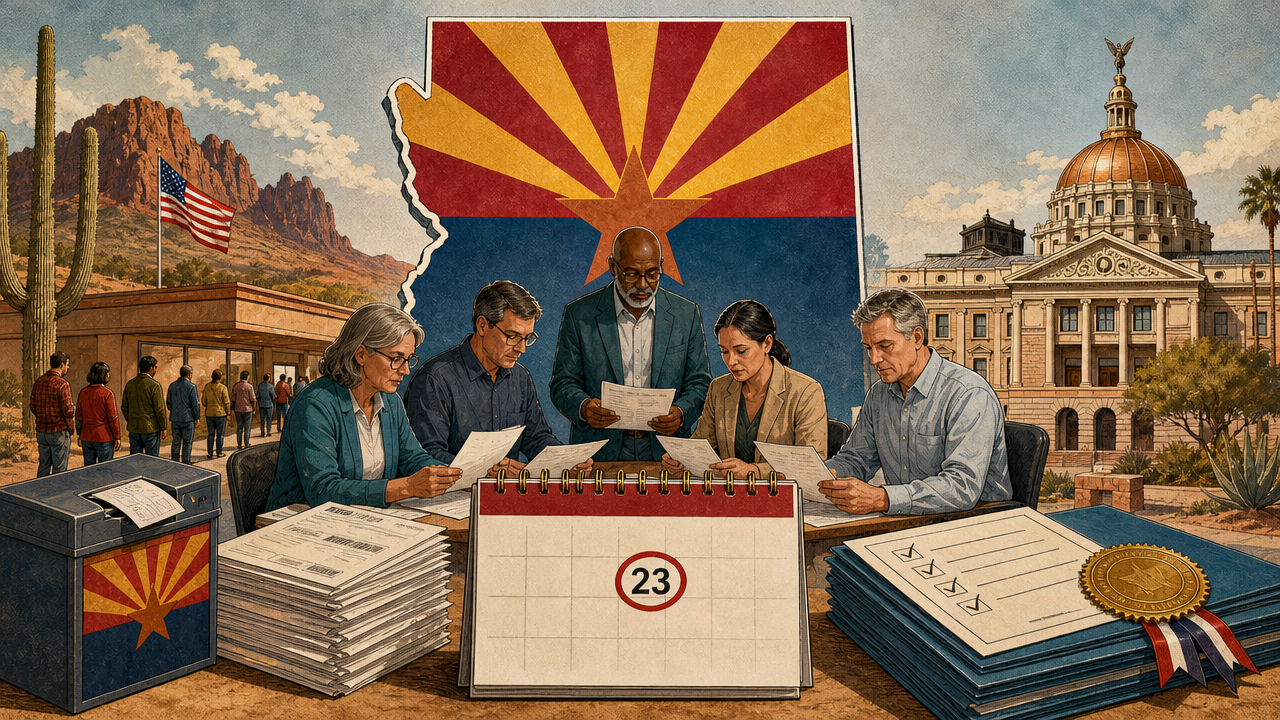
Arizona’s statewide canvass is scheduled for Monday
In effect: Arizona’s canvass procedure is operating for the November 3, 2026, general election. The Secretary of State lists the official statewide canvass for November 23, 2026. Verify status
What happened
Arizona’s Secretary of State lists November 23, 2026, as the official statewide canvass for the November 3 general election. This is the state-level public step that certifies contests for federal, statewide, and legislative offices after county canvasses and required hand-count checks.
What it means for voters
For voters, this is the point where county-level results become the state’s official record for offices that represent Arizonans in Congress and state government. It does not reopen voting or mean a problem was found. It is the normal legal check that puts counted ballots, county records, and certified totals into one statewide result.
Save stories & follow topics · Open this story
Get the context & analysis
What to watch
Watch the Arizona Secretary of State’s November 23 canvass record and any signed statewide certification posted after the meeting.
Context from earlier events
No relevant context from earlier events was found.
Check sources (2)
Voting; canvass; certification; election administration North Carolina; nationwide
North Carolina State Board will canvass the general election on November 24
In effect: North Carolina’s post-election canvass process is operating for the November 3, 2026, election, and the State Board has noticed its statewide canvass meeting for November 24. Verify status
What happened
North Carolina’s State Board of Elections has scheduled an in-person meeting at 11 a.m. on November 24, 2026, in Raleigh. Its tentative agenda includes canvassing the November 3 general election.
What it means for voters
The state canvass is when North Carolina completes its official review of contests under State Board authority. That matters to voters because election-night totals were never the final legal result. County boards have already done their canvass work, including decisions about eligible provisional and other ballots under state rules.
Save stories & follow topics · Open this story
Get the context & analysis
What to watch
Watch the State Board’s November 24 meeting materials, canvass action, and any certificates or audit information issued afterward.
Context from earlier events
No relevant context from earlier events was found.
Check sources (2)
Voting; audits; certification; U.S. representation Alaska; nationwide
Alaska remains in post-election review, with certification targeted for November 25
In effect: Alaska’s post-election review, hand-count verification, and certification process is underway for the November 3, 2026, general election. Results remained labeled unofficial as of November 22, and the state lists November 25 as its certification target. Verify status
What happened
As of November 22, Alaska’s Division of Elections still labels the November 3 general-election results unofficial. The state calendar says the State Review Board began reviewing election materials on November 19, conducted hand-count verification on November 20 and 21, and has a target certification date of November 25.
What it means for voters
Alaska voters are still in the normal review period between final counting and certification. The state says its review includes election materials and hand-count checks, so an unofficial result should not be treated as the final state record yet. For working households, the practical point is simple: representation is settled through the state’s legal certification process, not through early calls or social-media claims.
Save stories & follow topics · Open this story
Get the context & analysis
What to watch
Watch Alaska’s Division of Elections for the State Review Board’s completed review and an official certified-results posting, with November 25 listed as the target date.
Context from earlier events
No relevant context from earlier events was found.
Check sources (2)
Primary and independent sources
Voting; county election records; certification Mississippi; nationwide
Mississippi posts official county recapitulation reports
What happened
Mississippi’s Secretary of State now has a page labeled “Official 2026 General Election Results” that links county recapitulation sheets. The page says these official county reports contain precinct-level results for the reporting precincts listed.
What it means for voters
County recapitulations give voters a way to inspect a key layer of the official record rather than relying only on election-night updates or online commentary. That is especially useful in close contests, where people may want to compare precinct and county records with later statewide results. The reviewed state pages did not provide a separately dated statewide certification proclamation, so this scan does not treat the county postings alone as proof of every statewide certification step.
Save stories & follow topics · Open this story
Get the context & analysis
What to watch
Watch the Mississippi Secretary of State’s election-results pages for any statewide certification document, updated statewide totals, recount notice, or runoff notice.
Context from earlier events
No relevant context from earlier events was found.
Check sources (2)
Primary and independent sources
Voting; local certification; county offices Arkansas; nationwide
Arkansas county election certificates are due Monday after the Sunday deadline shifts
In effect: Arkansas’s 2026 election calendar applies the state rule that Sunday deadlines move to the next business day. The county-office certificate deadline therefore falls on Monday, November 23, 2026. Verify status
What happened
Arkansas’s 2026 election calendar says county boards of election commissioners must deliver certificates of election to county-office winners 19 days after the November 3 general election. Because that date falls on Sunday, November 22, the calendar says the deadline moves to Monday, November 23.
What it means for voters
This is a local-government step, but local offices can affect property-tax administration, courts, roads, public safety, and other services households use every day. The deadline is about providing certificates after the county’s result is certified; it is not an extra Election Day or a chance to cast more ballots.
Save stories & follow topics · Open this story
Get the context & analysis
What to watch
Watch Arkansas county election commissions and county clerks on November 23 for certificate delivery and any local notice involving a delayed or disputed county result.
Context from earlier events
No relevant context from earlier events was found.
Check sources (2)
Primary and independent sources
Work; wages; overtime; independent contractors; labor standards Nationwide
Labor Department’s worker-classification rule is scheduled for publication Monday
Passed: The Wage and Hour Division has issued a final rule scheduled for Federal Register publication on November 23, 2026. The public-inspection document states that it will take effect 60 days after publication, so it was not yet in effect as of November 22. Verify status
What happened
The Labor Department’s Wage and Hour Division has placed a final rule on public inspection that is scheduled to publish in the Federal Register on November 23. The rule rescinds the department’s 2024 approach for deciding whether a worker is an employee or independent contractor under the Fair Labor Standards Act and aligns related analysis under the Family and Medical Leave Act and farmworker-protection law.
What it means for voters
Worker classification can shape whether someone is covered by federal minimum-wage and overtime rules and, in some situations, other job protections. But nothing changes for workers on November 22: the document says the final rule becomes effective 60 days after Federal Register publication. Courts can also interpret the underlying laws, so a department rule does not settle every individual job dispute by itself.
Save stories & follow topics · Open this story
Get the context & analysis
What to watch
Watch for the November 23 Federal Register publication, the final effective date listed there, later Wage and Hour enforcement guidance, and any court challenge seeking to pause the rule.
Context from earlier events
No relevant context from earlier events was found.
Healthcare; Medicare Advantage; prescriptions; household costs Nationwide
CMS proposes future Medicare Advantage rules on food benefits, networks, and plan choice
Proposed: CMS issued the Medicare Advantage and Part D proposal on November 20, 2026. The described changes need a final rule before they can become binding; CMS says the proposed ADVaNCE MA model would begin in 2029 if finalized. Verify status
What happened
CMS issued a proposed rule on November 20 for Medicare Advantage, Part D drug plans, and PACE programs for contract year 2028. The proposal includes a federal “healthy food” standard for Medicare Advantage supplemental food benefits, possible limits on some ambulance and emergency-service cost sharing, and a proposed 90-day continuity-of-care requirement after a significant provider-network termination.
What it means for voters
For retirees, disabled people, and families helping an older relative choose or keep coverage, these ideas could matter for food cards, provider access, emergency bills, and the disruption that can happen when a doctor leaves a plan network. Still, these are proposals, not current benefits or protections. A plan member should not assume their 2027 or 2028 coverage changes until CMS finishes rulemaking and their plan publishes its own materials.
Save stories & follow topics · Open this story
Get the context & analysis
What to watch
Watch for Federal Register publication, the public-comment period, CMS’s final 2028 rule, and later plan notices. CMS says its proposed mandatory ADVaNCE MA model would begin in selected states in 2029 if finalized.
Context from earlier events
No relevant context from earlier events was found.
Check sources (2)
You're caught up on this briefing. Choose topics and save stories to return on your own schedule.
How this briefing was made
We used official records to verify government actions and independent reporting to add context. We also searched recent election-related videos on YouTube for topic leads. Search rank and popularity were not treated as proof or public opinion. We also checked recent uploads from preferred news and public-affairs channels on YouTube for topic leads. Channel preference was not treated as proof or an endorsement. Every included claim still had to be checked against the linked sources.