The daily civic brief
U.S. civic briefing
Arizona completes its statewide canvass of the November election / Appeals court lets Justice Department end California ballot-counting case / North Carolina close prosecutor race enters sample hand-recount stage / Labor Department’s new contractor-classification rule takes effect January 22 / Senate passes energy-permitting package; House still has to act / Congress has until December 11 to prevent a federal funding gap
Estimated 4-minute catch-up · 6 stories
Today's audio briefing
Today's spoken briefing
Hear the latest national briefing and what to watch next for every headline. A restrained instrumental bed plays in the web player.
Read the audio transcript
Voting; election certification; representation Arizona
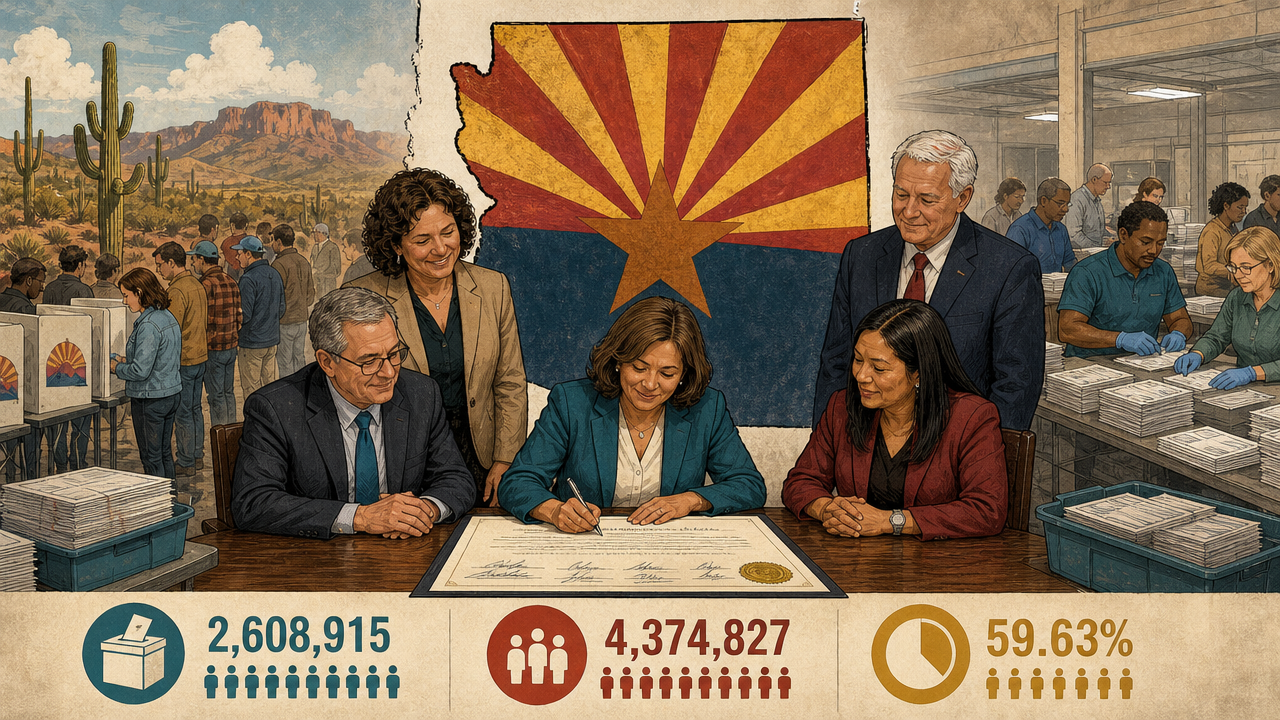
Arizona completes its statewide canvass of the November election
In effect: Arizona’s statutory statewide canvass process was completed on November 23, 2026, and the Secretary of State posted the signed canvass among its 2026 election materials. Verify status
What happened
Arizona officials completed the official statewide canvass of the November 3 general election on November 23. The Secretary of State reported 2,608,915 votes cast from 4,374,827 eligible voters, a turnout rate of 59.63%, and posted a signed statewide canvass record.
What it means for voters
For Arizona voters, this is the state step that turns county-certified totals into official results for federal, statewide, legislative, appellate-court, and statewide ballot-measure contests. It does not mean every possible recount or court matter everywhere is over, but it establishes the state’s official result record and confirms who will hold offices that make laws, set budgets, and oversee services affecting workers and households.
Save stories & follow topics · Open this story
Get the context & analysis
What to watch
As of November 24, watch the Arizona Secretary of State’s election-information page for any court-ordered recount records and for certificates issued to prevailing federal, statewide, and legislative candidates.
Context from earlier events
No relevant context from earlier events was found.
Check sources (3)
Voting; ballot counting; federal courts; election administration California; federal courts
Appeals court lets Justice Department end California ballot-counting case
What happened
A federal appeals court approved the Justice Department’s request to dismiss its own lawsuit seeking to stop California from counting about 20,000 ballots while officials checked the immigration status of recipients the government alleged were noncitizens. The Associated Press reported that the decision ended that litigation over the ballots.
What it means for voters
For voters and election workers, the outcome means this particular federal court fight no longer blocks California’s completed ballot-counting process. It also draws a clear line between an allegation about ballots and a court-ordered remedy: the case ended without the appellate court ordering the ballots set aside. That matters because lawful post-election counting is part of making sure every eligible voter’s ballot is included.
Save stories & follow topics · Open this story
Get the context & analysis
What to watch
As of November 24, no further step in this dismissed case was verified. Watch California election officials for certified-result records and any separate, filed election cases rather than treating this closed case as proof of wrongdoing.
Context from earlier events
No relevant context from earlier events was found.
Check sources (1)
Primary and independent sources
Voting; recount; local justice system; election administration North Carolina
North Carolina close prosecutor race enters sample hand-recount stage
In effect: North Carolina’s recount statute allows a candidate to seek a sample hand-to-eye recount after an initial recount. The State Board said the requested sample would cover one selected site in each of the three counties. Verify status
What happened
North Carolina’s State Board of Elections said a candidate requested a hand recount in a random sample of voting sites in the District Attorney District 21 contest, covering Anson, Richmond, and Scotland counties. After an initial machine recount, Jamie Adams led Todd G.
What it means for voters
District attorneys have major influence over local criminal prosecutions, so a 63-vote margin can have real consequences for communities and the local justice system. For voters, the important point is that a recount is a built-in verification process, not evidence by itself that machines failed or ballots were mishandled. The hand-count sample checks whether the machine recount matches the paper ballots at selected sites.
Save stories & follow topics · Open this story
Get the context & analysis
North Carolina’s State Board of Elections said a candidate requested a hand recount in a random sample of voting sites in the District Attorney District 21 contest, covering Anson, Richmond, and Scotland counties. After an initial machine recount, Jamie Adams led Todd G. Scott by 63 votes, 15,991 to 15,928. State rules call for one voting site in each county to be selected for a hand count; a full hand recount could follow only if the sample difference meets the legal threshold.
What to watch
As of November 24, watch the North Carolina State Board of Elections and the election boards in Anson, Richmond, and Scotland counties for the selected sites, hand-count results, and any decision on whether state law requires a full hand recount.
Context from earlier events
No relevant context from earlier events was found.
Work; wages; overtime; independent contractors; family leave Nationwide
Labor Department’s new contractor-classification rule takes effect January 22
Passed: The final rule was published in the Federal Register on November 23, 2026. Its text sets January 22, 2027, as the effective date, so it is not yet in effect as of November 24. Verify status
What happened
The U.S. Labor Department published a final rule on November 23 that rescinds its 2024 test for deciding whether a worker is an employee or independent contractor under the Fair Labor Standards Act. It replaces that approach with one similar to the department’s 2021 analysis, with changes, and applies the same framework to related status questions under the Family and Medical Leave Act and the federal farmworker-protection law.
What it means for voters
Worker classification can decide whether someone is covered by federal minimum-wage and overtime rules and, in some cases, whether they are counted as an employee for leave protections. The rule does not automatically turn every gig worker or contractor into an employee or vice versa. But it changes the federal Labor Department’s test, so workers and businesses may see different enforcement decisions after January 22. The agency says the change offers clarity; worker advocates warned during rulemaking that it could make misclassification more likely.
Save stories & follow topics · Open this story
Get the context & analysis
The U.S. Labor Department published a final rule on November 23 that rescinds its 2024 test for deciding whether a worker is an employee or independent contractor under the Fair Labor Standards Act. It replaces that approach with one similar to the department’s 2021 analysis, with changes, and applies the same framework to related status questions under the Family and Medical Leave Act and the federal farmworker-protection law. The rule is scheduled to take effect January 22, 2027.
What to watch
Watch the Wage and Hour Division for enforcement guidance before January 22, 2027, and watch federal courts for any lawsuit seeking to pause or overturn the rule.
Context from earlier events
The rule specifically rescinds the Labor Department’s 2024 worker-classification rule and replaces it with an approach similar to the department’s 2021 framework, with modifications.
Congress; electricity costs; infrastructure; jobs; environmental review Washington, D.C.; nationwide
Senate passes energy-permitting package; House still has to act
Passed: The Senate passed H.R. 2347, as amended, 62-33 on November 19, 2026. The measure needs further House approval and presidential action before it becomes law. Verify status
What happened
The Senate passed H.R. 2347, as amended, by a 62-33 vote on November 19. The Senate package, called the Bipartisan American Affordability and Jobs Act of 2026, aims to speed federal reviews for energy and infrastructure projects and includes provisions intended to make data centers cover their energy costs.
What it means for voters
The promise is faster construction of power plants, transmission lines, pipelines, mines, and other projects, which supporters say could add energy supply, reduce delays, and support construction jobs. The tradeoff is that critics say shorter reviews and narrower court challenges could weaken community input and environmental safeguards. For households, there is no immediate change to an electric bill or a jobsite rule. Any effect on bills, construction work, pollution, or local projects would depend on the final bill, whether it becomes law, and how agencies put it into practice.
Save stories & follow topics · Open this story
Get the context & analysis
The Senate passed H.R. 2347, as amended, by a 62-33 vote on November 19. The Senate package, called the Bipartisan American Affordability and Jobs Act of 2026, aims to speed federal reviews for energy and infrastructure projects and includes provisions intended to make data centers cover their energy costs. It is not law: because the Senate amended the measure, the House must act again before it can go to the President.
What to watch
Watch the U.S. House for a vote on the Senate-amended H.R. 2347 or for negotiations on a revised package. No House vote date was verified as of November 24.
Context from earlier events
No relevant context from earlier events was found.
Check sources (2)
Congress; federal budget; public services; federal workers Washington, D.C.; nationwide
Congress has until December 11 to prevent a federal funding gap
In effect: Public Law 119-103 is the current continuing funding law. It provides appropriations and authority through December 11, 2026, unless replaced sooner for a covered activity by an enacted appropriations law. Verify status
What happened
Federal agencies are operating under the Continuing Appropriations and Extensions Act, 2027. The law provides funding authority until the earliest of enactment of the relevant full-year funding law, another specified event, or December 11, 2026.
What it means for voters
This deadline can affect federal workers, contractors, and people who rely on federally funded services. A funding gap does not mean every program stops in the same way, but it can disrupt agency operations, delay some services, and create uncertainty for workers and businesses that deal with the government. Nothing automatically changes in a family budget today; the immediate issue is whether Congress finishes a funding deal before the deadline.
Save stories & follow topics · Open this story
Get the context & analysis
Federal agencies are operating under the Continuing Appropriations and Extensions Act, 2027. The law provides funding authority until the earliest of enactment of the relevant full-year funding law, another specified event, or December 11, 2026. Without new appropriations or another temporary funding law, a funding gap would begin December 12.
What to watch
Watch Congress and the President for enacted full-year appropriations bills or another continuing resolution by Friday, December 11, 2026. As of November 24, this briefing verified the current law’s deadline, not a replacement law.
Context from earlier events
No relevant context from earlier events was found.
Check sources (1)
Primary and independent sources
You're caught up on this briefing. Choose topics and save stories to return on your own schedule.
How this briefing was made
We used official records to verify government actions and independent reporting to add context. We also searched recent election-related videos on YouTube for topic leads. Search rank and popularity were not treated as proof or public opinion. We also checked recent uploads from preferred news and public-affairs channels on YouTube for topic leads. Channel preference was not treated as proof or an endorsement. Every included claim still had to be checked against the linked sources.