The daily civic brief
U.S. Civic Update: Election Results, Work Rules, and the Next Funding Deadline
As of November 23, 2026, election certification and recount work are still shaping who will represent voters in Congress next year. At the same time, a newly published Labor Department rule, a court decision affecting pregnancy accommodations, a White House contractor order, and a December funding deadline could matter for workers, public services, and government accountability.
Estimated 5-minute catch-up · 7 stories
Today's audio briefing
Today's spoken briefing
Hear the latest national briefing and what to watch next for every headline. A restrained instrumental bed plays in the web player.
Read the audio transcript
Voting; recount; U.S. House representation North Carolina
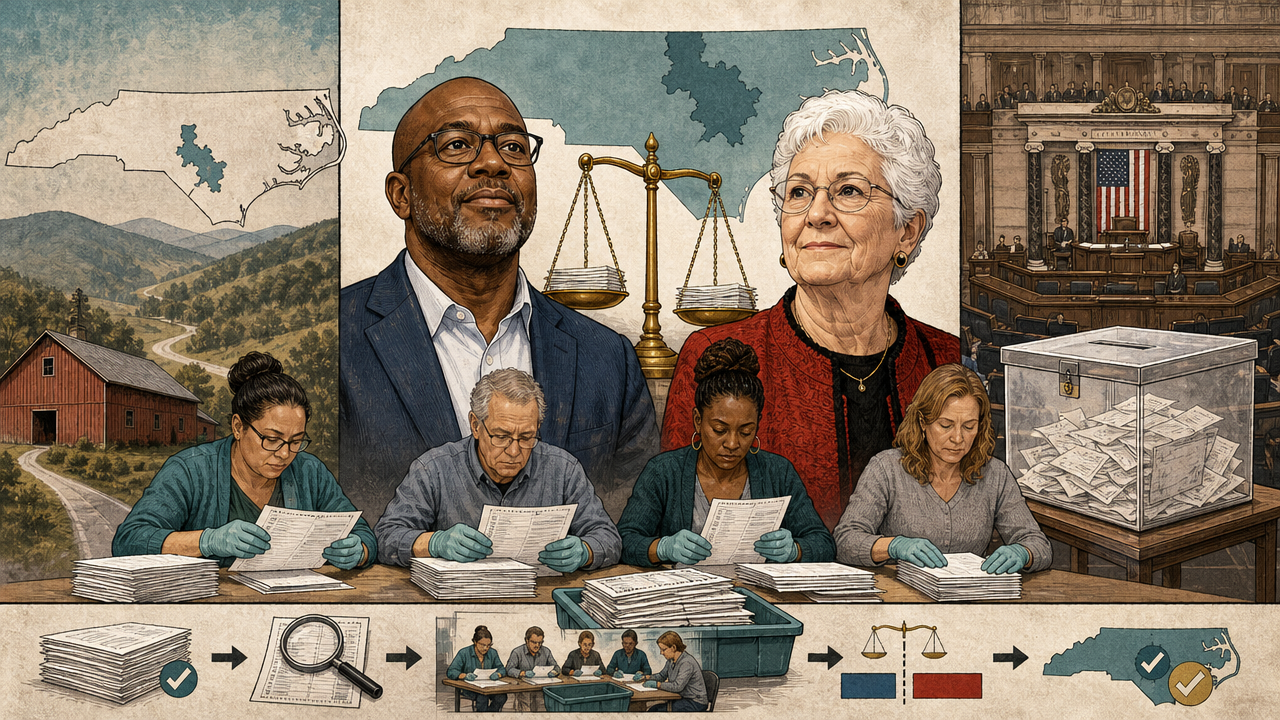
North Carolina recount confirms Hubbard’s win over Foxx in the 5th District
What happened
Democrat Chuck Hubbard defeated Republican Rep. Virginia Foxx after a recount in North Carolina’s 5th Congressional District, according to the Associated Press. Foxx had requested the recount after the county canvasses showed a 331-vote margin, less than 1% of votes cast.
What it means for voters
This is a real check built into the voting system: a close result was reviewed under state rules before the seat changes hands. For people in the district, the practical effect is representation: the member elected to this House seat votes on federal taxes, workplace rules, health programs, transportation, and federal funding. A recount does not by itself show wrongdoing; it is a lawful review of a close contest.
Save stories & follow topics · Open this story
Get the context & analysis
What to watch
Watch the North Carolina State Board of Elections for the final certification record for the 5th District and the board’s statewide canvass meeting scheduled for November 24, 2026.
Context from earlier events
Foxx sought the recount on November 17 after county canvasses put Hubbard ahead by 331 votes. The recount result is the material update.
Voting; certification; federal and state representation Arizona
Arizona holds its statewide canvass today
In effect: Arizona’s statewide canvass procedure is operating for the November 3, 2026 general election. The Secretary of State lists the official statewide canvass for November 23, 2026; no completed signed canvass record was located in the reviewed material. Verify status
What happened
Arizona’s Secretary of State lists November 23, 2026, for the official statewide canvass of the November 3 general election. Arizona law assigns the Secretary of State the duty to canvass contests involving federal, statewide, legislative, appellate-court, and statewide ballot-measure races.
What it means for voters
The canvass is a formal step between unofficial election-night totals and certified results. For Arizona voters, it is the point where statewide government confirms results using county returns and required post-election procedures. It does not mean every political dispute disappears, but it is the official record used for representation and for determining whether any automatic recount threshold applies.
Save stories & follow topics · Open this story
Get the context & analysis
What to watch
Watch the Arizona Secretary of State for a signed statewide canvass record after the November 23, 2026 event. If an official margin meets Arizona’s recount threshold, state procedures provide for a recount after the official canvass.
Context from earlier events
Arizona’s counties had already posted canvass records for the general election. The statewide canvass is the next formal certification step.
Check sources (3)
Voting; U.S. House; representation; congressional oversight Nationwide
Democrats have secured at least 258 House seats, AP reports
What happened
The Associated Press reported that Democrats had secured at least 258 seats in the 435-member U.S. House, their largest House election result since 1992. The report said four races remained outstanding, including runoffs in Louisiana and contests in Minnesota and Tennessee.
What it means for voters
The people elected in November will not take office until January 2027, but the result already changes the political math. A House majority controls committee leadership, what bills get floor time, and much of the chamber’s investigative agenda. That can affect issues families see directly, from tax and health legislation to oversight of federal contracts and agency spending. Still, a House majority alone cannot enact a law: the Senate and president remain part of the process.
Save stories & follow topics · Open this story
Get the context & analysis
What to watch
Watch the remaining House contests and each state’s certification process. The new House is scheduled to begin on January 3, 2027.
Context from earlier events
The AP described the at-least-258-seat result as the party’s largest House election showing since 1992.
Check sources (1)
Primary and independent sources
Work; wages; overtime; independent contractors; labor standards Nationwide
Labor Department publishes new test for employee versus contractor status
Passed: The Wage and Hour Division issued a final rule published on November 23, 2026. Its text states that it becomes effective 60 days after publication, on January 22, 2027, absent a later change or court order. Verify status
What happened
The Labor Department’s Wage and Hour Division has published a final rule that rescinds its 2024 approach for deciding whether a worker is an employee or independent contractor under the Fair Labor Standards Act. The rule also aligns related analysis under the Family and Medical Leave Act and the federal farmworker-protection law.
What it means for voters
For a delivery driver, home-care worker, construction worker, freelancer, or other worker labeled an independent contractor, classification can decide whether federal minimum-wage and overtime protections apply. The rule does not automatically reclassify everyone on January 22. It changes the Labor Department’s legal analysis, and the real effect will vary by job facts, industry, and any court challenges or future enforcement guidance. Businesses may say a clearer test helps planning; workers may worry that a more employer-friendly test can leave some people outside wage-and-hour protections.
Save stories & follow topics · Open this story
Get the context & analysis
The Labor Department’s Wage and Hour Division has published a final rule that rescinds its 2024 approach for deciding whether a worker is an employee or independent contractor under the Fair Labor Standards Act. The rule also aligns related analysis under the Family and Medical Leave Act and the federal farmworker-protection law. The document says it takes effect 60 days after publication, which is January 22, 2027.
What to watch
Watch for Wage and Hour Division enforcement guidance before the January 22, 2027 effective date, plus any lawsuit seeking to block or change the rule.
Context from earlier events
The final rule rescinds the department’s 2024 worker-classification analysis and replaces it with a revised economic-reality approach.
Work; pregnancy; workplace accommodations; federal courts Texas; Fifth Circuit; nationwide implications
Appeals court ruling puts pregnancy-accommodation law in legal trouble
Challenged in court: AP reported that the en banc Fifth Circuit ruled the law unconstitutional on November 22, 2026, based on its view of Congress’s proxy-voting procedure. The reviewed sources did not establish a final nationwide resolution, a stay, or the next appellate step. Verify status
What happened
A full U.S. Court of Appeals for the Fifth Circuit ruled that the federal Pregnant Workers Fairness Act was unconstitutional because of the way Congress passed the larger 2022 spending bill containing it, according to the Associated Press. The law requires many employers to provide reasonable workplace accommodations for pregnant workers and related conditions unless doing so would create an undue hardship.
What it means for voters
For workers who need a stool, water breaks, lighter lifting, schedule changes, or other pregnancy-related adjustments, the stakes are immediate. The decision creates legal uncertainty around a federal protection many workers and employers have been using. The reviewed reporting did not establish a final nationwide outcome, a stay, or whether the ruling will be reviewed by the Supreme Court, so workers should not assume their existing workplace rights have vanished everywhere. State and local protections may also differ.
Save stories & follow topics · Open this story
Get the context & analysis
What to watch
Watch for the federal government’s next court filing, any request to pause the ruling, and whether the Supreme Court agrees to review the case. No date for a next court step was verified as of November 23, 2026.
Context from earlier events
The Pregnant Workers Fairness Act was enacted in December 2022 as part of a larger federal spending package.
Check sources (1)
Primary and independent sources
Government accountability; federal contracting; congressional oversight Nationwide
New White House order tells federal contractors to coordinate congressional responses
In effect: Executive Order 14438, dated November 20, 2026, directs contractors and agencies to act immediately, while directing OMB to develop implementation guidance. Its enforcement provisions say agencies should consider available action consistent with law and contract terms. Verify status
What happened
President Donald Trump’s November 20 executive order directs federal contractors and subcontractors to notify the White House and their contracting agencies about pending or future congressional requests concerning their work or communications with the executive branch. It also says they must follow White House or agency instructions about withholding communications deemed protected by executive privilege.
What it means for voters
Federal contractors do work that touches everyday life, including technology, health services, defense, transportation, and benefits administration. The immediate effect is a new compliance requirement for contractors. For the public, the bigger question is whether the order slows or narrows Congress’s ability to get information about taxpayer-funded work. The White House says the policy protects confidential material and avoids waste; critics quoted by AP say it could restrict normal oversight. The courts may eventually decide the legal limits.
Save stories & follow topics · Open this story
Get the context & analysis
President Donald Trump’s November 20 executive order directs federal contractors and subcontractors to notify the White House and their contracting agencies about pending or future congressional requests concerning their work or communications with the executive branch. It also says they must follow White House or agency instructions about withholding communications deemed protected by executive privilege. The order says agencies may consider contract cancellation, termination, suspension, or debarment for noncompliance, consistent with law.
What to watch
Watch for Office of Management and Budget guidance to agencies and contractors, congressional responses, and any lawsuit challenging the order. No date for those next steps was verified as of November 23, 2026.
Context from earlier events
No relevant context from earlier events was found.
Congress; federal budget; public services; federal workers Washington, D.C.; nationwide
Congress has until December 11 to prevent a federal funding gap
In effect: Public Law 119-103 provides continuing appropriations through December 11, 2026. It remains the operating funding law as of November 23; a new law would be needed to continue funding after that date. Verify status
What happened
Current federal funding is set to expire on December 11, 2026, under the continuing appropriations law enacted in September. Congress must pass regular spending bills or another temporary funding law before then to avoid a funding gap beginning December 12.
What it means for voters
A funding gap can affect pay certainty for federal workers and contractors, delays in some public services, and the workload of people who keep essential operations running. What stays open and what pauses depends on agency shutdown plans and whether Congress passes a short-term extension before the deadline. There is no shutdown now, and a possible shutdown is not guaranteed. But households that depend on federal paychecks, contracts, inspections, loans, benefits processing, or public facilities have a reason to watch the talks closely.
Save stories & follow topics · Open this story
Get the context & analysis
Current federal funding is set to expire on December 11, 2026, under the continuing appropriations law enacted in September. Congress must pass regular spending bills or another temporary funding law before then to avoid a funding gap beginning December 12. Reuters reported on November 20 that lawmakers remained divided over a path forward.
What to watch
Watch Congress for an enacted full-year funding package or another continuing resolution before Friday, December 11, 2026. If neither becomes law in time, the funding gap would begin Saturday, December 12.
Context from earlier events
Congress enacted the current short-term funding law in September 2026, pushing the next deadline past the November election.
Check sources (2)
You're caught up on this briefing. Choose topics and save stories to return on your own schedule.
How this briefing was made
We used official records to verify government actions and independent reporting to add context. We also searched recent election-related videos on YouTube for topic leads. Search rank and popularity were not treated as proof or public opinion. We also checked recent uploads from preferred news and public-affairs channels on YouTube for topic leads. Channel preference was not treated as proof or an endorsement. Every included claim still had to be checked against the linked sources.