The daily civic brief
U.S. civic and pocketbook news scan — September 15, 2026
Today’s biggest confirmed civic development is a Supreme Court decision that leaves mail-ballot rules unchanged for the 2026 midterms. Housing-voucher rent limits, Medicare payment rules, a Senate crypto vote, and a Federal Reserve meeting also matter because they can shape access to housing, care, credit, and consumer protections. Several of these are decisions in progress, not changes households should count on yet.
Today's audio briefing
Today's spoken briefing
Hear the latest national briefing and what to watch next for every headline. A restrained instrumental bed plays in the web player.
Voting, federal courts, Postal Service rules, and state election administration Nationwide; effects are largest in states that mail ballots to voters or rely heavily on voting by mail
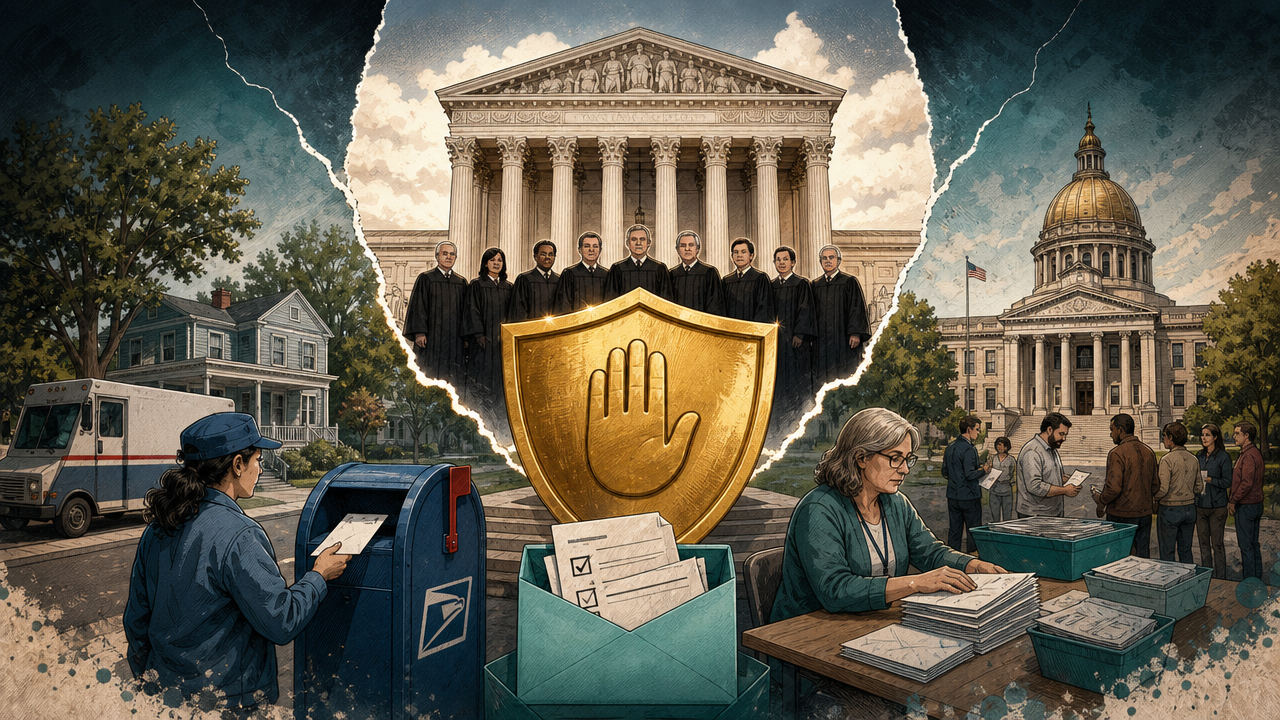
Supreme Court leaves federal mail-ballot restrictions blocked before the midterms
What happened
The U.S. Supreme Court on September 14 rejected the Trump administration’s request to put new federal mail-ballot restrictions into effect before the November midterm elections. That leaves lower-court orders in place for now. States can continue using their existing ballot-envelope and mail-ballot systems rather than following the disputed Postal Service requirements.
What it means for voters
For voters, this means there is no last-minute federal change to the way states send or process mail ballots. Election rules are usually set by states, while Congress sets some national protections and federal courts decide whether government actions follow the Constitution and federal law. This is not a final decision on every legal argument in the case, but it removes an immediate obstacle for election offices already preparing or mailing ballots.
What to watch
Watch for further court action on the underlying case, and check your state or local election office for its ballot-request, return, signature, and cure deadlines.
Context from earlier events
Lower federal courts had blocked the policy in the days leading up to the Supreme Court’s action, including a separate order on September 14 involving the Postal Service.
Inflation, borrowing costs, jobs, mortgages, credit cards, and the Federal Reserve Nationwide
Federal Reserve begins a two-day meeting; its rate decision comes Wednesday
What happened
The Federal Reserve’s rate-setting committee begins its scheduled two-day meeting on September 15. Its policy statement and chair’s news conference are scheduled for September 16. The Fed, which Congress set up as an independent central bank, uses interest-rate policy to pursue stable prices and maximum employment.
What it means for voters
A Fed rate change does not automatically change a household’s mortgage, car-loan, credit-card, or savings-account rate. But it can push many borrowing and savings rates over time, and it can affect hiring and consumer spending. People with variable-rate debt may feel changes sooner than people with fixed-rate loans. No new rate decision had been announced at the time of this scan.
What to watch
The committee’s September 16 statement, its vote, updated economic projections, and the chair’s explanation of what the Fed sees in inflation and employment data.
Context from earlier events
The Fed last released a policy statement after its July 28–29 meeting. Its next scheduled decision is September 16.
Cryptocurrency, consumer protections, federal ethics rules, and Congress Washington, D.C.; national consumer-finance relevance
Senate faces a key procedural vote on a broad crypto-market bill
What happened
The Senate is scheduled to take a procedural vote on the Digital Asset Market Clarity Act on September 15. The bill would create a wider federal framework for digital-asset markets. Negotiators added proposed ethics limits involving federal elected officials, their spouses, and federal judges, but the bill is not law unless it clears the Senate and House and is signed by the president.
What it means for voters
The practical question for people who own or use crypto is whether federal law will set clearer rules for trading platforms, digital tokens, and oversight. Supporters say a national framework could provide clearer consumer and market rules. Critics and some negotiators have argued that ethics safeguards are also needed when public officials have financial ties to the industry. Today’s procedural vote is not the same as final passage, and it does not create new protections or guarantees for consumers by itself.
What to watch
Whether the Senate vote reaches the threshold needed to move ahead, the final text of the ethics provisions, and whether the House takes up the Senate’s version.
Context from earlier events
A revised version of the bill was released by Sen. Cynthia Lummis on September 10 ahead of the planned vote.
Sources
- Office of Sen. Cynthia Lummis Lummis Releases Updated Clarity Act Text Ahead of Historic Tuesday Vote
- Associated Press Trump agreed to new ethics rules to get a crypto bill across the line. But that might not be enough
- Associated Press Trump agrees to new bipartisan ethics provision in massive crypto bill, Republican senators say
Medicare, doctor access, medical bills, and federal rulemaking Nationwide
Public comment period closes on proposed 2027 Medicare doctor-payment rules
What happened
September 14 was the deadline for public comments on CMS’s proposed 2027 Medicare Physician Fee Schedule. The proposal covers how Medicare Part B pays doctors and other medical professionals, along with other coverage and payment policies. It is still a proposal; CMS generally issues the final annual rule around November, with changes taking effect January 1 if finalized.
What it means for voters
Medicare payment rules can affect which services doctors offer, whether some practices take new Medicare patients, and how easily beneficiaries can find care. They do not directly set every patient bill, because coverage, deductibles, coinsurance, supplemental coverage, and provider participation also matter. The tradeoff CMS must weigh is between controlling program costs and keeping payment high enough to support access to care, especially in areas with fewer providers.
What to watch
CMS’s final rule, expected around November 1, and whether it changes payment rates or access-related policies from the proposal.
Context from earlier events
Medicare uses a yearly rulemaking process for many doctor and outpatient payment policies; proposed rules are followed by public comments and a final rule before the next calendar year.
Sources
- Centers for Medicare & Medicaid Services CMS-1848-P: CY 2027 Payment Policies under the Medicare Physician Fee Schedule and Other Changes to Part B Payment and Coverage Policies
- Centers for Medicare & Medicaid Services Calendar Year 2027 Medicare Physician Fee Schedule Proposed Rule
- Centers for Medicare & Medicaid Services CMS Rulemaking Schedule
Rent, Section 8 housing vouchers, public housing, and federal-local administration Nationwide; dollar amounts vary by local rental market and bedroom size
HUD’s new voucher-rent benchmarks take effect October 1
What happened
HUD published its fiscal-year 2027 Fair Market Rents on September 1. These local benchmarks are scheduled to take effect October 1 and help housing authorities set payment standards for Housing Choice Vouchers, often called Section 8 vouchers. HUD also uses them in some other assisted-housing programs.
What it means for voters
This does not cap a landlord’s rent or guarantee that a voucher holder’s rent will rise or fall by a particular amount. Local public housing authorities set their own payment standards within federal rules and may need to update them. Still, the benchmarks can affect how much rental assistance is available, whether a family can find a unit within the program limit, and the rent calculations used in some public-housing and homelessness-assistance programs.
What to watch
Local housing-authority decisions on their October payment standards, plus any local request to HUD to reevaluate an area’s figures. HUD’s comment and reevaluation-request deadline is October 1.
Context from earlier events
Federal law requires HUD to update these rent benchmarks at least once a year. The 2027 figures use recent Census rental data along with HUD’s adjustments for newer rent conditions.
Sources
- U.S. Department of Housing and Urban Development Fair Market Rents for the Housing Choice Voucher Program, Moderate Rehabilitation Single Room Occupancy Program, and Other Programs, Fiscal Year 2027
- Government Publishing Office Federal Register notice: FY 2027 Fair Market Rents
- National Council of State Housing Agencies NCSHA Washington Report — September 11, 2026
Paychecks, overtime records, workplace rights, and federal labor enforcement Nationwide
Labor Department rolls out updated work-hours tracking tool and new guidance letters
What happened
The Labor Department announced agency-wide worker and employer initiatives on September 8, including an updated Wage and Hour Division mobile app now called WorkWise Timesheet. The agency says the tool is meant to help people track regular hours, breaks, overtime, and pay. It also released opinion letters that explain how the department reads particular workplace laws in specific situations.
What it means for voters
A time-tracking app does not change the federal minimum wage, overtime law, or an employer’s duty to keep required records. But keeping a personal log can help a worker compare hours and pay stubs, spot a possible mistake, and explain a concern to an employer or labor agency. Opinion letters are guidance, not acts of Congress, and they do not replace stronger state or local wage protections where those apply.
What to watch
Whether the department issues broader wage-and-hour rules or enforcement guidance, and whether workers and employers begin using the new tracking tool. If a paycheck seems wrong, save schedules, time records, and pay stubs before seeking help.
Context from earlier events
The Fair Labor Standards Act is the federal law behind minimum-wage and overtime protections for covered workers, while states and cities can set stronger protections.
How this briefing was made
We used official records to verify government actions and independent reporting to add context. We also checked popular political videos on YouTube for topic leads. Popularity helped us decide what to investigate, but it was not treated as proof or public opinion. Every included claim still had to be checked against the linked sources.