The daily civic brief
U.S. Civic Daily Scan: household costs, public services, and voting rules
Today’s scan centers on the government decisions behind emergency help, healthcare dollars, student debt, veterans’ benefits, and mail voting. The clearest immediate developments are a federal court ruling against a proposed FEMA workforce cut and a renewed Supreme Court request over mail-ballot rules, while several recent federal actions set deadlines or costs that households will feel over time.
Today's audio briefing
Today's spoken briefing
Hear the latest national briefing and what to watch next for every headline. A restrained instrumental bed plays in the web player.
Disaster aid, public services, federal workforce, and court oversight Nationwide
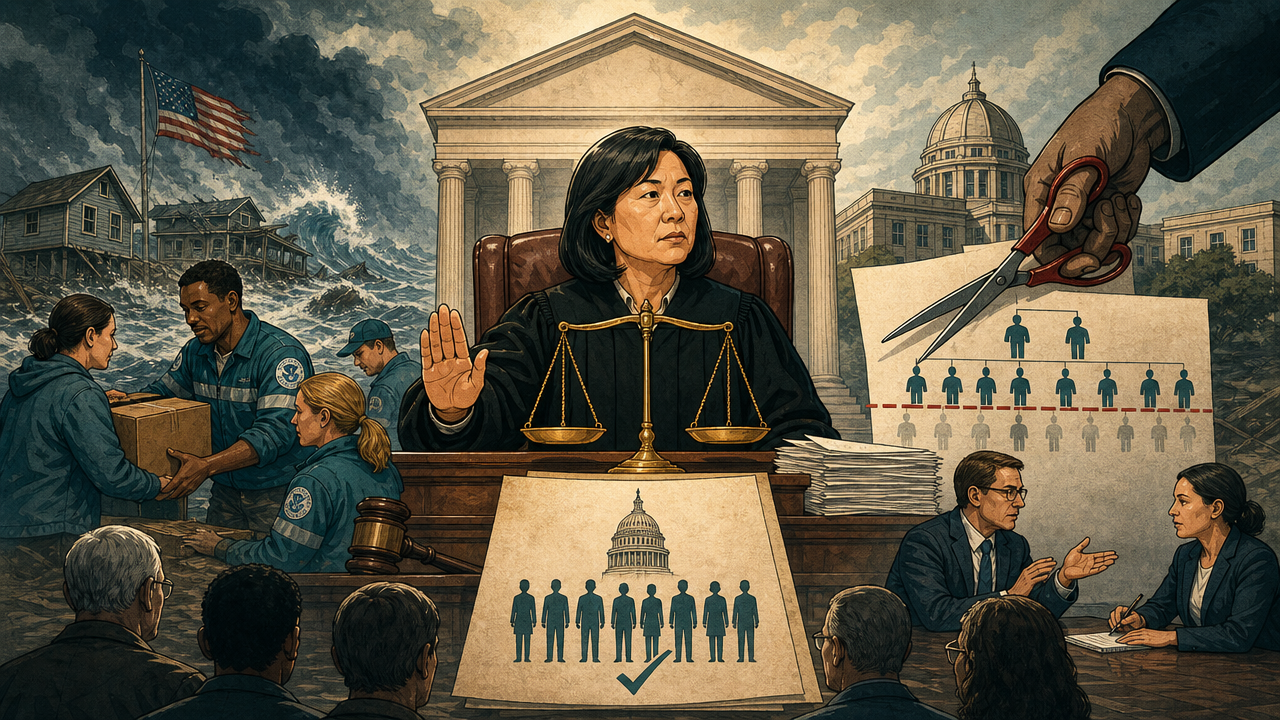
Federal judge says DHS could not direct a plan to cut FEMA staffing in half
What happened
A federal judge ruled that the Department of Homeland Security’s plan to cut Federal Emergency Management Agency staffing by 50% was unlawful. The judge found that Congress placed FEMA staffing decisions with FEMA itself after Hurricane Katrina, rather than allowing DHS to substantially reduce the agency’s work. The ruling does not yet spell out a final remedy; the judge told both sides to work out next steps.
What it means for voters
FEMA helps states and households after hurricanes, floods, fires, and other disasters. A smaller workforce could affect how quickly the agency processes disaster assistance, manages recovery grants, and deploys staff, though this ruling does not itself guarantee faster aid or restore any particular job. This is also a check on how much a Cabinet department can change an agency Congress structured to have some independence. The federal courts interpret the law; Congress can change the law; FEMA and DHS carry it out.
What to watch
The parties must propose a remedy, and the administration could appeal. Watch for whether the court orders staffing actions to be reversed or sets limits on future DHS direction of FEMA personnel decisions.
Context from earlier events
Congress strengthened FEMA’s institutional independence after the federal response to Hurricane Katrina in 2005 drew widespread criticism.
Voting, mail ballots, Postal Service rules, and federal courts Nationwide; effects depend on state election systems
Administration renews Supreme Court request to put mail-ballot restrictions in place
What happened
The Trump administration renewed its request for the U.S. Supreme Court to let Postal Service-related mail-ballot restrictions take effect before the November midterm elections. Lower courts have blocked the policy for now. The administration says the rules are within its authority to run the mail system; states and voting-rights groups argue that the rules are unlawful and would be difficult to carry out after ballots have already begun going out.
What it means for voters
State law still decides who may vote by mail and which ballots count. But the Postal Service policy could change the steps election offices must take to prepare and send ballot envelopes. That could matter most in states already mailing ballots, because changing procedures late can create costs, confusion, or delays for local election offices and voters. The Supreme Court, not the White House alone, will decide whether the lower-court block stays in place while the case continues.
What to watch
Watch for an emergency order from the Supreme Court and for notices from state and local election offices about any ballot-envelope or mailing changes. Several states were scheduled to begin mailing ballots during the week of September 13.
Context from earlier events
A federal appeals court upheld a lower-court block on key parts of the executive order on September 10, while the Supreme Court was already considering related emergency requests.
Student debt, college costs, and federal lending Nationwide
Education Department posts the 2026–27 rates for new federal student loans
What happened
The Education Department published its annual notice for federal Direct Loans first paid out between July 1, 2026, and June 30, 2027. The fixed rates are 6.52% for undergraduate subsidized and unsubsidized loans, 8.07% for graduate or professional unsubsidized loans, and 9.07% for Direct PLUS loans. These rates apply for the life of each new loan in that period, not to most borrowers’ older fixed-rate loans.
What it means for voters
For students and parents borrowing for this school year, the rate helps determine monthly payments and the total cost of college debt. The undergraduate rate is slightly higher than the 6.39% rate for loans first disbursed in the prior 12-month period. The Education Department sets the published rate under a formula enacted by Congress; schools package aid and originate loans, while borrowers choose how much to borrow.
What to watch
Families weighing federal loans against private loans should compare the full terms, including federal repayment protections and loan fees, rather than looking only at the interest rate. Watch for school financial-aid updates and repayment-plan information as the academic year moves forward.
Context from earlier events
Federal Direct Loan rates for newly issued loans are generally reset each year under a statutory formula tied to Treasury borrowing costs, while the rate on a particular fixed-rate loan remains fixed.
Sources
- U.S. Department of Education, Federal Student Aid Annual Notice of Interest Rates for Fixed-Rate Federal Student Loans Made Under the William D. Ford Federal Direct Loan Program
- Federal Register mirror Annual Notice of Interest Rates for Fixed-Rate Federal Student Loans Made Under the William D. Ford Federal Direct Loan Program, 91 FR 57581
Prescription drugs, Medicare, and federal healthcare policy Nationwide
Medicare drug-price negotiations move past their meeting deadline
What happened
September 11 was the last day scheduled for negotiation meetings between Medicare and drug companies in the third cycle of the Medicare Drug Price Negotiation Program. The program’s next deadline is September 18 for additional written offers or counteroffers. If Medicare and a manufacturer do not reach agreement, CMS must send a final offer by September 30; manufacturers then have until October 31 to accept or reject it.
What it means for voters
This does not lower a prescription price today. Any prices agreed to in this third cycle would take effect January 1, 2028. Still, the deadline matters to Medicare patients, taxpayers, and drugmakers because it is part of the process that will set future prices for selected high-cost medicines. Congress created the negotiation program; the Centers for Medicare & Medicaid Services runs it; court challenges or later legislation could still affect how it works.
What to watch
Watch for CMS announcements after the September 18 written-offer deadline, then the September 30 final-offer deadline. CMS is scheduled to publish any agreed prices by November 30, 2026.
Context from earlier events
CMS selected 15 drugs for the third negotiation cycle in January 2026, plus one drug for renegotiation. The resulting prices are scheduled to start in 2028.
Healthcare costs, Medicaid oversight, and accountability Brooklyn, New York; national Medicaid and taxpayer relevance
Justice Department sentencing closes a $64 million Medicaid fraud case in New York
What happened
A Brooklyn owner of two adult day-care centers and a home-health company was sentenced to 76 months in federal prison for her role in a Medicaid fraud and kickback scheme, the Justice Department said. Prosecutors said the businesses billed about $64 million for services that were not provided as represented, and Medicaid paid about $56 million. The court also ordered more than $56 million in restitution and $5 million in forfeiture.
What it means for voters
This case does not change an individual beneficiary’s eligibility or benefits. But Medicaid fraud can drain money intended for care for low-income families, older adults, and people with disabilities, and it can raise administrative costs for taxpayers and health plans. Criminal courts decide guilt and sentences; federal and state agencies investigate and administer Medicaid, which is jointly financed by federal and state governments.
What to watch
Watch for restitution collections and for any separate civil, licensing, or provider-enrollment actions involving the businesses or other defendants. The Justice Department said multiple law-enforcement agencies investigated the case.
Context from earlier events
According to the Justice Department, the fraudulent billing occurred from roughly 2017 through July 2024, and the owner pleaded guilty in August 2025.
Veterans’ healthcare, benefits, jobs, and federal administration Nationwide
White House order sets deadlines to improve veterans’ benefit records and job connections
What happened
A September 8 executive order directs the Defense Department, Department of Veterans Affairs, and Department of Labor to improve the sharing of military personnel and health records and to connect separating service members with jobs, training, and benefit help. The order sets a 30-day target for records to be shared when a service member leaves active duty, with longer deadlines of 120 and 180 days for system and program changes.
What it means for voters
Veterans can face gaps in healthcare, disability payments, education help, home-loan support, and job placement when records do not move quickly between agencies. The order may make applying less burdensome, but it does not create a new cash benefit and says implementation is subject to available funding and existing law. The White House directs executive agencies; Congress controls appropriations and can change benefit rules.
What to watch
Watch for agency updates over the next 30 days on discharge-record sharing, then for the required systems and transition-program changes due over the next four to six months.
Context from earlier events
The order says separate military and VA record systems can delay benefit processing and make the move from active duty to civilian life harder.
How this briefing was made
We used official records to verify government actions and independent reporting to add context. We also checked popular political videos on YouTube for topic leads. Popularity helped us decide what to investigate, but it was not treated as proof or public opinion. Every included claim still had to be checked against the linked sources.