The daily civic brief
U.S. civic briefing
Mississippi counties have until Friday to certify election results / Arizona posts more hand-count results before county canvasses / Kansas completes its post-election audit process for close races / Georgia House control changes, but divided state government remains / Senate clears first hurdle for a broad energy-permitting bill
Estimated 3-minute catch-up · 5 stories
Today's audio briefing
Today's spoken briefing
Hear the latest national briefing and what to watch next for every headline. A restrained instrumental bed plays in the web player.
Read the audio transcript
Voting; election administration; Senate representation Mississippi
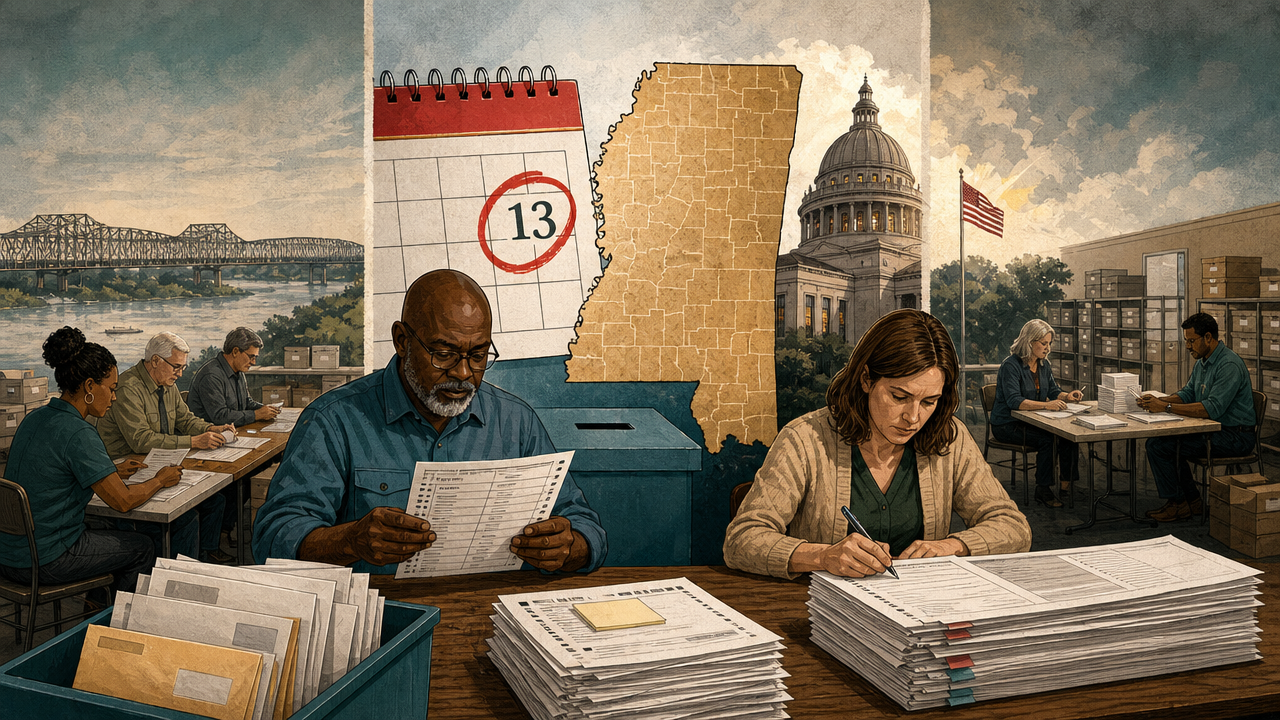
Mississippi counties have until Friday to certify election results
In effect: Mississippi’s county-level ballot review and certification process is underway for the November 3, 2026 general election. Counties have until November 13 to submit certified results, according to the Secretary of State. Verify status
What happened
Mississippi’s U.S. Senate result was still not called as of November 10. The Secretary of State said counties have until November 13 to submit certified results.
What it means for voters
For Mississippi voters, this is the normal part of making unofficial election-night numbers official. Eligible late-arriving mail ballots and qualifying affidavit ballots can still be considered under state rules. The Senate seat matters nationally because senators vote on federal judges, cabinet nominees, taxes, labor rules, health programs, and spending. But no winner is official until the state process is complete.
Save stories & follow topics · Link to this story
Get the context & analysis
Mississippi’s U.S. Senate result was still not called as of November 10. The Secretary of State said counties have until November 13 to submit certified results. The office also said about 3,600 mail absentee ballots were outstanding after Election Day and that affidavit ballots were still being processed during the county certification period.
What to watch
Watch county election offices and the Mississippi Secretary of State through Friday, November 13, 2026, for certified county returns and a statewide result.
Context from earlier events
No relevant context from earlier events was found.
Check sources (3)
Voting; election administration; audits; certification Arizona
Arizona posts more hand-count results before county canvasses
In effect: Arizona’s statutory hand-count and canvass procedures are being carried out for the November 3, 2026 general election. County canvasses may occur through November 19, followed by the statewide canvass on November 23. Verify status
What happened
Arizona’s election office added more county hand-count audit results to its post-election page. As of November 10, Apache, Cochise, Coconino, Greenlee, Navajo, Pinal, Santa Cruz, and Yuma were listed as completed.
What it means for voters
A hand-count audit checks a sample of paper ballots against machine totals. That does not certify every race by itself, but it is one of the checks voters can see before official results are finalized. Arizona’s county canvasses run through November 19, and the statewide canvass is set for November 23, so results remain unofficial until those steps are done.
Save stories & follow topics · Link to this story
Get the context & analysis
Arizona’s election office added more county hand-count audit results to its post-election page. As of November 10, Apache, Cochise, Coconino, Greenlee, Navajo, Pinal, Santa Cruz, and Yuma were listed as completed. Most showed no discrepancies; Yuma’s listed discrepancies as within the acceptable margin. Other counties were still listed as coming soon.
What to watch
Watch Arizona county boards of supervisors through November 19, 2026, for their public canvasses. Then watch the Secretary of State’s statewide canvass on November 23.
Context from earlier events
No relevant context from earlier events was found.
Check sources (2)
Primary and independent sources
Voting; election administration; audits; statewide elections Kansas
Kansas completes its post-election audit process for close races
In effect: Kansas’s post-election and close-race audit procedures are being used for the November 3, 2026 general election. The state’s audit page marks the audit process completed, while county and state canvassing steps remain separate. Verify status
What happened
Kansas triggered close-race audits in six contests after unofficial election-night results showed margins of 1% or less. The races included governor, secretary of state, attorney general, and three state House seats.
What it means for voters
Kansas uses paper ballots and has election boards hand-count selected ballots to compare them with tabulator totals. That matters most in tight contests, where voters need a documented check before canvassing and certification. It does not by itself decide a winner or mean an error occurred; it is a required safeguard triggered by close unofficial results.
Save stories & follow topics · Link to this story
Get the context & analysis
Kansas triggered close-race audits in six contests after unofficial election-night results showed margins of 1% or less. The races included governor, secretary of state, attorney general, and three state House seats. The Secretary of State’s audit page now says the audit process is completed, though the reviewed statewide pages did not provide a full county-by-county tally of the hand counts.
What to watch
Watch county canvasses, which Kansas says must occur by November 16, 2026. The State Board of Canvassers is scheduled to post official statewide results after its December 1 meeting.
Context from earlier events
No relevant context from earlier events was found.
Check sources (3)
Representation; state government; budgets; laws Georgia
Georgia House control changes, but divided state government remains
What happened
The Associated Press determined on November 9 that Democrats won enough Georgia House races to control the chamber. AP reported a 91-86 edge, with three races not yet called.
What it means for voters
This affects what can realistically move in Georgia on wages, schools, transit, housing, health coverage, taxes, and election rules. The House can pass bills and appropriations, but the Senate must also agree and the governor has a role in signing or vetoing bills. For working households, that means big changes will likely require negotiation instead of being automatic after the election.
Save stories & follow topics · Link to this story
Get the context & analysis
The Associated Press determined on November 9 that Democrats won enough Georgia House races to control the chamber. AP reported a 91-86 edge, with three races not yet called. Republicans kept the state Senate, while Democrat Keisha Lance Bottoms won the governor’s office, so Georgia is headed for divided government rather than one-party control of every elected branch.
What to watch
Watch Georgia’s official certification process and the organization of the new General Assembly before the 2027 session. The key practical question is which bills can win support in both legislative chambers and reach the governor.
Context from earlier events
AP reported that Republicans had controlled the Georgia House since 2005 and both the Senate and governor’s office since 2003. The 2026 result changes the House but does not erase the Senate’s separate power.
Check sources (3)
Energy; utility costs; jobs; infrastructure; Congress Washington, D.C.; nationwide
Senate clears first hurdle for a broad energy-permitting bill
Proposed: The Senate voted 73-25 to invoke cloture on a motion to proceed to the legislative vehicle for the package. That advanced debate but did not pass the bill; amendments, final Senate passage, House action, and presidential action would still be required. Verify status
What happened
The U.S. Senate voted 73-25 on November 9 to limit debate and begin considering the Bipartisan American Affordability and Jobs Act, using H.R. 2347 as the legislative vehicle. It was a procedural vote, not final passage.
What it means for voters
The bill could shape how quickly large energy, transmission, industrial, and data-center projects move through federal approvals. Supporters say faster, clearer approvals could help build infrastructure and ease power-cost pressure over time. Critics say parts of the package could limit community input, weaken protections around water and historic resources, or affect Tribal sovereignty. None of those changes apply yet because the Senate has not passed the bill and the House has not completed action on the package.
Save stories & follow topics · Link to this story
Get the context & analysis
The U.S. Senate voted 73-25 on November 9 to limit debate and begin considering the Bipartisan American Affordability and Jobs Act, using H.R. 2347 as the legislative vehicle. It was a procedural vote, not final passage. The substitute text includes provisions on electric-transmission planning, data-center electricity demand, energy permitting, pipelines, geothermal projects, and environmental review timelines.
What to watch
Watch the U.S. Senate for amendment votes and a final-passage vote. As of November 10, 2026, no final Senate vote date was verified in the records reviewed.
Context from earlier events
No relevant context from earlier events was found.
Check sources (4)
Primary and independent sources
- U.S. Senate Democratic Caucus Wrap Up for Monday, November 9, 2026
- Office of U.S. Senator Martin Heinrich Substitute Amendment to Bipartisan American Affordability and Jobs Act
- Senate Environment and Public Works and Energy and Natural Resources Committee Democrats ENR and EPW Democrats’ Summary of Changes Contained in Substitute Amendment
- Office of U.S. Senator Edward J. Markey Senator Markey Statement on Permitting Reform Deal
You're caught up on this briefing. Choose topics and save stories to return on your own schedule.
How this briefing was made
We used official records to verify government actions and independent reporting to add context. We also searched recent election-related videos on YouTube for topic leads. Search rank and popularity were not treated as proof or public opinion. We also checked recent uploads from preferred news and public-affairs channels on YouTube for topic leads. Channel preference was not treated as proof or an endorsement. Every included claim still had to be checked against the linked sources.