The daily civic brief
U.S. civic briefing
Arizona voters appear to approve a 2% cap on new or higher local grocery taxes / Arizona’s projected new state-government lineup could reset the policy agenda / New Medicare outpatient payment rules are set to begin January 1
Estimated 2-minute catch-up · 3 stories
Today's audio briefing
Today's spoken briefing
Hear the latest national briefing and what to watch next for every headline. A restrained instrumental bed plays in the web player.
Read the audio transcript
Voting; taxes; groceries; local government Arizona
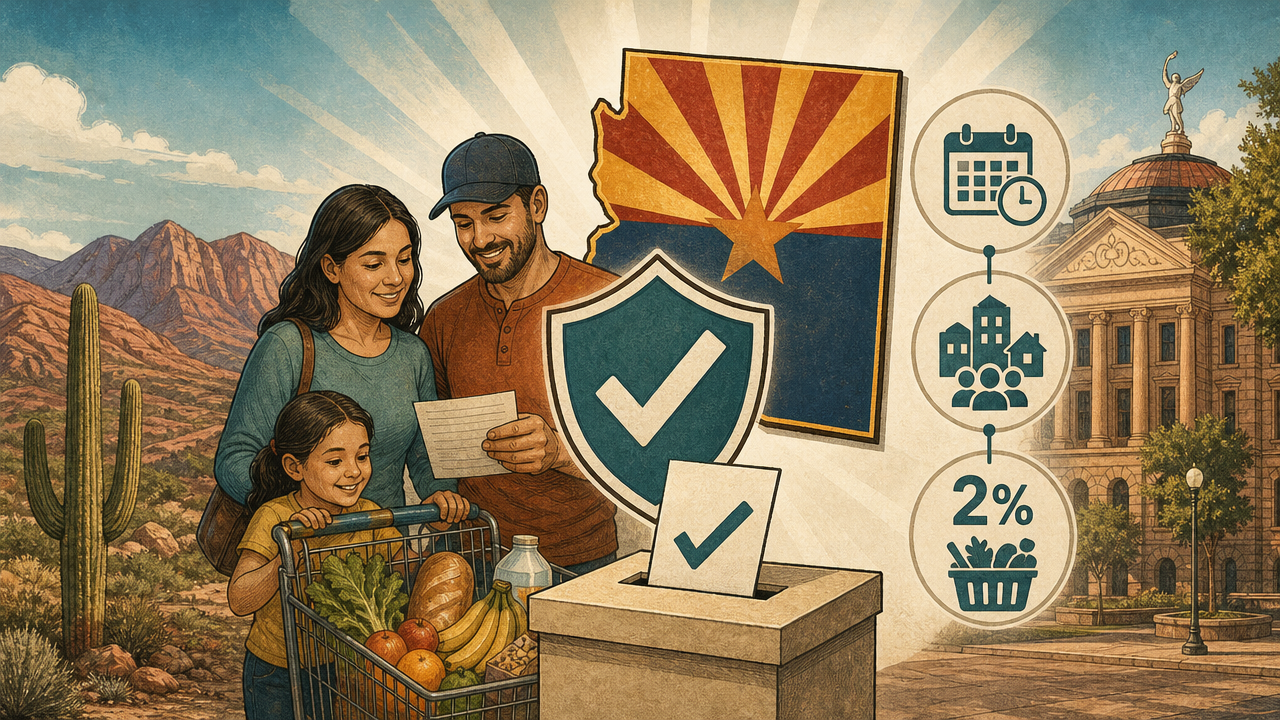
Arizona voters appear to approve a 2% cap on new or higher local grocery taxes
Passed: Unofficial Arizona results show Proposition 316 passing. The measure’s stated text pauses local grocery-tax adoption or increases through June 30, 2027, then requires voter approval and caps a new or increased local rate at 2%. County and state canvasses were still ahead as of November 7. Verify status
What happened
Arizona’s unofficial election results show Proposition 316 passing. The measure blocks local governments from adopting or increasing a grocery tax from July 1, 2025, through June 30, 2027.
What it means for voters
For shoppers, the measure limits one part of the grocery bill: municipal taxes on food for home consumption. It does not set grocery prices, cover restaurant meals, or guarantee that every household will see the same change. For cities and towns, the tradeoff is less flexibility to raise money through a grocery tax without going back to voters, which can affect how local leaders plan for services and budgets.
Save stories & follow topics · Link to this story
Get the context & analysis
Arizona’s unofficial election results show Proposition 316 passing. The measure blocks local governments from adopting or increasing a grocery tax from July 1, 2025, through June 30, 2027. After that, a city or town would need voter approval for a new or higher grocery tax, and the rate could not exceed 2%. Arizona’s official canvass is still pending.
What to watch
Arizona counties are scheduled to canvass results from November 9 through November 19, and the state canvass is scheduled for November 23, 2026. After certification, watch Arizona tax agencies and local governments for implementation guidance before the June 30, 2027 transition point in the measure.
Context from earlier events
No relevant context from earlier events was found.
Representation; state government; taxes; schools; housing; voting Arizona
Arizona’s projected new state-government lineup could reset the policy agenda
What happened
AP reported that Democrats won the Arizona House and Senate while Gov. Katie Hobbs retained the governor’s office, giving one party projected control of all three elected parts of state government for the first time since 1966. Those race calls still await Arizona’s formal canvass.
What it means for voters
A governor and Legislature that agree can move more quickly on state issues such as public-school funding, housing rules, taxes, healthcare oversight, and voting laws. That can matter for family budgets and services, but no specific new policy is automatic. Bills still need to be written, passed by both chambers, signed or otherwise enacted, funded where needed, and sometimes reviewed by courts.
Save stories & follow topics · Link to this story
Get the context & analysis
AP reported that Democrats won the Arizona House and Senate while Gov. Katie Hobbs retained the governor’s office, giving one party projected control of all three elected parts of state government for the first time since 1966. Those race calls still await Arizona’s formal canvass. The change does not pass any new law by itself, but it changes which elected officials can move bills through the 2027 legislative session.
What to watch
Arizona’s state canvass is scheduled for November 23, 2026. After that, watch leadership elections in the Arizona House and Senate and the bills filed for the 2027 session. As of November 7, no single package of new household policies was verified as enacted.
Context from earlier events
No relevant context from earlier events was found.
Check sources (2)
Healthcare; Medicare; prescriptions; outpatient care Nationwide
New Medicare outpatient payment rules are set to begin January 1
What happened
CMS issued its calendar-year 2027 final rule for Medicare hospital outpatient departments and ambulatory surgical centers. The rule updates payment policies and rates for services in those settings beginning January 1, 2027.
What it means for voters
This matters most to people with Medicare who get care at hospital outpatient departments or surgery centers, plus the workers and health systems providing that care. The rule can affect how facilities are paid and how services are administered, but it does not mean every patient will get the same bill change. Out-of-pocket costs can still depend on the procedure, where it is performed, Original Medicare versus Medicare Advantage, and supplemental coverage.
Save stories & follow topics · Link to this story
Get the context & analysis
CMS issued its calendar-year 2027 final rule for Medicare hospital outpatient departments and ambulatory surgical centers. The rule updates payment policies and rates for services in those settings beginning January 1, 2027. It also includes changes involving price-transparency data, prior authorization, and certain outpatient payment policies.
What to watch
Watch CMS and Medicare plan materials for 2027 benefit and cost-sharing information. The final rule’s provisions are effective January 1, 2027; the reviewed sources do not support predicting a specific bill change for an individual patient.
Context from earlier events
No relevant context from earlier events was found.
Check sources (2)
Primary and independent sources
- Federal Register / Centers for Medicare & Medicaid Services Medicare Program: Hospital Outpatient Prospective Payment and Ambulatory Surgical Center Payment Systems, Calendar Year 2027 Final Rule
- Centers for Medicare & Medicaid Services Calendar Year 2027 Hospital Outpatient Prospective Payment System and Ambulatory Surgical Center Final Rule
You're caught up on this briefing. Choose topics and save stories to return on your own schedule.
How this briefing was made
We used official records to verify government actions and independent reporting to add context. We also searched recent election-related videos on YouTube for topic leads. Search rank and popularity were not treated as proof or public opinion. We also checked recent uploads from preferred news and public-affairs channels on YouTube for topic leads. Channel preference was not treated as proof or an endorsement. Every included claim still had to be checked against the linked sources.