The daily civic brief
U.S. Civic Update: Election Day, ballot rules, and Medicaid coverage
It’s Election Day, Tuesday, November 3, 2026. The biggest verified developments are about who runs elections, how ballots are handled, and the state-level questions voters are deciding. A separate federal court ruling also affects a health-coverage exemption ahead of Medicaid work requirements scheduled to begin in 2027.
Estimated 4-minute catch-up · 5 stories
Today's audio briefing
Today's spoken briefing
Hear the latest national briefing and what to watch next for every headline. A restrained instrumental bed plays in the web player.
Read the audio transcript
Voting; election administration; representation Nationwide
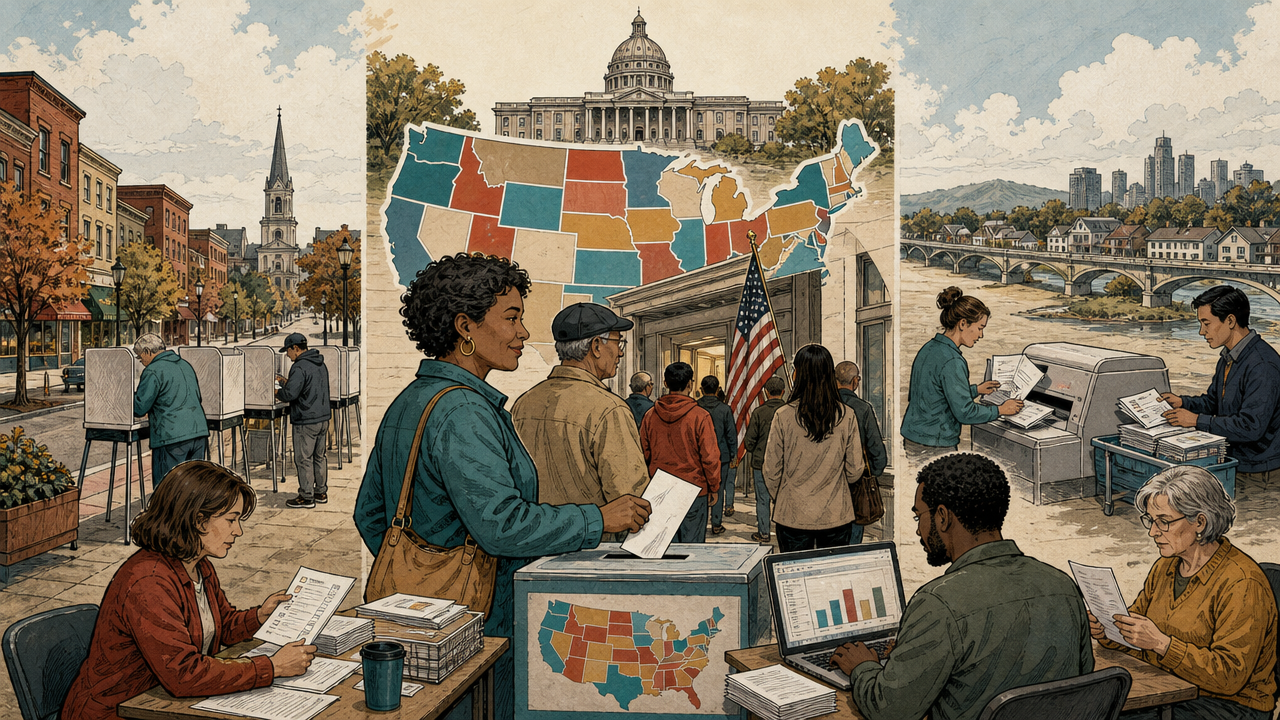
Election Day is here; voting locations, deadlines, and counting rules remain state-run
In effect: November 3, 2026, is the scheduled federal general-election date. State and local voting procedures are in force, but the exact rules, hours, and ballot deadlines differ by jurisdiction. Verify status
What happened
Tuesday, November 3, 2026, is the regularly scheduled federal general-election date. States and local election offices run the actual voting process: they set polling locations and hours under state law, handle ballots, and report and certify results on their own timelines.
What it means for voters
For workers juggling a shift, school pickup, or a long commute, the practical move is to check the official election office before heading out. A race being on a federal ballot does not mean Washington runs your polling place. Results reported tonight can be unofficial; counting, canvassing, and certification happen later under each state’s rules.
Save stories & follow topics · Link to this story
Get the context & analysis
Tuesday, November 3, 2026, is the regularly scheduled federal general-election date. States and local election offices run the actual voting process: they set polling locations and hours under state law, handle ballots, and report and certify results on their own timelines. The federal Election Assistance Commission advises voters to use their state election office to confirm where to vote and what identification, if any, is required.
What to watch
As of 2026-11-03, watch your state and county election office for polling-place updates, unofficial returns, ballot-curing notices where applicable, and the jurisdiction’s certification schedule. No single national certification date applies to every race.
Context from earlier events
No relevant context from earlier events was found.
Check sources (2)
Primary and independent sources
Voting; federal courts; election administration; worker protections California
Supreme Court leaves California ballot-processing rules in place; Ninth Circuit keeps protections for election workers
Challenged in court: The Supreme Court denied the emergency request for ballot segregation on November 2, 2026. The Ninth Circuit also denied a stay of the separate temporary order protecting election workers. The broader disputes remain in litigation. Verify status
What happened
On November 2, the U.S. Supreme Court denied the federal government’s emergency request to require California to segregate and not count mail ballots tied to a list of about 20,000 people the government described as likely noncitizens. Also on November 2, the Ninth U.S. Circuit Court of Appeals denied the administration’s request to pause a temporary order that bars threats, intimidation, or coercion of California election officials and workers over processing those ballots.
What it means for voters
For California voters, there was no court-ordered last-minute change requiring counties to pull aside these ballots before Election Day. For election workers, the Ninth Circuit decision means the temporary protection against pressure tied to ordinary ballot processing remains in place for now. That matters because county staff are the people doing the hands-on work of receiving, verifying, and counting ballots under state procedures.
Save stories & follow topics · Link to this story
Get the context & analysis
What to watch
As of 2026-11-03, watch for any further Justice Department appeal or a district-court ruling on the underlying cases. No later court date was confirmed in the records reviewed for this update.
Context from earlier events
This follows the Ninth Circuit’s October 30 denial of an emergency request to force ballot segregation before the election, as described in California’s November 2 release and the later Ninth Circuit order.
Check sources (3)
Primary and independent sources
- California Department of Justice Attorney General Bonta Secures Fourth Legal Victory as U.S. Supreme Court Delivers Final Blow to Trump Administration’s Emergency Court Efforts to Disrupt California Elections
- U.S. Court of Appeals for the Ninth Circuit Ninth U.S. Circuit Court of Appeals order in Case No. 26-7303
- Associated Press Supreme Court rejects Trump administration push to set aside thousands of California ballots
Voting; federal courts; Senate representation; ballot secrecy Alaska
Federal judge dismisses Justice Department bid to block possible Alaska Senate-race certification
Challenged in court: The federal district judge dismissed the Justice Department’s pre-election request on November 1, 2026. The department said it would appeal, so the litigation may continue even though the requested Election Day remedy was denied. Verify status
What happened
A federal judge dismissed the Justice Department’s lawsuit seeking to stop certification of Alaska’s U.S. Senate contest if incumbent Sen. Dan Sullivan lost and votes for another candidate, Daniel J. Sullivan, might have affected the result.
What it means for voters
Alaskans can vote under the state’s existing ballot and ranked-choice procedures today. The ruling did not decide whether anyone committed wrongdoing connected to the second candidate; it decided that the federal government had not secured the requested election-day remedy. For workers and families, the direct stake is that a late court fight did not create a new extra step at the ballot box.
Save stories & follow topics · Link to this story
Get the context & analysis
A federal judge dismissed the Justice Department’s lawsuit seeking to stop certification of Alaska’s U.S. Senate contest if incumbent Sen. Dan Sullivan lost and votes for another candidate, Daniel J. Sullivan, might have affected the result. The judge said the requested ballot segregation and investigation plan was infeasible after ballots had already been cast and did not provide a workable way to preserve ballot secrecy. The Justice Department said it planned to appeal.
What to watch
As of 2026-11-03, watch for a Justice Department appeal and for Alaska election officials’ normal count and certification notices. No new court deadline was confirmed in the sources reviewed.
Context from earlier events
The Alaska Supreme Court had previously rejected an earlier effort to keep Daniel J. Sullivan off the primary ballot, according to Associated Press reporting on the federal case.
Check sources (1)
Primary and independent sources
Voting; state government; taxes; representation Nationwide
Voters decide hundreds of state ballot measures, including taxes, voting rules, and redistricting
Proposed: As of Election Day, the statewide ballot measures are proposals awaiting votes and state-specific certification. Their effects differ by jurisdiction and measure text. Verify status
What happened
Voters in 39 states and the Northern Mariana Islands are deciding 146 statewide ballot measures on November 3, according to the National Conference of State Legislatures. The measures include questions about taxes, bonds, budgets, abortion, redistricting, and voter citizenship or identification rules.
What it means for voters
These questions can matter as much as candidate races because they may directly change a state constitution or law. Some deal with taxes or public borrowing, which can affect future public services and state budgets. Others could change future voting requirements, district maps, or healthcare rules. There is no one-size-fits-all household effect, so voters should check their own state’s official voter guide before assuming a national headline applies to them.
Save stories & follow topics · Link to this story
Get the context & analysis
Voters in 39 states and the Northern Mariana Islands are deciding 146 statewide ballot measures on November 3, according to the National Conference of State Legislatures. The measures include questions about taxes, bonds, budgets, abortion, redistricting, and voter citizenship or identification rules. The exact questions and legal effects depend on each state’s official ballot language.
What to watch
As of 2026-11-03, watch state election offices for official ballot-measure returns and later certification. A measure’s final legal effect may also depend on its wording, required vote threshold, court review, and any future implementation by the legislature or state agencies.
Context from earlier events
No relevant context from earlier events was found.
Check sources (2)
Healthcare; Medicaid; workplace rules; federal courts Nationwide
Federal court blocks stricter Medicaid exemption test for people with serious health conditions
Challenged in court: The court vacated and permanently enjoined the part of CMS’s interim final rule that added the significant-impairment test to the medical-frailty definition. Other challenged provisions remained intact, and the overall January 1, 2027, statutory implementation date was not changed. Verify status
What happened
On October 29, a federal judge in Massachusetts struck down part of a Centers for Medicare & Medicaid Services rule that required some people seeking the Medicaid “medically frail” exemption to show that a health condition significantly limited their ability to meet a work, school, or community-service requirement. The court left other parts of the rule in place, including a 12-month limit on certain claims data used to assess medical frailty and restrictions on self-attestation.
What it means for voters
For Medicaid enrollees with serious physical, mental-health, behavioral-health, or substance-use conditions, the ruling removes one extra federal test for the exemption. That could reduce the risk that someone who is legally exempt has to prove they are unable to work or volunteer in the specific way the blocked rule demanded. But the broader work requirements are not canceled, and states still have to build and run their own systems. People who may be affected should watch for notices from their state Medicaid agency rather than assume their status is automatic.
Save stories & follow topics · Link to this story
Get the context & analysis
On October 29, a federal judge in Massachusetts struck down part of a Centers for Medicare & Medicaid Services rule that required some people seeking the Medicaid “medically frail” exemption to show that a health condition significantly limited their ability to meet a work, school, or community-service requirement. The court left other parts of the rule in place, including a 12-month limit on certain claims data used to assess medical frailty and restrictions on self-attestation. The order says it does not change the congressionally set January 1, 2027, start date for Medicaid work requirements overall.
What to watch
The court gave states a six-month stay of enforcement concerning medical-frailty determinations to help with rollout errors or delays, while saying the January 1, 2027, implementation date for the broader work requirements remains unchanged. Watch for any appeal, later court order, or state Medicaid instructions explaining enrollment and exemption steps.
Context from earlier events
CMS issued the interim final rule in June 2026. The October 29 ruling addresses one part of that rule and does not erase the broader work-requirement law.
Check sources (3)
Primary and independent sources
- U.S. District Court for the District of Massachusetts Commonwealth of Massachusetts et al. v. Oz et al., Memorandum and Order on Cross-Motions for Summary Judgment
- Federal Register Medicaid Program; Implementation of Certain Provisions of H.R. 1
- Associated Press Judge blocks Trump administration's Medicaid rule forcing sick recipients to prove frailty
You're caught up on this briefing. Choose topics and save stories to return on your own schedule.
How this briefing was made
We used official records to verify government actions and independent reporting to add context. We also searched recent election-related videos on YouTube for topic leads. Search rank and popularity were not treated as proof or public opinion. We also checked recent uploads from preferred news and public-affairs channels on YouTube for topic leads. Channel preference was not treated as proof or an endorsement. Every included claim still had to be checked against the linked sources.