The daily civic brief
U.S. civic briefing
California courts block DOJ effort to separate disputed ballots and pressure election workers / Federal judge seeks details before deciding national election-administration case
Estimated 2-minute catch-up · 2 stories
Today's audio briefing
Today's spoken briefing
Hear the latest national briefing and what to watch next for every headline. A restrained instrumental bed plays in the web player.
Read the audio transcript
Voting; federal courts; election administration; worker protections California
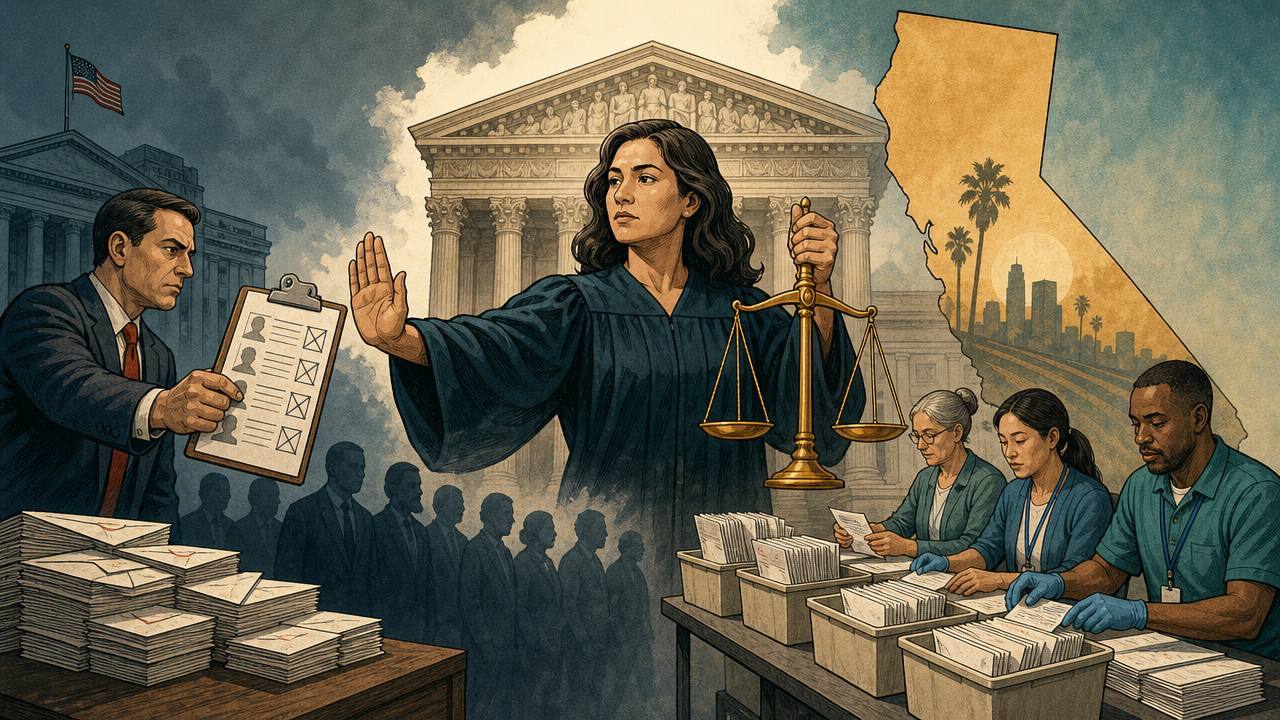
California courts block DOJ effort to separate disputed ballots and pressure election workers
Challenged in court: As of October 31, the Ninth Circuit had rejected the Justice Department’s request to segregate the disputed California ballots, and a federal district judge had barred cited threats or coercion of election workers over ballot processing. The broader disputes and appeals remain unresolved. Verify status
What happened
On October 31, the Ninth U.S. Circuit Court of Appeals refused the Justice Department’s request to make California set aside ballots connected to about 20,000 people the department says may not be U.S. citizens. Later that day, a federal district judge barred the department from threatening or coercing election workers to stop processing ballots or to separate or not count ballots based on the department’s list.
What it means for voters
For California voters, there is no cited court order telling counties to stop counting otherwise valid ballots because a name appears on the federal list. For the county workers who process votes, the October 31 order matters because it blocks the cited federal threats while the case continues. For working people voting around shifts, school pickup, or a long commute, the practical move is still simple: follow the county election office’s official instructions and make sure a mail ballot is returned by the state deadline.
Save stories & follow topics · Link to this story
Get the context & analysis
On October 31, the Ninth U.S. Circuit Court of Appeals refused the Justice Department’s request to make California set aside ballots connected to about 20,000 people the department says may not be U.S. citizens. Later that day, a federal district judge barred the department from threatening or coercing election workers to stop processing ballots or to separate or not count ballots based on the department’s list. California officials say the list is unreliable; the Justice Department says it is enforcing federal law against noncitizen voting.
What to watch
As of 2026-11-01, watch for any emergency appeal by the Justice Department, including a possible Supreme Court request, and for the federal courts’ next orders after Election Day. No later order changing California’s published voting procedures was located in this scan.
Context from earlier events
California had already won a district-court ruling against the requested ballot segregation on October 28. The October 31 appeals-court decision and the separate order protecting election workers are new developments.
Check sources (2)
Voting; federal courts; state authority; accountability Nationwide
Federal judge seeks details before deciding national election-administration case
Challenged in court: The case seeks to restrict specified federal election-related conduct. As of 2026-11-01, the cited reporting showed disclosure ordered and a ruling anticipated for November 2, but not a final nationwide injunction. Verify status
What happened
Chief U.S. District Judge James Boasberg ordered the Trump administration to identify states where it had pressured election officials over its effort to stop noncitizens from voting. Democratic Party leaders asked the court to block federal actions they say could interfere with state voter lists, ballot issuance, and vote counting.
What it means for voters
Election administration is usually handled by state and local officials. A nationwide court order could affect how much room federal agencies have to demand last-minute changes from state election offices. For voters, there is no cited nationwide order changing who can vote, where to vote, or how ballots are counted as of November 1. The immediate effect is legal uncertainty for officials, not a new voter requirement.
Save stories & follow topics · Link to this story
Get the context & analysis
Chief U.S. District Judge James Boasberg ordered the Trump administration to identify states where it had pressured election officials over its effort to stop noncitizens from voting. Democratic Party leaders asked the court to block federal actions they say could interfere with state voter lists, ballot issuance, and vote counting. The judge said he intended to rule by Monday, November 2, the day before Election Day. That was a stated plan, not a final ruling, as of November 1.
What to watch
Watch the U.S. District Court for the District of Columbia for Judge Boasberg’s expected decision on Monday, November 2. Any actual injunction should spell out which agencies and conduct it covers; until then, readers should rely on their own state or local election office for voting instructions.
Context from earlier events
The plaintiffs filed their suit on October 20, 2026, after federal actions involving California and other states. The October 29 hearing produced the order to identify additional states and the stated November 2 decision timeline.
Check sources (2)
You're caught up on this briefing. Choose topics and save stories to return on your own schedule.
How this briefing was made
We used official records to verify government actions and independent reporting to add context. We also searched recent election-related videos on YouTube for topic leads. Search rank and popularity were not treated as proof or public opinion. We also checked recent uploads from preferred news and public-affairs channels on YouTube for topic leads. Channel preference was not treated as proof or an endorsement. Every included claim still had to be checked against the linked sources.