The daily civic brief
U.S. Civic News Scan: Paychecks, Household Costs, and Voting
Today’s biggest practical stories include work authorization for Salvadorans with temporary legal status, a proposed $5,000 election-year payment that would need Congress to act, and court fights that could change which Missouri voters elect which House member. There are also new consumer-protection actions involving unauthorized card charges and health-app privacy rules. Several of these are not final laws, so the key question is who has the power to make the next decision: Congress, a court, a federal agency, or state election officials.
Today's audio briefing
Today's spoken briefing
Hear the latest national briefing and what to watch next for every headline. A restrained instrumental bed plays in the web player.
Jobs, work permits, immigration policy, and household stability Nationwide; especially communities with Salvadoran TPS holders
Salvadorans with temporary status can keep working for now, but the next federal decision is still unclear
What happened
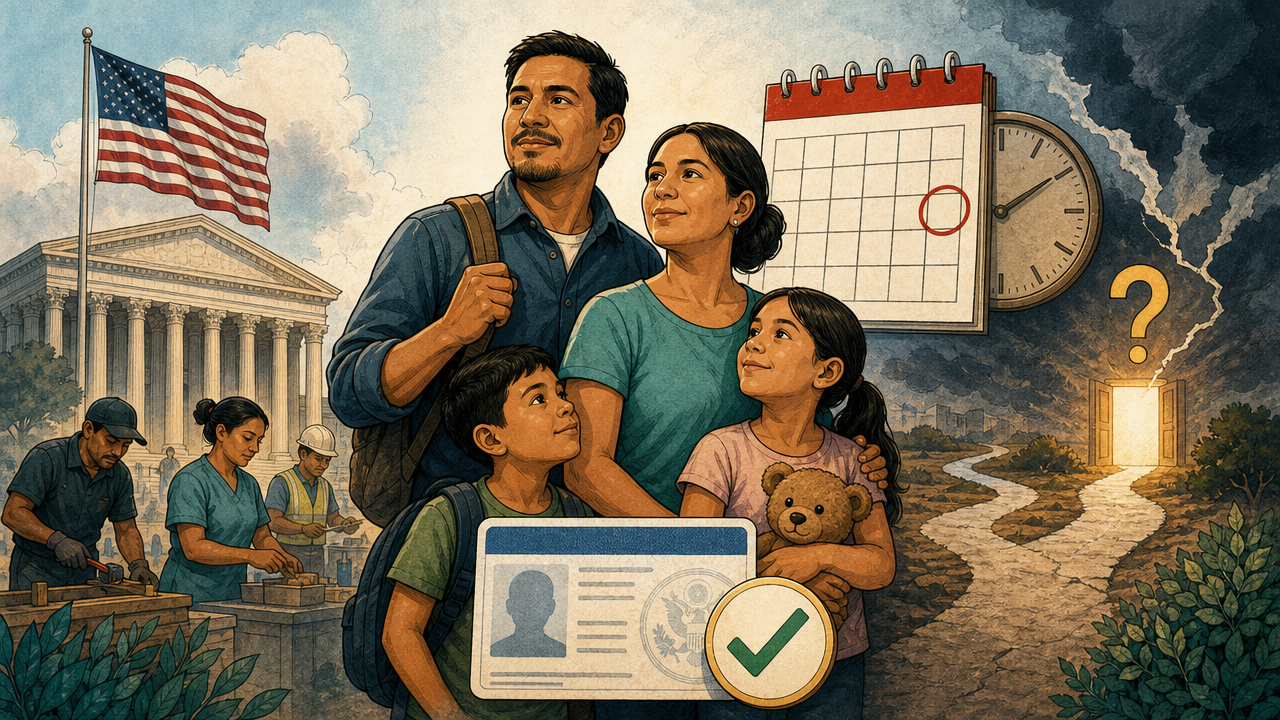
The Department of Homeland Security said Wednesday that Temporary Protected Status, or TPS, for Salvadorans would remain in effect while the department prepares an announcement. The program had been set to reach its current end date on September 9. TPS lets eligible people from El Salvador live and work legally in the United States for a limited period.
What it means for voters
This is an immediate paycheck issue for roughly 200,000 Salvadoran TPS holders and for employers that rely on their work. The department’s statement means people covered by TPS keep their protection for now, but families and employers still do not know how long it will last or what documents may be needed later. DHS, part of the executive branch, controls the designation decision; Congress wrote the underlying TPS law.
What to watch
Watch for a formal DHS or USCIS notice explaining whether TPS is extended, ended, or given a new transition period, and how work-permit documents will be handled.
Context from earlier events
El Salvador has had a TPS designation tied to major 2001 earthquakes, with extensions and legal disputes over the years. The current uncertainty followed DHS missing the usual deadline for announcing a decision before the September 9, 2026 end date.
Taxes, federal spending, inflation, and elections Nationwide
Trump’s proposed $5,000 ‘dividend’ is a campaign promise, not a payment program
What happened
President Trump said at a Republican midterm convention that every U.S. adult would receive $5,000 if Republicans keep control of Congress after the November election. No bill, payment formula, income cutoff, funding source, or implementation plan was released. The White House did not provide details when asked by the Associated Press.
What it means for voters
A $5,000 payment would matter a lot to household budgets if it became law. But it is not money people can claim or count on today. Congress controls federal spending, so lawmakers would need to pass legislation and provide funding. Independent estimates cited by AP put a universal adult payment above $1 trillion, which could add to federal borrowing or require new revenue, spending cuts, or both. Supporters may see direct payments as relief; critics may worry about cost and inflation. Those tradeoffs cannot be judged fully without a proposal.
What to watch
Watch for a written White House proposal, a bill in the House or Senate, and details about eligibility, payment timing, taxes, and how the program would be paid for.
Context from earlier events
Congress approved direct economic-impact payments during the COVID-19 emergency, but those payments were created through laws passed by Congress, not by a president acting alone.
Voting, redistricting, courts, and representation Missouri; national implications for control of the U.S. House
Missouri’s U.S. House map fight returns to the Supreme Court as ballot deadlines near
What happened
A federal appeals-court panel on September 9 left in place a federal judge’s order favoring Missouri’s newer congressional map. Opponents immediately appealed to the U.S. Supreme Court. That came one day after the Court declined to stop a Missouri Supreme Court decision saying the newer map could not be used while a referendum challenge remained unresolved.
What it means for voters
Missouri voters need to know their congressional district and which candidates will be on their ballot. The competing orders create confusion for voters, candidates, and county election workers. The outcome also matters nationally because every Missouri House seat counts toward which party controls the U.S. House. State lawmakers draw the map, Missouri courts interpret the state constitution and referendum process, and federal courts are now being asked to decide parts of the dispute. Overseas and military absentee ballots face a September 19 federal mailing deadline.
What to watch
Watch for emergency action by the U.S. Supreme Court and for Missouri election officials to announce which map and candidate lists they will use before absentee-ballot deadlines.
Context from earlier events
On September 3, the Missouri Supreme Court ordered the state to put the map referendum on the November ballot and barred use of the newer congressional map. The court said the older 2022 map was the only map then in effect.
Credit and debit cards, scams, and consumer protection Nationwide; federal case filed in Michigan
FTC settlement targets payment processor accused of enabling unauthorized charges
What happened
The Federal Trade Commission announced a proposed settlement with Humboldt Merchant Services, a payment processor. The FTC alleges that the company handled payments for more than 1,000 sham merchant accounts connected to unauthorized billing scams. Under the proposed order, Humboldt would pay $12 million and be permanently barred from processing payments for merchants considered at high risk for fraud.
What it means for voters
Unauthorized charges can drain checking accounts, trigger overdraft fees, and take time to dispute. This case does not automatically refund every customer who lost money, and the court still must enter the proposed order. Still, it is a reminder that people should review card and bank statements quickly and dispute charges they do not recognize. The FTC, an independent federal agency, enforces consumer-protection laws; the federal court has the final say on the order.
What to watch
Watch for the federal court’s action on the settlement and for FTC instructions on whether any consumer refund process will be created.
Context from earlier events
Payment companies sit between shoppers, banks, and sellers. Federal enforcement can require processors to screen businesses more carefully, but it does not by itself prevent every scam or unauthorized charge.
Sources
Health-data privacy, consumer protection, and federal regulation Nationwide
FTC withdraws an older health-app breach policy statement, while the underlying rule remains
What happened
The Federal Trade Commission rescinded a 2021 policy statement about when health apps and connected devices must report certain breaches of consumer health information. The FTC said its 2024 update to the Health Breach Notification Rule already covers health apps and devices such as fitness trackers, making the older policy statement unnecessary.
What it means for voters
For people using period trackers, symptom checkers, fitness devices, or other health apps, the immediate legal rule has not been repealed. The FTC says the 2024 rule remains in place. But taking away the older policy statement may change how clearly companies understand the agency’s enforcement approach. This is about privacy and control over sensitive information, not a new change in health insurance coverage or medical bills. The FTC controls its guidance and enforcement priorities, while courts would decide any disputed enforcement case.
What to watch
Watch for FTC enforcement actions or new guidance explaining how it will apply the 2024 Health Breach Notification Rule to apps and connected devices.
Context from earlier events
The FTC updated its Health Breach Notification Rule in 2024 to expressly cover many health apps and connected devices that hold sensitive health information outside traditional medical-record systems.
Voting, representation, and national elections New Hampshire; national implications for Senate control
New Hampshire primary sets a major U.S. Senate race for November
What happened
New Hampshire voters chose former U.S. Sen. John E. Sununu as the Republican nominee for the state’s open U.S. Senate seat. He will face Democratic U.S. Rep. Chris Pappas in the November 3 general election. The seat is open because Sen. Jeanne Shaheen is retiring.
What it means for voters
This is one of the Senate races that could help determine which party controls the chamber. That matters for federal judges, cabinet confirmations, tax and spending bills, health policy, and other laws that affect households nationwide. New Hampshire voters made the nomination choice in the state-run primary; all eligible voters will decide the seat in the November general election.
What to watch
Watch the November 3 general election, including candidate positions on wages, taxes, healthcare costs, housing, and federal spending. Also watch whether outside groups add money to the race.
Context from earlier events
Sununu previously represented New Hampshire in the Senate before losing reelection in 2008. Pappas has represented New Hampshire in the U.S. House since 2019.
How this briefing was made
We used official records to verify government actions and independent reporting to add context. We also checked popular political videos on YouTube for topic leads. Popularity helped us decide what to investigate, but it was not treated as proof or public opinion. Every included claim still had to be checked against the linked sources.