The daily civic brief
U.S. Civic Daily Scan — September 4, 2026
Today’s biggest household-facing civic stories are about childcare help, the cost of borrowing, rural healthcare access, and the rules for casting a mail ballot. The common thread is that federal decisions often set the money or the baseline rules, while states and local agencies decide how services and elections work on the ground. A popular video lead about a driver passing a stopped school bus was checked first, but it did not point to a verified public-policy development with national briefing value, so it is not included.
Estimated 5-minute catch-up · 7 stories
Today's audio briefing
Today's spoken briefing
Hear the latest national briefing and what to watch next for every headline. A restrained instrumental bed plays in the web player.
A verbatim transcript is unavailable for this edition. Read the written briefing below.
Childcare costs, work, state services, and federal funding Nationwide; examples include Indiana, Minnesota, and California
Childcare-aid waitlists now reach hundreds of thousands of children
What happened
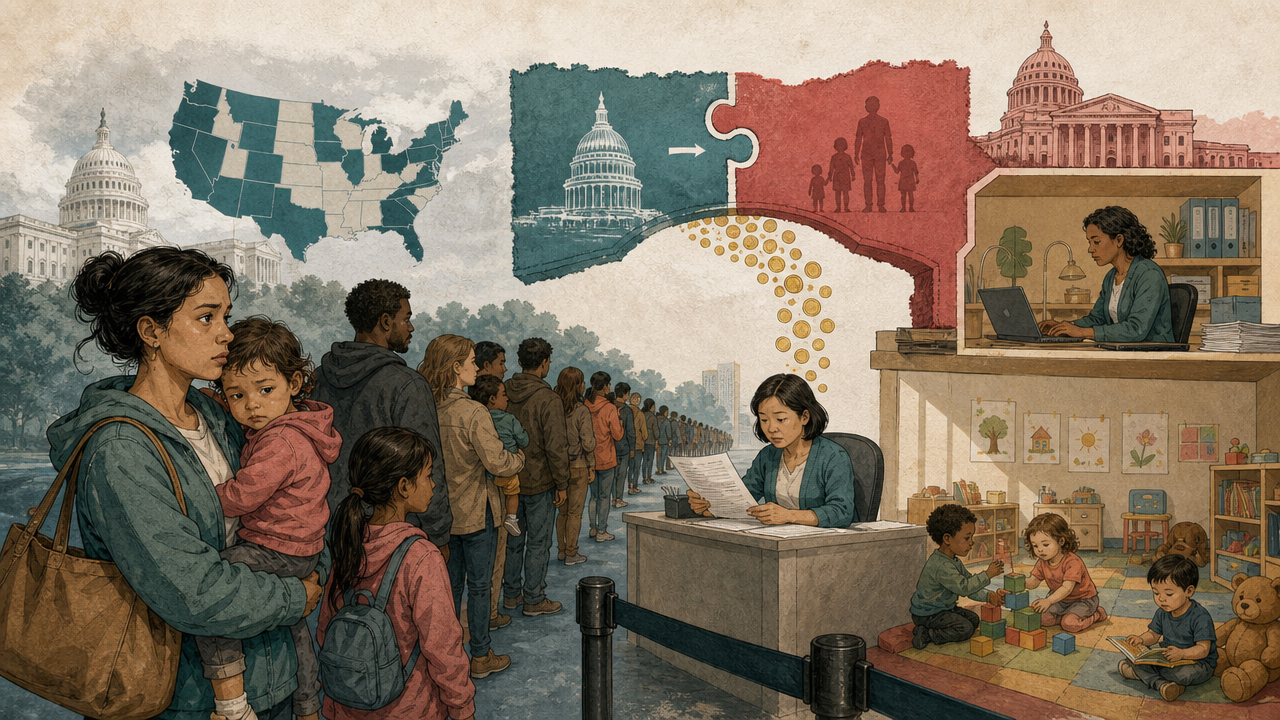
Associated Press reporting found that, as of this spring, hundreds of thousands of children were on childcare-assistance waitlists in 23 states and Washington, D.C. Families who qualify can still be waiting because these programs have limited funding. The assistance is federally funded with state participation, and states run enrollment and waitlists.
What it means for voters
For parents, this can decide whether a job, more work hours, or school is possible. Families on a waitlist may have to pay full daycare prices, cut work hours, rely on relatives, or go without other basics. This is not one new nationwide cutoff rule: the immediate effect depends on the state. Congress controls the main federal funding level, while governors and state legislatures can add state money or change how their programs prioritize families.
Save stories & follow topics · Link to this story
Get the context & analysis
What to watch
Watch state budget decisions and the next federal spending negotiations before the current stopgap funding law expires on December 11, 2026. Also watch whether states shorten waitlists, especially for foster families, homeless families, and parents required to work or attend school.
Context from earlier events
The reporting traces many growing waitlists to the expiration of $28 billion in temporary pandemic-era childcare aid in fall 2024. Congress did not renew that extra funding.
Check sources (1)
Primary and independent sources
Inflation, mortgages, car loans, credit cards, and independent government Washington, D.C.; nationwide effect
Federal Reserve governor says the next inflation report could shape a September rate vote
What happened
Federal Reserve Governor Christopher Waller said September 3 that he would lean toward holding interest rates steady if August inflation data show continued improvement. But he said he could support a rate increase if inflation comes in stronger than expected.
What it means for voters
The Fed does not directly set your mortgage or credit-card rate, but its decisions influence the borrowing costs banks and lenders charge. A rate increase can make new car loans, credit-card balances, business loans, and some mortgages more expensive over time. Holding rates steady would not automatically lower bills, especially for people with existing high-rate debt.
Save stories & follow topics · Link to this story
Get the context & analysis
Federal Reserve Governor Christopher Waller said September 3 that he would lean toward holding interest rates steady if August inflation data show continued improvement. But he said he could support a rate increase if inflation comes in stronger than expected. The Fed’s next policy meeting is September 15-16.
What to watch
The Bureau of Labor Statistics is scheduled to release the August Consumer Price Index on September 11. Then the Federal Open Market Committee will decide whether to hold or change its benchmark rate on September 15-16.
Context from earlier events
The Fed is independent from the White House and Congress in its interest-rate decisions. Individual governors can explain their views, but the rate is set by a committee vote.
Check sources (2)
Voting, mail ballots, Postal Service operations, and federal courts North Carolina; nationwide implications
North Carolina begins sending mail ballots while federal court fights continue
What happened
North Carolina is beginning broad mail-ballot distribution for the November midterm election. State election officials say voting by mail remains available under current state rules.
What it means for voters
For voters who use absentee or mail ballots because of work schedules, disability, military service, travel, or distance from a polling place, the practical message is simple: follow your state and local election office’s current instructions. The court fight has not itself canceled mail voting. States run elections, while Congress can alter rules for federal elections; the central legal dispute is whether a president and federal agencies can impose these changes on their own.
Save stories & follow topics · Link to this story
Get the context & analysis
North Carolina is beginning broad mail-ballot distribution for the November midterm election. State election officials say voting by mail remains available under current state rules. Meanwhile, the Trump administration is asking the U.S. Supreme Court to remove a lower-court block on parts of the administration’s proposed federal mail-ballot system.
What to watch
Watch for Supreme Court action and for any official instruction from your state or county election office. The next key dates are each state’s ballot-mailing, registration, request, and return deadlines—not social-media claims about a nationwide change.
Context from earlier events
The Supreme Court’s late-August emergency order did not decide whether the administration’s mail-voting order is legal. It found that the states in one case could not bring that particular challenge at that stage, leaving other cases active.
Check sources (3)
Primary and independent sources
- Associated Press Mail ballots start to go to voters as Trump injects uncertainty
- Associated Press Trump again appeals to Supreme Court on mail-voting restrictions with midterm elections looming
- Associated Press Supreme Court sides with Trump administration on mail voting restrictions ahead of midterms
Voting, redistricting, state courts, and representation Missouri; national House representation
Missouri Supreme Court says older congressional map must be used in November unless voters approve the new one
What happened
Missouri’s Supreme Court unanimously ruled September 3 that a referendum on the state’s new congressional map is allowed under the Missouri Constitution. The court said the newer map cannot be used in the November general election unless voters approve it first.
What it means for voters
Congressional maps decide which communities vote together and which candidate appears on a voter’s U.S. House ballot. This ruling changes the districts Missouri will use in November unless a higher court changes the result. It also puts the new map itself before Missouri voters, giving them a direct say on a state Legislature decision.
Save stories & follow topics · Link to this story
Get the context & analysis
Missouri’s Supreme Court unanimously ruled September 3 that a referendum on the state’s new congressional map is allowed under the Missouri Constitution. The court said the newer map cannot be used in the November general election unless voters approve it first. The map adopted after the 2020 census remains in effect for now.
What to watch
Missouri election officials must finalize the November ballot and administer the general election using the older map under the state court’s ruling. The state attorney general has said she plans to appeal, so any federal-court filing or U.S. Supreme Court action is worth watching.
Context from earlier events
Congressional lines are usually redrawn after each census. Missouri’s dispute is part of an unusual round of mid-decade map changes that could affect control of the U.S. House.
Check sources (2)
Healthcare access, maternal care, rural jobs, and federal spending Indiana; part of a nationwide rural-health program
Indiana receives $120 million for rural healthcare projects
What happened
The Centers for Medicare & Medicaid Services announced September 3 that Indiana will receive $120 million through the federal Rural Health Transformation Program. Indiana plans to use the money across eight regional coalitions for maternal and infant care, primary and behavioral healthcare, transportation to appointments, workforce training, nutrition support, and telehealth-related services.
What it means for voters
This does not change every Indiana resident’s insurance premium or guarantee a new local clinic tomorrow. But it can help rural communities build services that reduce long drives, missed appointments, and staffing gaps. Congress created and funded the program; CMS distributes and oversees the federal money; Indiana and local regional groups choose and carry out projects.
Save stories & follow topics · Link to this story
Get the context & analysis
What to watch
Watch for Indiana’s regional grant details, contracts, service start dates, and public reporting on whether the money produces more appointments, workers, transportation options, or local care capacity.
Context from earlier events
The program is being rolled out state by state. Funding levels and projects vary, so a federal announcement does not mean every rural community receives the same support.
Check sources (2)
Federal infrastructure, drinking water, fisheries, jobs, and accountability Illinois, Michigan, and the Great Lakes region
Great Lakes invasive-carp barrier work resumes after federal stop-work order is lifted
What happened
Work may resume on the Brandon Road Interbasin Project near Joliet, Illinois, after the Trump administration lifted a stop-work order this week. The Army Corps project is designed to keep invasive carp from reaching the Great Lakes.
What it means for voters
This is not a change to anyone’s bill today. The long-term stakes are larger: invasive carp could damage Great Lakes fisheries, recreation, and connected local businesses, and officials say the project also matters for water protection. The federal government funds and manages the Army Corps work, while Illinois and Michigan have major direct interests because the project site and the threatened waters are in their region.
Save stories & follow topics · Link to this story
Get the context & analysis
Work may resume on the Brandon Road Interbasin Project near Joliet, Illinois, after the Trump administration lifted a stop-work order this week. The Army Corps project is designed to keep invasive carp from reaching the Great Lakes. The project had been paused since July without a public explanation, according to reporting from the Associated Press.
What to watch
Watch for a public Army Corps schedule, an explanation for the earlier pause, and whether work continues without another interruption. Congress can also press the agency for details because it authorized and funded the project.
Context from earlier events
Illinois, Michigan, and the Army Corps have spent years planning a mix of barriers and deterrents at a key waterway connection near Chicago.
Check sources (2)
Primary and independent sources
Utilities, data centers, local participation, air permits, and state authority Nationwide; implementation would vary by state and locality
EPA proposal would leave public-notice rules for many smaller air permits to states and local agencies
What happened
The Environmental Protection Agency has proposed ending the minimum federal requirement that states and local agencies give the public notice and a chance to comment before issuing certain smaller-source air permits. The proposal does not change pollution limits itself.
What it means for voters
The rule could affect whether families hear early about nearby projects such as data-center generator systems, industrial expansions, or other facilities that need a minor air permit. Supporters say it could speed projects and reduce paperwork. Critics say it could make it harder for residents to know about projects that may affect local air quality, power demand, water use, traffic, or property concerns. Nothing has changed yet because this remains a proposal.
Save stories & follow topics · Link to this story
Get the context & analysis
The Environmental Protection Agency has proposed ending the minimum federal requirement that states and local agencies give the public notice and a chance to comment before issuing certain smaller-source air permits. The proposal does not change pollution limits itself. It would let state and local air agencies decide whether and how to provide public participation for these permits.
What to watch
Watch for EPA’s final rule or withdrawal of the proposal. Also watch your state and local air agencies: even if EPA removes the federal minimum, they can keep or strengthen their own notice and comment rules.
Context from earlier events
Most of these permits are issued by state, local, or tribal air agencies under federally approved programs. That makes this a federal rule change with very different local effects.
Check sources (2)
You're caught up on this briefing. Choose topics and save stories to return on your own schedule.
How this briefing was made
We used official records to verify government actions and independent reporting to add context. We also checked popular political videos on YouTube for topic leads. Popularity helped us decide what to investigate, but it was not treated as proof or public opinion. Every included claim still had to be checked against the linked sources.