The daily civic brief
U.S. Civic Daily Scan — October 19, 2026
As of October 19, 2026, early-voting windows are opening or approaching in several states, making the next two weeks a key time for voters to check their local rules. On the household side, September’s inflation report showed a sharp jump in gas prices, while federal actions on insurance tax credits, Medicare payments, housing finance, and hurricane-related healthcare could affect specific groups of families.
Estimated 4-minute catch-up · 6 stories
Today's audio briefing
Today's spoken briefing
Hear the latest national briefing and what to watch next for every headline. A restrained instrumental bed plays in the web player.
Read the audio transcript
Voting; election administration; voter access Connecticut and Florida, with nationwide election-administration relevance
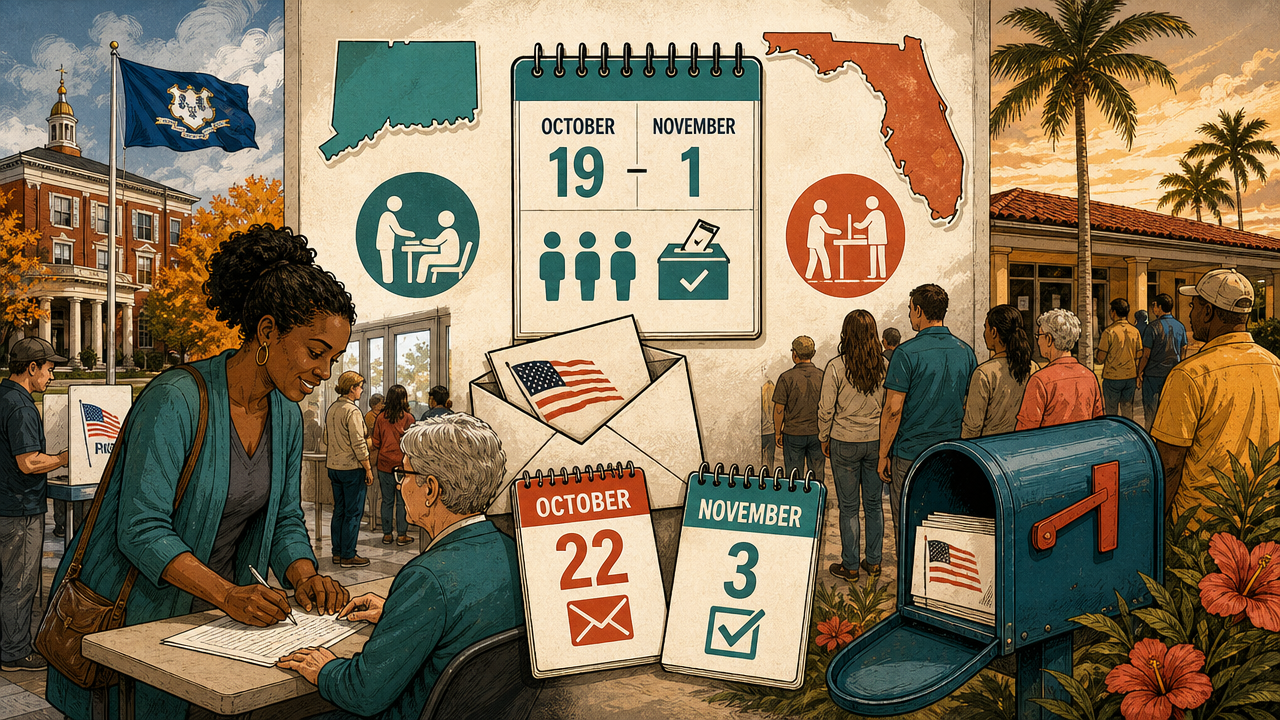
Early voting opens in Connecticut and Florida counties; key vote-by-mail deadlines are close
In effect: Connecticut’s October 19-November 1 early-voting and same-day-registration period is in effect for the November 3, 2026 election. Florida’s statewide calendar sets an October 22 mail-ballot request deadline, while counties set their own permitted early-voting days and sites. Verify status
What happened
As of October 19, Connecticut’s general-election early-voting period is open through November 1, and early-voting sites also offer same-day voter registration. In Florida, counties set their own early-voting schedules within the state’s allowed period; Hillsborough County, for example, is open for early voting from October 19 through November 1.
What it means for voters
For people working long shifts, handling school pickups, or commuting, early voting can be the more practical option than waiting for Election Day. Connecticut voters who need to register or update their registration can do that at an early-voting site during the stated period. Florida voters who need a ballot mailed to them have a short window left to make that request, but local county rules and locations matter.
Save stories & follow topics · Link to this story
Get the context & analysis
As of October 19, Connecticut’s general-election early-voting period is open through November 1, and early-voting sites also offer same-day voter registration. In Florida, counties set their own early-voting schedules within the state’s allowed period; Hillsborough County, for example, is open for early voting from October 19 through November 1. Florida’s deadline to request a mail ballot is October 22, and Election Day is November 3.
What to watch
As of 2026-10-19, Florida’s statewide mail-ballot request deadline is October 22, 2026. Connecticut early voting and same-day registration continue through November 1, 2026; voters should confirm their town’s site and hours with local election officials.
Context from earlier events
:null
Everyday prices; commuting; rent; household budgets Nationwide
September inflation rose 0.6%, with gasoline driving much of the jump
In effect: This is a current federal statistical release, not a new price-control policy. The September 2026 CPI figures were published October 14, 2026. Verify status
What happened
The Consumer Price Index rose 0.6% in September and 3.7% over the prior 12 months, according to the Bureau of Labor Statistics. Gasoline rose 9.1% in September and was responsible for more than half of the monthly overall increase.
What it means for voters
Higher gas prices can hit fast because workers may need fuel to get to a job, school, appointments, or a second shift. The report does not say what any one family spends, and it does not prove every local price moved the same way. Still, it shows that transportation and housing costs were adding pressure even though grocery prices, on average, did not rise in September.
Save stories & follow topics · Link to this story
Get the context & analysis
The Consumer Price Index rose 0.6% in September and 3.7% over the prior 12 months, according to the Bureau of Labor Statistics. Gasoline rose 9.1% in September and was responsible for more than half of the monthly overall increase. Food prices were flat for the month, while shelter rose 0.4%; over 12 months, food rose 2.5%, shelter 3.2%, and energy 20.4%.
What to watch
BLS is scheduled to release the October 2026 CPI report on November 10, 2026. That will show whether September’s gasoline-driven jump carried into October.
Context from earlier events
:null
Check sources (2)
Healthcare costs; taxes; Affordable Care Act Marketplace Nationwide
IRS proposal would carry out tighter Marketplace premium-tax-credit rules
Proposed: The October 15 notice is a proposed IRS rule, with comments due November 30, 2026. It describes both proposed regulations and statutory changes that the agencies say already supersede conflicting older regulations for relevant tax and plan years. Verify status
What happened
Treasury and the IRS published a proposed rule on October 15 about the premium tax credit, which helps eligible people pay for Marketplace health insurance. The proposal addresses eligibility, how the credit is calculated, verification for advance credits, and tax liability when too much advance credit was paid.
What it means for voters
This matters most to people who buy their own health insurance through a Marketplace rather than getting coverage through an employer, Medicare, or Medicaid. A lower or lost tax credit can mean a higher monthly premium, while stronger verification can require more paperwork before subsidies are applied. The proposal itself is not the final rule, and the exact effect depends on income, household members, immigration status, state Medicaid rules, and the plan chosen.
Save stories & follow topics · Link to this story
Get the context & analysis
Treasury and the IRS published a proposed rule on October 15 about the premium tax credit, which helps eligible people pay for Marketplace health insurance. The proposal addresses eligibility, how the credit is calculated, verification for advance credits, and tax liability when too much advance credit was paid. Some underlying statutory changes already apply under the law cited by the rule, while other proposed regulatory provisions would apply later if finalized.
What to watch
Written comments are due to the IRS by November 30, 2026. Treasury has scheduled a public hearing for December 8, 2026, at 10 a.m. Eastern, unless no one asks to speak.
Context from earlier events
:null
Check sources (2)
Healthcare costs; Medicare; retirement income Nationwide
Eligible Original Medicare enrollees are receiving a one-time $90 payment this month
In effect: CMS states that the one-time $90 premium rebate is being issued in October 2026 to eligible Original Medicare Part B beneficiaries, with paper checks due later in the month for some recipients. Verify status
What happened
CMS says eligible people with Original Medicare Part B will receive a one-time $90 payment in October 2026. Eligibility is limited to people living in the United States who have Original Medicare Part B, do not receive Medicaid premium assistance, and do not pay the income-related monthly adjustment amount.
What it means for voters
For an eligible retiree or worker with a disability, $90 can help with a premium, a prescription, a utility bill, or groceries. But it is a one-time payment, not a permanent benefit increase. Medicare Advantage enrollees and many low-income people receiving Medicaid premium assistance are excluded, so households should not assume every person on Medicare gets it.
Save stories & follow topics · Link to this story
Get the context & analysis
CMS says eligible people with Original Medicare Part B will receive a one-time $90 payment in October 2026. Eligibility is limited to people living in the United States who have Original Medicare Part B, do not receive Medicaid premium assistance, and do not pay the income-related monthly adjustment amount. CMS says most direct deposits were expected around October 8; paper checks from Treasury are expected later in October.
What to watch
As of 2026-10-19, eligible people who have not received a direct deposit may still receive a Treasury paper check later in October. CMS says beneficiaries can call 1-800-MEDICARE about eligibility and the Social Security Administration beginning October 15 about payment status.
Context from earlier events
The Medicare Improvement Fund was created by Congress in 2008. The Associated Press reported that it had previously been used for other Medicare-related purposes, while this is the first direct payment to beneficiaries under the current administration’s use of the fund.
Check sources (2)
Housing; rent; federal housing finance Nationwide
FHA expands insured financing for build-to-rent communities
In effect: HUD says the FHA financing update for qualifying build-to-rent communities took effect immediately on October 14, 2026. Actual construction, refinancing, and any local rental effect depend on separate project and local approvals. Verify status
What happened
HUD announced October 14 that FHA will allow eligible build-to-rent communities to qualify for FHA-insured financing through two multifamily mortgage-insurance programs. The policy covers rental developments made up of single-family homes, duplexes, or triplexes, including site-built and manufactured homes.
What it means for voters
More financing options could make some rental construction or refinancing easier, which may add supply over time in places where developers use these FHA programs. But this is not a rent cap, a voucher expansion, or an immediate rent reduction. A family renting now should not expect this announcement alone to lower next month’s lease payment.
Save stories & follow topics · Link to this story
Get the context & analysis
HUD announced October 14 that FHA will allow eligible build-to-rent communities to qualify for FHA-insured financing through two multifamily mortgage-insurance programs. The policy covers rental developments made up of single-family homes, duplexes, or triplexes, including site-built and manufactured homes. HUD says the change is effective immediately.
What to watch
Watch for FHA lender guidance, project applications, and local development proposals using the Section 221(d)(4) and Section 223(f) programs. HUD did not provide a national estimate of rent changes or new units from this policy.
Context from earlier events
:null
Check sources (2)
Healthcare access; disaster response; public services Florida and Alabama, with federal disaster-response relevance
Federal health emergency brings care flexibilities to hurricane-affected Florida and Alabama
In effect: HHS declared the public health emergencies on October 13, 2026, with stated retroactive dates of October 6 in Florida and October 7 in Alabama. CMS says related provider and beneficiary flexibilities are available in affected areas. Verify status
What happened
HHS declared public health emergencies for Hurricane Isaias impacts in Florida and Alabama, and CMS announced related health-system flexibilities. The actions are retroactive to October 6 in Florida and October 7 in Alabama.
What it means for voters
For workers and families dealing with evacuation, damaged homes, missed appointments, or closed clinics, the biggest value is keeping care from falling through the cracks. This does not automatically erase medical bills or guarantee coverage, but it can give hospitals, providers, Medicaid and CHIP agencies, and Marketplace consumers extra tools during a disruption.
Save stories & follow topics · Link to this story
Get the context & analysis
HHS declared public health emergencies for Hurricane Isaias impacts in Florida and Alabama, and CMS announced related health-system flexibilities. The actions are retroactive to October 6 in Florida and October 7 in Alabama. CMS says providers can use certain waivers and flexibilities, and that affected people may have options to maintain care, including help with dialysis access and certain Marketplace enrollment problems tied to the disaster.
What to watch
As of 2026-10-19, affected residents should watch state emergency agencies, insurers, providers, and CMS for county-specific service updates. CMS says people who missed a Marketplace enrollment opportunity because of a FEMA-designated emergency may contact the Marketplace Call Center to ask about a special enrollment period.
Context from earlier events
:null
Check sources (2)
Primary and independent sources
You're caught up on this briefing. Choose topics and save stories to return on your own schedule.
How this briefing was made
We used official records to verify government actions and independent reporting to add context. We also searched recent election-related videos on YouTube for topic leads. Search rank and popularity were not treated as proof or public opinion. Every included claim still had to be checked against the linked sources.