The daily civic brief
U.S. Civic & Pocketbook Scan — October 18, 2026
As of October 18, voting operations are the biggest immediate civic story: Texas early voting starts Monday, election offices are responding to security incidents, and North Carolina is pushing back on a false ballot claim. For household budgets, Medicare open enrollment is underway and a new federal health-price rule is on track to take effect later this year. The latest federal jobs report also shows a labor market that added little in September, with hours holding steady.
Estimated 5-minute catch-up · 7 stories
Today's audio briefing
Today's spoken briefing
Hear the latest national briefing and what to watch next for every headline. A restrained instrumental bed plays in the web player.
Read the audio transcript
Voting; election administration; voter registration Texas
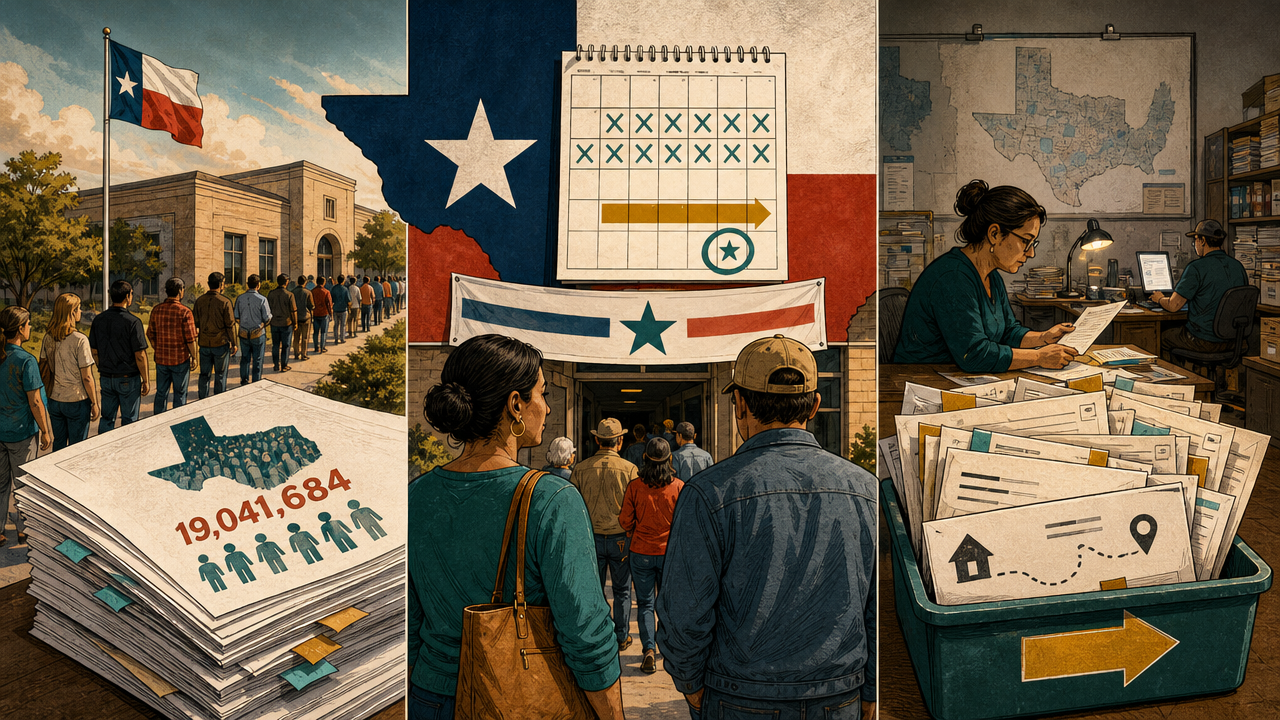
Texas early voting starts Monday after a new voter-record backlog surfaced
In effect: Texas's early-voting schedule and identification rules are in force for the November 3, 2026 election. Early voting begins October 19; the separate record-processing problems are administrative issues, not a court ruling changing the schedule. Verify status
What happened
Texas says it has 19,041,684 registered voters, a state record, and early in-person voting for the November 3 general election begins Monday, October 19, and runs through October 30. This comes after state officials said counties had cleared an earlier registration backlog, but Votebeat reported on October 16 that another state error left some counties with thousands of delayed voter address updates to process before early voting.
What it means for voters
For people working long shifts, commuting, or juggling child care, early voting can offer more choices than Election Day. But an address-update problem can matter if a voter moved, needs the right local ballot, or shows up unsure where they are registered. Texans who are unsure should check their registration with their county election office before going. Texas says people who cannot reasonably obtain an accepted photo ID may be able to use a Reasonable Impediment Declaration with a supporting document. The registration deadline for this election was October 5, so a new registration cannot be added for this election now.
Save stories & follow topics · Link to this story
Get the context & analysis
Texas says it has 19,041,684 registered voters, a state record, and early in-person voting for the November 3 general election begins Monday, October 19, and runs through October 30. This comes after state officials said counties had cleared an earlier registration backlog, but Votebeat reported on October 16 that another state error left some counties with thousands of delayed voter address updates to process before early voting. The state has said voters can use any early-voting location in their county of registration.
What to watch
On October 19, watch whether county election offices report problems locating voters or processing address changes as early voting opens. The last day to apply for a Texas mail ballot is October 23, and early voting ends October 30.
Context from earlier events
On October 15, state officials said counties had cleared the earlier backlog tied to the Department of Public Safety portal. The newly reported address-update backlog is a separate, later operational problem.
Check sources (4)
Primary and independent sources
- Texas Secretary of State Secretary Howden Announces Texas Has a Record 19 Million Registered Voters
- Texas Secretary of State Important Election Dates
- Votebeat Texas has a new backlog of voter address updates due to another state error
- Associated Press Massive Texas backlog of voter registrations that scrambled workers has been cleared, state says
Voting; election security; public safety Nationwide
Suspicious letters disrupt election offices as federal investigators look for sender
In effect: Federal law-enforcement agencies are actively investigating the mailings, while state and local offices continue their existing election-security procedures. This is an enforcement response, not a new national voting rule. Verify status
What happened
The FBI and U.S. Postal Inspection Service are investigating suspicious mail sent to offices around the country, including state and local election offices. The Associated Press reported that some letters contained an unknown substance, prompting evacuations at election offices in at least Louisiana and Oklahoma; Wisconsin said testing found the powder in its letter was not hazardous.
What it means for voters
Election workers are local public employees trying to keep polling places, mail ballots, and vote counts moving. A threat can pull staff away from regular work, force an evacuation, and add stress during the busiest part of the election calendar. The public record so far does not show altered ballots or a change in voting rules from these mailings. For voters, the practical move is to rely on a county or state election office for any change in location, hours, or ballot instructions—not a social-media post or forwarded message.
Save stories & follow topics · Link to this story
Get the context & analysis
The FBI and U.S. Postal Inspection Service are investigating suspicious mail sent to offices around the country, including state and local election offices. The Associated Press reported that some letters contained an unknown substance, prompting evacuations at election offices in at least Louisiana and Oklahoma; Wisconsin said testing found the powder in its letter was not hazardous. Election-administrator groups said offices have security plans and are working with law enforcement while continuing election operations.
What to watch
Watch for statements from the FBI, Postal Inspection Service, and affected state election offices identifying the sender, testing results, or any voting-site changes. No nationwide voting disruption has been announced as of October 18.
Context from earlier events
Similar powder mailings reached election offices in several states in 2023, according to the Associated Press. That history helps explain why offices are treating the current letters as serious operational threats.
Voting; election equipment; election security Maricopa County, Arizona
Arizona officials replace ballot printers after after-hours access report
In effect: Maricopa County's equipment-security procedures were used: the machines were removed, replaced, and referred for examination. The investigation is ongoing; it has not produced a finding of tampering. Verify status
What happened
Maricopa County's Recorder's Office said an election inspector found that paper trays on three ballot-on-demand printers at the Chandler-Gilbert Community College early-voting site appeared to have been opened overnight on October 15. The county replaced the printers, sent the original machines for forensic examination, and notified the sheriff's office.
What it means for voters
This is the kind of incident that deserves a quick, documented response without jumping to conclusions. For voters at that site, the county says voting was not interrupted and no ballots were affected. The important public question is whether the county's investigation confirms a mistake or finds unauthorized access, and whether officials explain the result clearly enough that voters know what happened.
Save stories & follow topics · Link to this story
Get the context & analysis
Maricopa County's Recorder's Office said an election inspector found that paper trays on three ballot-on-demand printers at the Chandler-Gilbert Community College early-voting site appeared to have been opened overnight on October 15. The county replaced the printers, sent the original machines for forensic examination, and notified the sheriff's office. Officials said the trays were empty because ballot paper is removed and secured nightly, voting continued without interruption, and no voters were affected. The cause remains under investigation and officials said it could have been human error.
What to watch
Watch for the Maricopa County Recorder's Office and sheriff's office to release the forensic findings. As of October 18, no one has been publicly identified and no evidence has been reported that ballots or vote totals were changed.
Context from earlier events
No relevant context from earlier events was found.
Check sources (2)
Voting; election information; ballot counting North Carolina
North Carolina election board says poll-worker marks do not void ballots
In effect: The ballot-handling practices described by the State Board are current election procedures during North Carolina's 2026 general-election early-voting period. Verify status
What happened
North Carolina's State Board of Elections says a resurfacing social-media claim is false: a ballot is not disqualified just because an election worker writes on it. The board says workers may add legally required notes or sorting marks to early, mail, or provisional ballots.
What it means for voters
A bad voting tip can create a real hassle. A voter who wrongly demands a replacement ballot may slow down their own trip and the line behind them. If a poll worker marks a ballot or explains that a mark is needed, that alone is not a sign the ballot will be rejected. If a voter thinks there is a real problem, they can ask election staff for an explanation or contact their county board rather than relying on a viral post.
Save stories & follow topics · Link to this story
Get the context & analysis
North Carolina's State Board of Elections says a resurfacing social-media claim is false: a ballot is not disqualified just because an election worker writes on it. The board says workers may add legally required notes or sorting marks to early, mail, or provisional ballots. It says stray marks do not prevent tabulation unless they affect the ballot's timing bars or the ovals used to record choices. In-person early voting in North Carolina began October 15 and ends October 31.
What to watch
North Carolina's absentee-ballot request deadline is October 20, and in-person early voting ends October 31. Watch the State Board and county boards for any new voter alerts as voting continues.
Context from earlier events
No relevant context from earlier events was found.
Check sources (2)
Healthcare costs; Medicare; prescription drugs Nationwide
Medicare open enrollment is open for 2027 coverage choices
In effect: Medicare's annual enrollment period for Medicare Advantage and Part D began October 15, 2026 and ends December 7, 2026. The plan premiums and benefits cited by CMS are projections and vary by plan and place. Verify status
What happened
Medicare open enrollment began October 15 and runs through December 7 for 2027 Medicare Advantage and Part D drug coverage. CMS says people can compare plans' premiums, drug coverage, provider networks, and benefits through Medicare Plan Finder or by calling 1-800-MEDICARE.
What it means for voters
This is a real budget check for retirees, people with disabilities, and working families helping a parent manage care. Even when an average national premium looks steady, a person's own plan may change its doctor network, drug list, deductible, copay, or monthly cost. People who want to keep their current coverage generally do not need to re-enroll, but comparing the annual notice and available plans can catch changes before January.
Save stories & follow topics · Link to this story
Get the context & analysis
Medicare open enrollment began October 15 and runs through December 7 for 2027 Medicare Advantage and Part D drug coverage. CMS says people can compare plans' premiums, drug coverage, provider networks, and benefits through Medicare Plan Finder or by calling 1-800-MEDICARE. CMS projects national average premiums will be fairly stable overall, but actual premiums, deductibles, drug lists, doctors, and benefits can differ sharply by county and plan.
What to watch
The enrollment deadline is December 7, 2026. Plan choices made during this window generally affect 2027 coverage, so beneficiaries should compare their own prescriptions and preferred doctors before selecting or keeping a plan.
Context from earlier events
Medicare Advantage and Part D plans are renewed and priced annually, which is why a plan that worked in one year may have different costs, coverage, or networks the next year.
Check sources (2)
Healthcare costs; employer health plans; insurance Nationwide
Federal health-price transparency rule is final, but key consumer changes come later
Passed: The agencies issued a final rule, published in the Federal Register on October 6, 2026. It becomes effective December 7, 2026, while particular requirements have later applicability dates, including January 1, 2027 for the phone-based cost-sharing tool requirement. Verify status
What happened
The Departments of Health and Human Services, Labor, and Treasury published a final rule on October 6 to improve health-plan price disclosures. The rule takes legal effect December 7, 2026.
What it means for voters
Workers with job-based coverage often have to make medical decisions without knowing what a test, doctor visit, or out-of-network service may cost. This rule is meant to make existing price data more usable and add a phone route for people who cannot or do not want to use an online tool. Still, it is not a promise that a hospital bill will fall. The value depends on whether plans provide accurate information and whether patients can use it before they get care.
Save stories & follow topics · Link to this story
Get the context & analysis
The Departments of Health and Human Services, Labor, and Treasury published a final rule on October 6 to improve health-plan price disclosures. The rule takes legal effect December 7, 2026. It requires plans and insurers to make pricing data easier to find and standardize, and it will require a phone option for personalized cost-sharing information for plan years beginning on or after January 1, 2027. Several data-reporting changes begin later, on separate timelines.
What to watch
The rule becomes effective December 7, 2026. Watch for plans and employers to explain the phone-based cost tool before plan years beginning on or after January 1, 2027, and for the Labor Department, Treasury, and CMS to publish implementation guidance.
Context from earlier events
Federal transparency rules already required many plans to publish machine-readable price files and offer online cost information. This rule changes how some information must be organized and expands access by phone.
Check sources (2)
Primary and independent sources
Work and wages; jobs; household income Nationwide
September jobs report shows slow hiring, steady work hours
In effect: The monthly Employment Situation report is an ongoing federal statistical release, not a new wage or labor policy. The September figures were released October 2, 2026. Verify status
What happened
The Bureau of Labor Statistics reported that U.S. employers added 29,000 jobs in September and the unemployment rate was 4.2%, little changed from August. Average hourly earnings for all private nonfarm workers rose 5 cents to $37.81, up 3.0% over 12 months.
What it means for voters
A small pay increase does not tell a whole household story. Hours matter too, especially for hourly workers whose weekly check depends on a full schedule and overtime. The report shows September hours were steady overall, but weak job growth can make it harder for people looking for a new job or extra work. These are national averages, so conditions can look very different by occupation, city, and industry.
Save stories & follow topics · Link to this story
Get the context & analysis
The Bureau of Labor Statistics reported that U.S. employers added 29,000 jobs in September and the unemployment rate was 4.2%, little changed from August. Average hourly earnings for all private nonfarm workers rose 5 cents to $37.81, up 3.0% over 12 months. For production and nonsupervisory workers, average hourly pay rose 7 cents to $32.60. The average private-sector workweek held at 34.4 hours, while manufacturing overtime remained 3.0 hours.
What to watch
BLS is scheduled to release the October employment report on November 6, 2026. That report will show whether September's slow hiring was a one-month pause or part of a longer slowdown.
Context from earlier events
No relevant context from earlier events was found.
Check sources (1)
Primary and independent sources
You're caught up on this briefing. Choose topics and save stories to return on your own schedule.
How this briefing was made
We used official records to verify government actions and independent reporting to add context. We also searched recent election-related videos on YouTube for topic leads. Search rank and popularity were not treated as proof or public opinion. Every included claim still had to be checked against the linked sources.