The daily civic brief
U.S. Civic News Scan — October 17, 2026
Today’s biggest verified developments for household budgets involve future Medicare and prescription-drug rules, a Social Security increase set for the turn of the year, and a federal power-grid investment that could affect reliability in parts of the Mid-Atlantic. On voting, the Justice Department’s conflict with California escalated while a separate lawsuit challenged the federal collection of voter data. Several of these actions are proposals or lawsuits, not settled rules, so the next court and agency steps matter.
Estimated 4-minute catch-up · 5 stories
Today's audio briefing
Today's spoken briefing
Hear the latest national briefing and what to watch next for every headline. A restrained instrumental bed plays in the web player.
Read the audio transcript
Healthcare costs; Medicare Advantage; prescription drugs; federal rulemaking Nationwide
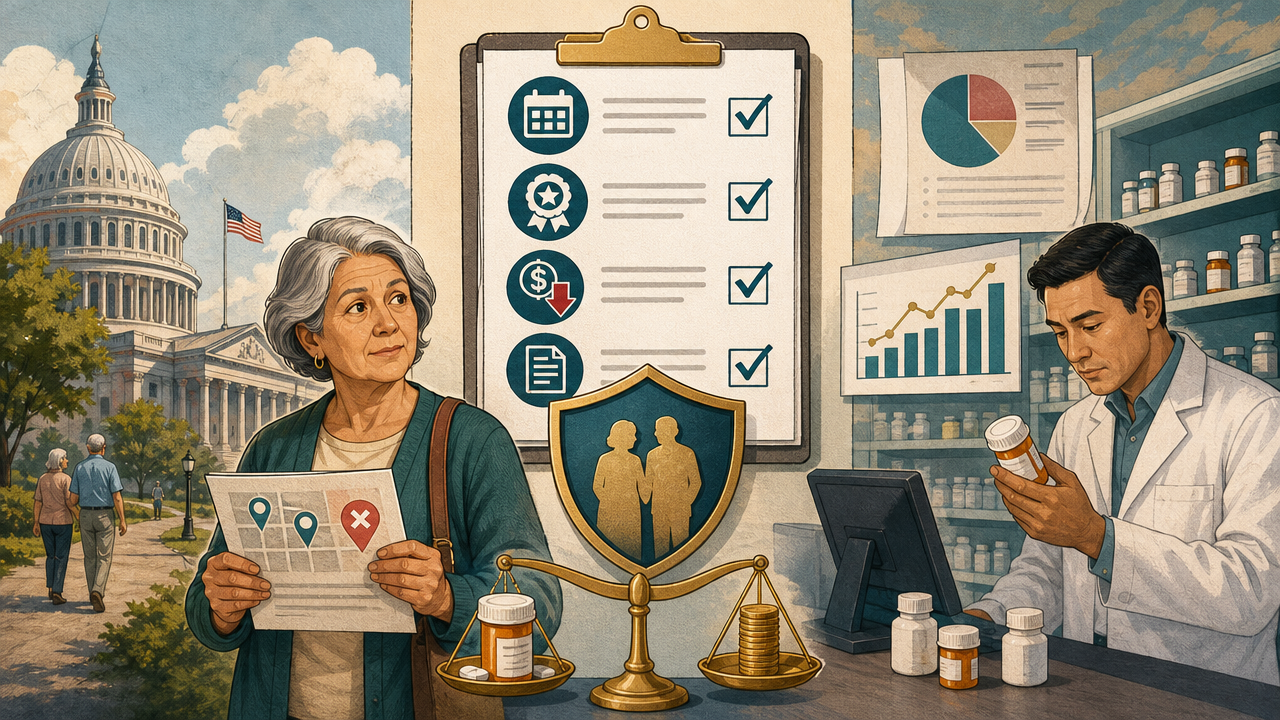
CMS proposes stronger protections when Medicare plan directories are wrong
Proposed: CMS issued the proposal on October 16, 2026, for Medicare Advantage and Part D contract year 2028. It is not yet a binding rule and will go through public comment before any final decision. Verify status
What happened
CMS issued a proposed rule on October 16 for Medicare Advantage and Part D plans. It would require Medicare Advantage plans to check and update provider directories at least every 90 days, publish directory-accuracy scores, and limit what enrollees pay when they relied on an incorrect in-network listing.
What it means for voters
For retirees, disabled workers, and families helping parents navigate Medicare, a bad provider directory can mean an unexpected out-of-network bill or a disrupted care plan. The proposed protection could limit that bill to the in-network amount when a person reasonably relied on wrong plan information. PBM reporting could give regulators and health plans more visibility into drug-price middlemen, but it does not cut prescription prices today; the rule would apply to 2028 coverage if finalized.
Save stories & follow topics · Link to this story
Get the context & analysis
CMS issued a proposed rule on October 16 for Medicare Advantage and Part D plans. It would require Medicare Advantage plans to check and update provider directories at least every 90 days, publish directory-accuracy scores, and limit what enrollees pay when they relied on an incorrect in-network listing. The proposal would also require pharmacy benefit managers, known as PBMs, to report compensation and cost information to plans and CMS.
What to watch
The proposal is scheduled for a 60-day public-comment period after it appears in the Federal Register. Watch for consumer groups, insurers, PBMs, and employers to weigh in on whether the protections are broad enough and what they could cost.
Context from earlier events
Congress included the provider-directory and PBM-accountability provisions CMS is implementing in the Consolidated Appropriations Act of 2026, but the agency still must complete the rulemaking process.
Check sources (1)
Retirement income; disability benefits; household budgets; federal benefits Nationwide
Social Security benefits will rise 3.6% in 2027
In effect: The increase is an automatic adjustment required under the Social Security Act’s COLA formula. SSI payments are set to increase on December 31, 2026, and regular Social Security benefits in January 2027. Verify status
What happened
The Social Security Administration announced a 3.6% cost-of-living adjustment for 2027. SSA says the average retirement benefit will rise by about $75 a month beginning in January, while higher SSI payments for about 7.3 million recipients begin December 31, 2026.
What it means for voters
For households living on Social Security, survivor, or disability benefits, this raises monthly income automatically at the end of this year or in January. It can help with groceries, rent, utilities, and medicine, but the actual effect on a household budget will also depend on 2027 Medicare premiums and other deductions, which SSA says will be shown in benefit notices later this fall.
Save stories & follow topics · Link to this story
Get the context & analysis
The Social Security Administration announced a 3.6% cost-of-living adjustment for 2027. SSA says the average retirement benefit will rise by about $75 a month beginning in January, while higher SSI payments for about 7.3 million recipients begin December 31, 2026. Nearly 72 million Social Security beneficiaries are expected to receive the adjustment.
What to watch
People with a my Social Security account can view their COLA notice starting in late November. People who want an online notice need to create an account and choose paperless notices by November 18; others should receive a mailed notice in December.
Context from earlier events
The annual adjustment is tied by law to inflation measured through the Consumer Price Index for Urban Wage Earners and Clerical Workers, rather than a separate vote by Congress or the White House.
Check sources (1)
Primary and independent sources
Utilities; electricity reliability; federal infrastructure spending Virginia and West Virginia, with regional implications for the PJM power grid
Energy Department plans up to $50 million for Virginia–West Virginia grid upgrades
Proposed: DOE announced its intent to deploy up to $50 million, rather than a completed project or a finalized household-rate change. The stated project timeline is 48 months. Verify status
What happened
The Energy Department announced October 16 that it intends to provide up to $50 million under the Defense Production Act for a Virginia and West Virginia transmission project. DOE says the project would use upgraded conductors and real-time line monitoring on existing lines, adding an estimated 290 megawatts of capacity across Appalachian Power’s Virginia system and moving faster than conventional upgrades.
What it means for voters
Electricity reliability and power bills are a pocketbook issue, especially for households already dealing with higher utility costs. The project could add capacity without waiting to build entirely new transmission corridors, but DOE’s claim that it will lower costs is a projected result, not a guaranteed bill reduction. Customers will need to watch state utility regulators and the companies involved for actual rate effects.
Save stories & follow topics · Link to this story
Get the context & analysis
What to watch
Watch for the final funding agreement, project milestones, state regulatory filings, and whether Appalachian Power or other utilities identify any customer-rate changes connected to the work. DOE describes the project as a 48-month effort, so any household effect would not be immediate.
Context from earlier events
DOE has been pressing PJM-region utilities and regulators to prevent the cost of new large power users from being shifted onto existing households and smaller businesses.
Check sources (2)
Primary and independent sources
- U.S. Department of Energy Energy Department Announces Virginia and West Virginia Transmission Project to Receive Defense Production Act Funding, Strengthening National Security and Grid Reliability
- U.S. Department of Energy Energy Department Supports FERC’s Call for PJM to Protect Ratepayers and Build More Reliable Power
Voting; election administration; federal courts; local government California, with national implications for federal-state election authority
Justice Department warns California election officials as its ballot lawsuit moves forward
Challenged in court: DOJ filed its federal lawsuit on October 15, 2026. The October 16 warning letter is not a court order, and California has not been ordered to change how it handles these ballots. Verify status
What happened
The Justice Department sent California and Los Angeles County officials a new warning on October 16, saying they could risk investigation or prosecution if they knowingly count ballots from people federal agencies identify as noncitizens. The warning came one day after DOJ sued California, seeking to stop the state from counting mail ballots from more than 20,000 people it says are likely noncitizens until citizenship can be confirmed.
What it means for voters
This is about who gets to run elections and what safeguards apply before a ballot is rejected or counted. California voters are not subject to a new court order from this letter. But fast-moving federal-state conflict close to Election Day can create confusion for voters and pressure on county election workers, so people should rely on their county election office for registration and ballot-status information.
Save stories & follow topics · Link to this story
Get the context & analysis
The Justice Department sent California and Los Angeles County officials a new warning on October 16, saying they could risk investigation or prosecution if they knowingly count ballots from people federal agencies identify as noncitizens. The warning came one day after DOJ sued California, seeking to stop the state from counting mail ballots from more than 20,000 people it says are likely noncitizens until citizenship can be confirmed. California officials dispute the federal claims and say the matter should be resolved in court.
What to watch
Watch for California’s formal court response and for any request by DOJ for emergency relief before the November 3 election. A judge, not the DOJ letter, would decide whether the federal government gets the ballot restrictions it seeks.
Context from earlier events
On October 15, DOJ sued California after demanding that state officials review a federal list of more than 20,000 people described as likely noncitizens. The next day’s letter raised the stakes by warning local officials of possible criminal exposure.
Check sources (2)
Voting; privacy; federal courts; government accountability Nationwide; case filed in Washington, D.C.
Voting and privacy groups sue over DHS collection of voter records
Challenged in court: The organizations filed the case in U.S. District Court for the District of Columbia on October 15, 2026. The lawsuit asks for court orders against DHS data collection and use; no final ruling has been reported. Verify status
What happened
The League of Women Voters, the Electronic Privacy Information Center, and the League of United Latin American Citizens sued the Department of Homeland Security on October 15. They allege that DHS collected voter records from at least 47 states and combined or analyzed them in ways that violate federal privacy protections.
What it means for voters
Voter files can contain sensitive information such as names, addresses, dates of birth, driver’s-license details, and voting history, depending on the state. The case raises a basic accountability question: what limits apply when federal agencies collect state-held voter information for election enforcement? There is no verified change today to an individual voter’s registration or voting eligibility from this lawsuit itself.
Save stories & follow topics · Link to this story
Get the context & analysis
The League of Women Voters, the Electronic Privacy Information Center, and the League of United Latin American Citizens sued the Department of Homeland Security on October 15. They allege that DHS collected voter records from at least 47 states and combined or analyzed them in ways that violate federal privacy protections. The groups are asking the court to stop the practice, block use or sharing of the data, and require deletion of data already collected. These are allegations that DHS has not yet answered in court.
What to watch
Watch for DHS’s response, the government’s explanation of what data it holds and how it uses it, and any early ruling on whether the court will stop the program while the case proceeds.
Context from earlier events
The lawsuit is part of a broader 2026 conflict over federal efforts to obtain state voter data and investigate possible noncitizen registration or voting.
You're caught up on this briefing. Choose topics and save stories to return on your own schedule.
How this briefing was made
We used official records to verify government actions and independent reporting to add context. We also checked popular political videos on YouTube for topic leads. Popularity helped us decide what to investigate, but it was not treated as proof or public opinion. Every included claim still had to be checked against the linked sources.