The daily civic brief
U.S. Civic News Scan — Friday, August 28, 2026
Today’s biggest household-policy developments are about paychecks, housing protections, electric bills, and voting rules. Two federal court decisions limited recent administration actions involving farmworker pay and fair-housing grants, while a separate court again paused the White House mail-voting order. State actions in New Jersey and a South Carolina Senate runoff also show how state voters and lawmakers can shape issues with wider national stakes.
Estimated 5-minute catch-up · 6 stories
Today's audio briefing
Today's spoken briefing
Hear the latest national briefing and what to watch next for every headline. A restrained instrumental bed plays in the web player.
A verbatim transcript is unavailable for this edition. Read the written briefing below.
Paychecks, farm jobs, food prices, and federal courts Nationwide; U.S. District Court for the Eastern District of California
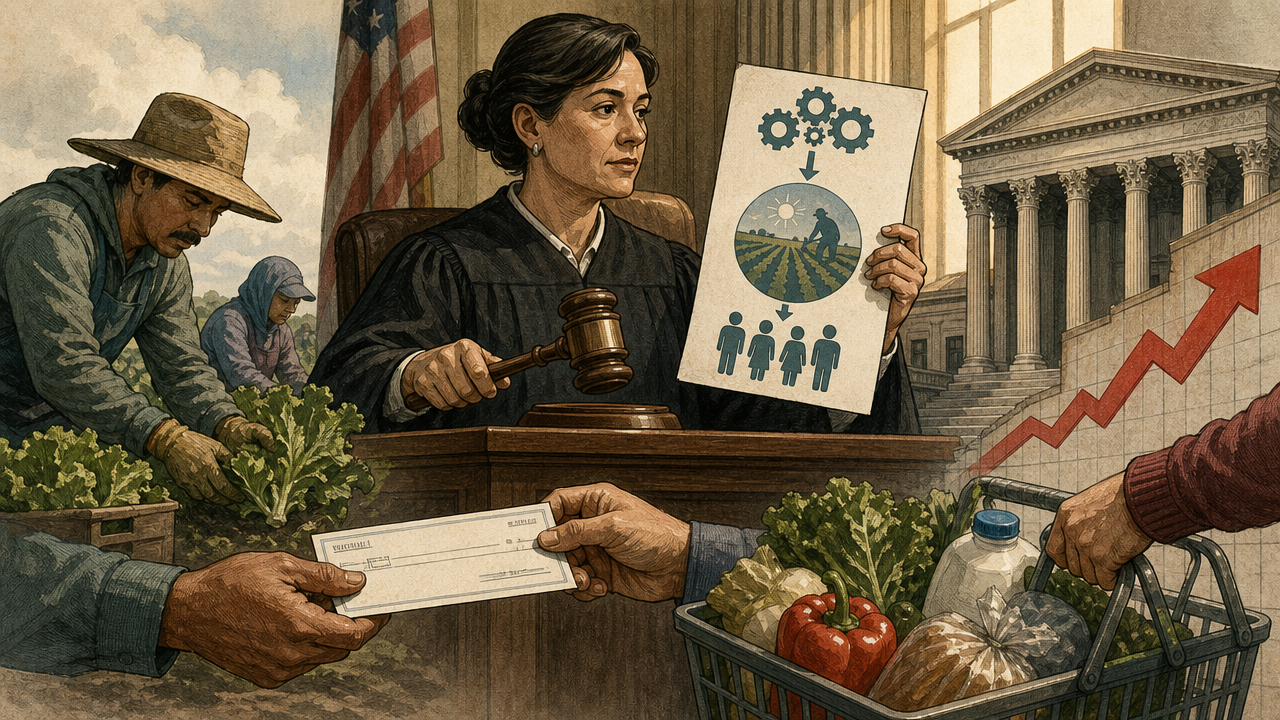
Federal judge orders Labor Department to replace H-2A farmworker wage formula
What happened
On August 25, a federal judge ruled that the Labor Department’s 2025 method for setting minimum pay rates for many H-2A temporary farm jobs was unlawful. The judge did not immediately erase the existing rates.
What it means for voters
This is mainly a paycheck issue for farmworkers and a labor-cost issue for growers. The H-2A program requires employers to offer at least a set wage floor or another higher applicable wage, so the new method could change payroll costs in farm-heavy states. The court has not set new rates yet, and it has not decided whether back pay will be required or how much. Any effect on grocery prices is uncertain: higher labor costs can matter to growers, but the record does not show that this ruling will raise store prices.
Save stories & follow topics · Link to this story
Get the context & analysis
On August 25, a federal judge ruled that the Labor Department’s 2025 method for setting minimum pay rates for many H-2A temporary farm jobs was unlawful. The judge did not immediately erase the existing rates. Instead, the court ordered the department to quickly create and publish a new wage method, and said some employers may later owe wage adjustments to H-2A workers and U.S. workers doing corresponding jobs.
What to watch
The Labor Department must notify state workforce agencies, employers, and the public within seven days of the August 25 order. The parties must report back to the judge in two weeks, around September 8, with the department’s first steps and expected timeline for new rates.
Context from earlier events
H-2A is the federal temporary agricultural-worker visa program. Employers must generally pay the highest applicable wage among the program’s adverse-effect wage rate, a prevailing wage, a union-contract wage, or the relevant minimum wage.
Check sources (3)
Primary and independent sources
- U.S. District Court record via Justia Order on cross-motions for summary judgment, United Farm Workers v. U.S. Department of Labor
- U.S. Department of Labor Fact Sheet #26F: Wage Requirements under the H-2A Visa Program
- The Washington Post Trump administration’s pay cuts for migrant farmworkers ruled illegal
Rent, homebuying, housing discrimination, and court oversight Nationwide; U.S. District Court for the District of Massachusetts
Judge blocks HUD overhaul of fair-housing grant program
What happened
A federal judge in Massachusetts ruled on August 26 that HUD did not adequately justify major changes to its Fair Housing Initiatives Program grant structure. Reporting on the ruling says the decision blocks the planned restructuring that would have moved funding away from more than 100 local nonprofit groups that help people identify, investigate, and challenge illegal housing discrimination.
What it means for voters
This does not set rents or guarantee anyone housing. But these grants support local organizations that help renters, homebuyers, families with children, older adults, and people with disabilities understand fair-housing rights and pursue complaints when they believe they have been denied housing or treated differently unlawfully. The immediate effect is to stop HUD’s challenged overhaul; longer-term funding still depends on future agency action, court decisions, and federal appropriations approved by Congress.
Save stories & follow topics · Link to this story
Get the context & analysis
What to watch
Watch for an appeal, a revised HUD grant plan, and court action on the groups’ separate challenge to the fiscal-year 2026 funding approach.
Context from earlier events
The Fair Housing Initiatives Program is the federal grant program specifically designed to support private efforts to prevent and address housing discrimination under the Fair Housing Act.
Check sources (3)
Primary and independent sources
Voting, election administration, and separation of powers Nationwide; federal court in Massachusetts
Federal judge again pauses White House mail-voting order
What happened
On August 27, a federal judge again blocked the federal government from putting President Trump’s mail-voting executive order into effect for two weeks while the lawsuit continues. The new order came after states and voting-rights groups refiled their case following the Supreme Court’s August 24 procedural ruling.
What it means for voters
For now, voters should not assume their state’s mail-ballot rules have changed because of this White House order. States run most election details, while Congress can set some federal-election rules. The lawsuit is about whether the president and Postal Service can impose conditions that would require states to change ballot envelopes, share voter data, or meet other federal mail-ballot requirements. Election officials need clarity soon because the November 2026 election is approaching.
Save stories & follow topics · Link to this story
Get the context & analysis
On August 27, a federal judge again blocked the federal government from putting President Trump’s mail-voting executive order into effect for two weeks while the lawsuit continues. The new order came after states and voting-rights groups refiled their case following the Supreme Court’s August 24 procedural ruling. The judge did not make a final decision on whether the president’s order is lawful.
What to watch
The two-week order is temporary, so an appeal or another emergency request could reach the Supreme Court quickly. Watch for a ruling before about September 10 and for guidance from state and local election offices.
Context from earlier events
On August 24, the Supreme Court allowed the administration to overcome one earlier procedural barrier, but it did not decide the underlying legality of the executive order. A separate Postal Service-related court block had also limited implementation.
Check sources (2)
Electric bills, water use, local control, jobs, and state regulation New Jersey; state-policy trend with national relevance
New Jersey adds reporting rules and local bargaining guidance for data centers
What happened
New Jersey Gov. Mikie Sherrill signed a law on August 27 requiring data-center owners and operators to report their energy and water use to the state Board of Public Utilities twice a year. The administration also issued guidance to help towns negotiate community-benefit agreements with developers, such as commitments involving infrastructure, emergency services, schools, workforce programs, and labor standards.
What it means for voters
Data centers can bring construction and technology jobs, but they can also require large amounts of electricity, water, and local infrastructure. The new reporting law does not itself set a household utility rate or stop construction. It gives state regulators and communities more information when deciding who should pay for new power and water needs. New Jersey says an earlier law created a separate electricity rate class for data centers, meant to keep their added demand from being shifted to other customers; how well that works will depend on implementation by regulators and utilities.
Save stories & follow topics · Link to this story
Get the context & analysis
What to watch
Watch for the Board of Public Utilities’ reporting requirements, the first public data-center reports, and whether towns use the new guidance when negotiating with developers.
Context from earlier events
States are increasingly weighing the tradeoff between attracting data-center investment and protecting residents from possible utility, water, and infrastructure costs.
Check sources (2)
Housing assistance, homelessness, federal grants, and accountability Nationwide; U.S. Court of Appeals for the First Circuit
HUD appeals court order that stopped its homelessness-grant competition
What happened
HUD says the Justice Department has appealed a Rhode Island federal court ruling that set aside HUD’s 2026 Continuum of Care grant competition. The court had found problems with the agency’s process for changing the competition.
What it means for voters
Continuum of Care grants help state and local systems pay for housing and services for people experiencing homelessness, including families, survivors of domestic violence, older adults, and people with disabilities. The immediate problem is uncertainty: HUD cannot use the challenged competition while the court order remains in force, unless an appeals court changes that result. Providers and local governments may have trouble planning services, staffing, and housing placements when a multibillion-dollar federal funding process is delayed.
Save stories & follow topics · Link to this story
Get the context & analysis
HUD says the Justice Department has appealed a Rhode Island federal court ruling that set aside HUD’s 2026 Continuum of Care grant competition. The court had found problems with the agency’s process for changing the competition. The appeal does not restart the competition or release new grants by itself.
What to watch
Watch whether HUD asks the appeals court to pause the lower-court ruling while the appeal is heard, and whether the department publishes a replacement grant notice that follows the court’s instructions.
Context from earlier events
The Continuum of Care program is HUD’s main nationwide system for funding local homelessness housing and service networks. Congress sets the program’s framework and funding; HUD writes the annual competition rules; courts can review whether the agency followed the law.
Check sources (3)
Primary and independent sources
- U.S. Department of Housing and Urban Development HUD Appeals Judicial Decision to Shift Homelessness Paradigm
- U.S. District Court for the District of Rhode Island State of Washington v. United States Department of Housing and Urban Development, Memorandum and Order
- U.S. Court of Appeals record via Justia National Alliance to End Homelessness v. Department of Housing and Urban Development
Voting, Senate representation, and the November election South Carolina; national election
Darline Graham wins South Carolina’s Republican Senate runoff
What happened
Darline Graham won the August 25 Republican primary runoff for South Carolina’s open U.S. Senate seat, according to the state election office and The Associated Press. She beat U.S. Rep. Ralph Norman and will be the Republican nominee in the special general election.
What it means for voters
This was a party primary, not the final election. South Carolina voters will still choose who serves the next full Senate term in November. One Senate seat can matter nationally because senators vote on federal taxes, health programs, judges, labor rules, farm policy, and spending bills. For voters, the practical next step is to check the state election office for the general-election ballot, registration deadlines, and voting options.
Save stories & follow topics · Link to this story
Get the context & analysis
Darline Graham won the August 25 Republican primary runoff for South Carolina’s open U.S. Senate seat, according to the state election office and The Associated Press. She beat U.S. Rep. Ralph Norman and will be the Republican nominee in the special general election. Graham is already serving in the seat through a gubernatorial appointment after the death of her brother, Sen. Lindsey Graham.
What to watch
Watch the November special general election and the final certified statewide results. Also watch whether the race changes the balance of power or vote margins in the U.S. Senate.
Context from earlier events
Gov. Henry McMaster appointed Graham to fill the vacancy until January 3, 2027. The special election determines who will hold the seat after that temporary appointment ends.
Check sources (3)
You're caught up on this briefing. Choose topics and save stories to return on your own schedule.
How this briefing was made
We used official records to verify government actions and independent reporting to add context. We also checked popular political videos on YouTube for topic leads. Popularity helped us decide what to investigate, but it was not treated as proof or public opinion. Every included claim still had to be checked against the linked sources.