The daily civic brief
U.S. Civic News Scan — September 2, 2026
The biggest household story is that Congress has sent a short-term funding bill to the president, which would avert a shutdown through December 11 if signed. Other developments touch housing access, federal-worker job protections, trucking enforcement, utility-cost policy, insurance claims, and election oversight. Several of these are rules or court decisions, not new laws, so their real effects will depend on implementation, appeals, or a governor’s signature.
Estimated 5-minute catch-up · 7 stories
Today's audio briefing
Today's spoken briefing
Hear the latest national briefing and what to watch next for every headline. A restrained instrumental bed plays in the web player.
A verbatim transcript is unavailable for this edition. Read the written briefing below.
Federal budget, benefits, public services, transit, and congressional power Washington, D.C.; nationwide
Congress sends a short-term government funding bill to the president
What happened
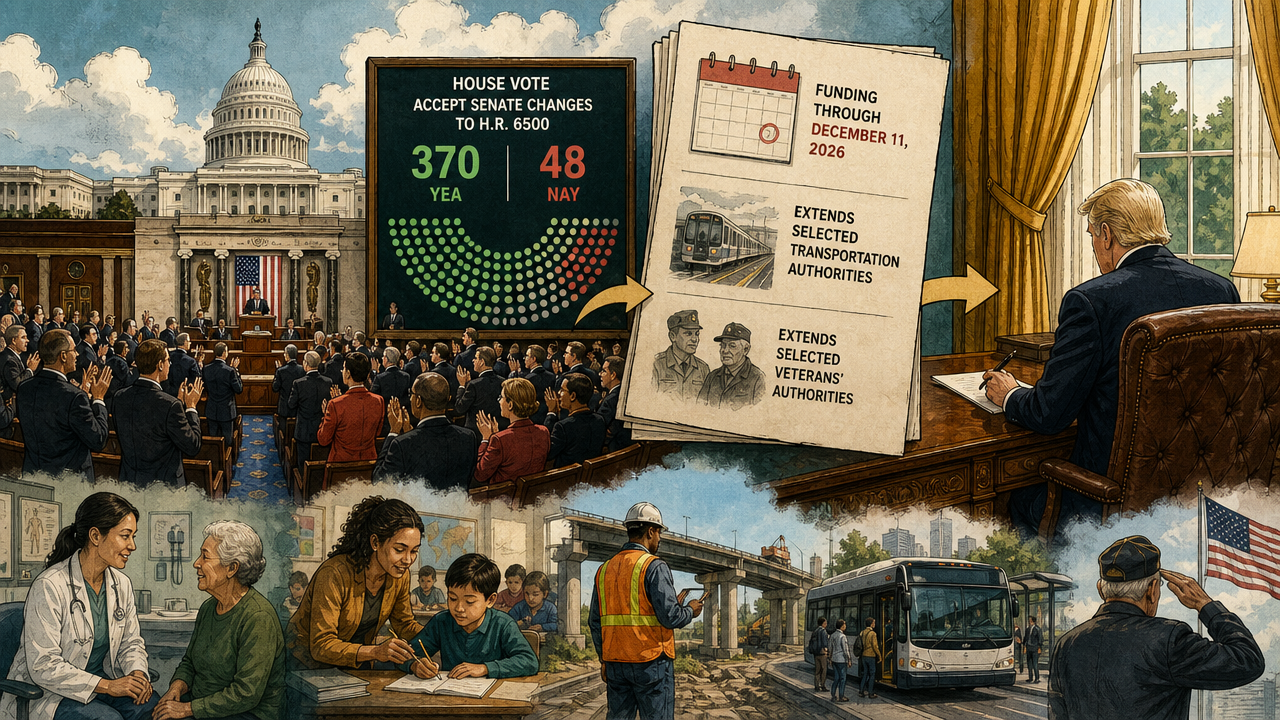
The House voted 370-48 on September 1 to accept the Senate’s changes to H.R. 6500, the Continuing Appropriations and Extensions Act, 2027. The bill would generally continue federal funding through December 11, 2026, and extends selected transportation and veterans’ authorities.
What it means for voters
This is about keeping day-to-day federal services running after the current budget year ends on September 30. If signed, it would lower the near-term risk of disruptions to federal pay, some benefit administration, air-travel security, disaster work, and federally supported transportation projects. It does not settle the full 2027 budget or create a permanent funding plan; Congress would still face another deadline in December. Congress controls federal spending, while the president can sign or veto the bill.
Save stories & follow topics · Link to this story
Get the context & analysis
The House voted 370-48 on September 1 to accept the Senate’s changes to H.R. 6500, the Continuing Appropriations and Extensions Act, 2027. The bill would generally continue federal funding through December 11, 2026, and extends selected transportation and veterans’ authorities. It has cleared Congress but still needs President Trump’s signature to become law.
What to watch
Watch for the president’s signature and for Congress’s work on full-year funding bills after the November 3 election. If H.R. 6500 is not enacted before October 1, agencies would again face a shutdown risk.
Context from earlier events
Congress used short-term funding bills repeatedly during fiscal year 2026, including a partial shutdown earlier in the year. This bill is meant to avoid another lapse while lawmakers have not completed regular appropriations bills.
Rent, housing accessibility, disability rights, and executive-branch enforcement Nationwide
HUD shortens its filing window for many apartment accessibility complaints
What happened
HUD has told its fair-housing enforcement staff to treat a design-or-construction accessibility violation in covered multifamily housing as ending when the building receives its first certificate of occupancy. Under the new guidance, an administrative complaint to HUD generally must be filed within one year of that certificate.
What it means for voters
For renters and buyers with disabilities, this could make it harder to use HUD’s administrative complaint process against older apartment buildings with alleged accessibility problems. For builders and later property owners, it offers more certainty about when HUD administrative claims can be filed. This is agency guidance, not a congressional rewrite of the Fair Housing Act, and courts can interpret the law for themselves. HUD also says the guidance does not change the time period for Justice Department enforcement against builders.
Save stories & follow topics · Link to this story
Get the context & analysis
HUD has told its fair-housing enforcement staff to treat a design-or-construction accessibility violation in covered multifamily housing as ending when the building receives its first certificate of occupancy. Under the new guidance, an administrative complaint to HUD generally must be filed within one year of that certificate. The prior HUD position had treated an inaccessible feature as a continuing violation until it was fixed.
What to watch
Watch for lawsuits challenging the guidance, how HUD applies it to pending complaints, and whether Congress changes the underlying law. People with a possible housing-discrimination claim may want to check deadlines quickly because deadlines can differ for HUD complaints and private court cases.
Context from earlier events
The Fair Housing Act requires certain newer multifamily buildings to include accessible design features. HUD and DOJ had issued joint accessibility guidance in 2013; HUD and DOJ rescinded the portions about time limits in August 2026 before HUD issued this new interpretation.
Check sources (2)
Paychecks, federal jobs, due process, and executive-branch accountability Nationwide
New federal-worker layoff appeal rules take effect today
What happened
Starting September 2, federal employees covered by a reduction in force, or RIF, will generally appeal qualifying layoffs, demotions, or long furloughs to the Office of Personnel Management instead of the Merit Systems Protection Board. The change applies only when an agency issues the employee’s specific RIF notice on or after today.
What it means for voters
This matters directly to federal workers facing job loss or a long unpaid furlough, and indirectly to communities where federal employment supports local economies. The appeal route is changing, not the basic fact that agencies must follow RIF laws and regulations. OPM says workers can still use other channels that have separate legal authority, such as the EEOC or Office of Special Counsel, when those fit the case. The immediate practical point is that affected workers now need to use OPM’s filing system and deadlines for covered new notices.
Save stories & follow topics · Link to this story
Get the context & analysis
Starting September 2, federal employees covered by a reduction in force, or RIF, will generally appeal qualifying layoffs, demotions, or long furloughs to the Office of Personnel Management instead of the Merit Systems Protection Board. The change applies only when an agency issues the employee’s specific RIF notice on or after today. Employees generally have 30 calendar days after a RIF takes effect to file an appeal with OPM.
What to watch
Watch for legal challenges, OPM decisions under the new system, and whether agencies begin new RIF actions. Workers who receive a notice should read it closely and seek prompt advice because appeal rights and deadlines depend on the type and date of the action.
Context from earlier events
RIF appeals had generally gone to the Merit Systems Protection Board. OPM’s final rule transfers this particular appeal process to OPM for future covered actions.
Check sources (2)
Jobs, trucking, highway safety, consumer costs, and federal enforcement Nationwide, with initial task-force work centered in the Midwest
Federal agencies begin a nationwide crackdown on commercial-driver training and testing fraud
What happened
The Justice Department, Transportation Department, Homeland Security, and other agencies announced a coordinated enforcement campaign focused on alleged fraud in commercial-driver licensing, training, testing, and related businesses. Officials said the Transportation Department will immediately remove more than 110 training providers from its registry, audit third-party commercial-license testers and state oversight, and build on investigations in 40 states.
What it means for voters
Truck drivers, driving schools, carriers, and employers could face tighter checks or lose access to approved training programs. For everyone else, the stated goal is safer highways and more reliable licensing standards. The government has not proved that every school or business being inspected committed wrongdoing; an inspection, removal action, or investigation is not a criminal conviction. There is no clear evidence yet that this will change grocery or delivery prices, though trucking costs can affect them over time.
Save stories & follow topics · Link to this story
Get the context & analysis
The Justice Department, Transportation Department, Homeland Security, and other agencies announced a coordinated enforcement campaign focused on alleged fraud in commercial-driver licensing, training, testing, and related businesses. Officials said the Transportation Department will immediately remove more than 110 training providers from its registry, audit third-party commercial-license testers and state oversight, and build on investigations in 40 states. Homeland Security said it planned inspections involving more than 200 schools across 23 states.
What to watch
Watch for named enforcement cases, appeals by removed training providers, the results of the tester audits, and whether states change how they oversee commercial-license testing.
Context from earlier events
Commercial driver’s licenses are issued by states, but federal agencies set major safety and training standards. That split means enforcement often requires federal-state coordination.
Check sources (2)
Primary and independent sources
Utilities, taxes, climate costs, state authority, and federal courts New York; national significance for state energy policy
Federal judge blocks New York’s $75 billion climate-damage charge on fossil-fuel companies
What happened
A federal judge ruled that New York cannot enforce its Climate Change Superfund Act, which would have required certain large fossil-fuel companies to pay a combined $75 billion over 25 years into a state fund for climate-related damage. The court concluded that the state law conflicted with areas controlled by federal law and federal foreign-affairs authority.
What it means for voters
The decision does not lower anyone’s utility bill or taxes today. But it removes, at least for now, a possible funding source for New York climate-adaptation projects and prevents the state from imposing the planned charges on companies. Supporters saw the law as a way to shift some disaster costs away from taxpayers; business and fossil-fuel groups argued it would create major costs that could spread through energy markets. Other states considering similar laws will be watching the case closely.
Save stories & follow topics · Link to this story
Get the context & analysis
A federal judge ruled that New York cannot enforce its Climate Change Superfund Act, which would have required certain large fossil-fuel companies to pay a combined $75 billion over 25 years into a state fund for climate-related damage. The court concluded that the state law conflicted with areas controlled by federal law and federal foreign-affairs authority. The ruling blocks enforcement for now.
What to watch
Watch for an appeal by New York and for how courts handle related state laws or proposals. State legislatures, not Congress, wrote these kinds of state cost-recovery laws, but federal courts decide whether they conflict with federal law.
Context from earlier events
New York enacted the law in 2024. The case is part of a broader dispute over how much room states have to make energy producers pay for climate-related public costs.
Check sources (3)
Primary and independent sources
- Associated Press New York’s plan to charge fossil-fuel producers $75B for climate change damages is struck down
- U.S. Department of Justice New York Judge Blocks State of New York’s Unconstitutional Climate Superfund Act
- Stateline Judge blocks New York’s ‘climate Superfund’ law as other states watch closely
Home insurance, disaster recovery, housing, and state government California; state insurance-policy trend with national relevance
California Legislature sends wildfire-smoke insurance protections to Gov. Newsom
What happened
California lawmakers passed Assembly Bill 1795, the Smoke Damage Recovery Act, and sent it to Gov. Gavin Newsom. The proposal would set a framework for testing and restoring homes affected by wildfire smoke, require insurers to cover necessary testing and sampling for qualifying claims, set timelines for inspections, and limit when insurers can end temporary living-expense coverage.
What it means for voters
For families whose homes are still standing after a wildfire but may have smoke contamination, the bill could make insurance claims more predictable and help them stay housed during repairs. Insurers could face added claim costs, which may become part of future debates about premiums and availability. The bill would apply in California, but other states facing wildfire and home-insurance strain may look to it as a model.
Save stories & follow topics · Link to this story
Get the context & analysis
California lawmakers passed Assembly Bill 1795, the Smoke Damage Recovery Act, and sent it to Gov. Gavin Newsom. The proposal would set a framework for testing and restoring homes affected by wildfire smoke, require insurers to cover necessary testing and sampling for qualifying claims, set timelines for inspections, and limit when insurers can end temporary living-expense coverage. It is not law unless the governor signs it.
What to watch
Watch for Newsom’s decision and the bill’s effective-date provisions if he signs it. California’s Department of Toxic Substances Control would need to develop the public-health standards that insurers would then have to follow.
Context from earlier events
California officials say the state has lacked clear enforceable standards for testing and restoring smoke-damaged homes for decades, even as wildfire-related insurance disputes have grown.
Check sources (2)
Voting, federal oversight, and election administration Massachusetts; national election-administration significance
Justice Department monitors Massachusetts primary polling places
What happened
The Justice Department monitored polling places in Boston, New Bedford, and Lowell during Massachusetts’s September 1 primary. DOJ said it used 12 monitors there and has deployed more than 80 monitors across eight states and over 200 polling locations during this primary season.
What it means for voters
Federal monitors do not take over a state election or change a voter’s ballot, registration, ID, or mail-ballot rules. Local and state election officials still run the election. Monitoring can document potential problems involving access, discrimination, disability accommodations, or other federal voting protections, and it gives voters a federal channel for complaints. The practical effect for most voters is no change at the polls, unless monitoring identifies a problem that officials need to address.
Save stories & follow topics · Link to this story
Get the context & analysis
The Justice Department monitored polling places in Boston, New Bedford, and Lowell during Massachusetts’s September 1 primary. DOJ said it used 12 monitors there and has deployed more than 80 monitors across eight states and over 200 polling locations during this primary season. The department says its role is to observe compliance with federal voting-rights laws.
What to watch
Watch for DOJ monitoring announcements in other states before the November 3 general election, any complaints or enforcement actions that come from observed problems, and continuing court fights over federal involvement in election rules.
Context from earlier events
The Justice Department regularly sends personnel to observe elections under federal voting-rights laws. This year’s activity is drawing extra attention because courts are also reviewing federal efforts to reshape mail-voting rules.
Check sources (2)
You're caught up on this briefing. Choose topics and save stories to return on your own schedule.
How this briefing was made
We used official records to verify government actions and independent reporting to add context. We also checked popular political videos on YouTube for topic leads. Popularity helped us decide what to investigate, but it was not treated as proof or public opinion. Every included claim still had to be checked against the linked sources.