The daily civic brief
U.S. Civic Daily Scan — September 5, 2026
Friday brought new federal actions affecting grocery supply, jobs, water rules, and the rules around this fall’s elections. The clearest immediate household news is a stronger August jobs report; the beef and water actions are starts of longer policy processes, not instant price changes. Courts also made two election-related decisions that could affect how campaigns spend money and how some states run mail voting.
Estimated 4-minute catch-up · 6 stories
Today's audio briefing
Today's spoken briefing
Hear the latest national briefing and what to watch next for every headline. A restrained instrumental bed plays in the web player.
A verbatim transcript is unavailable for this edition. Read the written briefing below.
Paychecks, jobs, inflation, and Federal Reserve policy Nationwide
August jobs report shows stronger hiring and modest wage growth
What happened
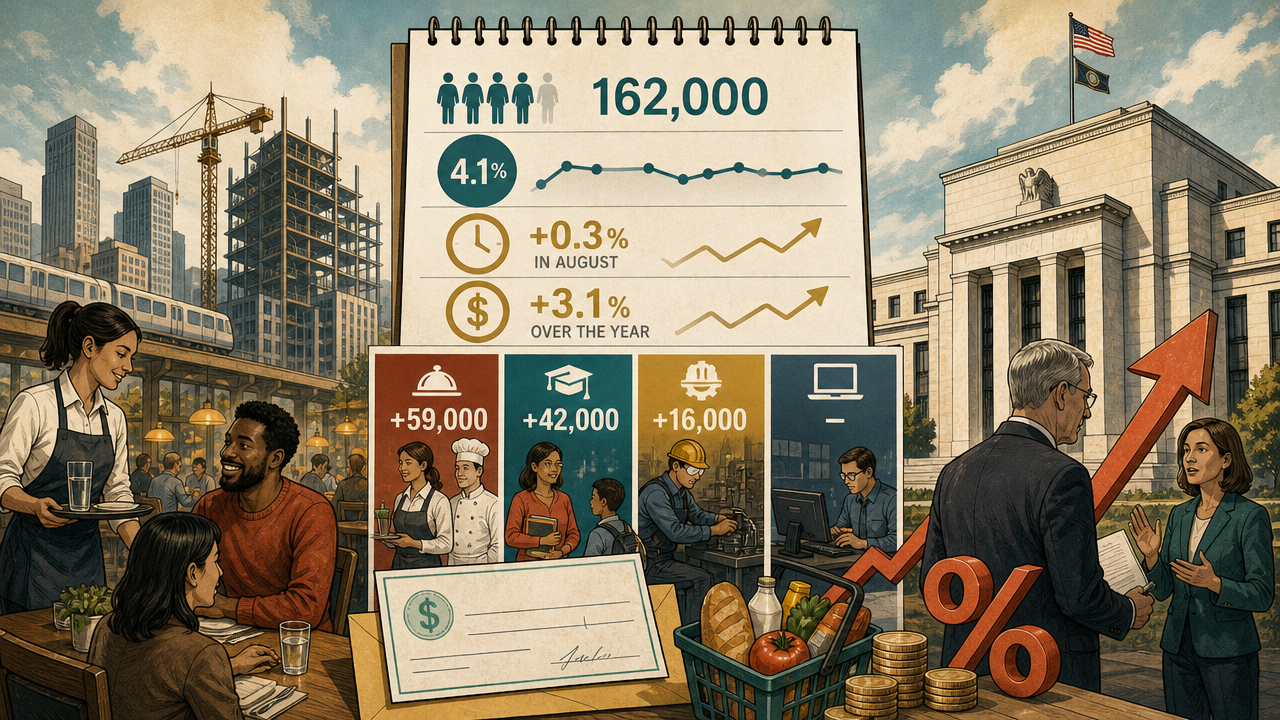
The Bureau of Labor Statistics reported September 4 that employers added 162,000 jobs in August and the unemployment rate stayed at 4.1%. Average hourly pay for private-sector workers rose 0.3% in August and 3.1% over the year.
What it means for voters
This is a national snapshot, not a guarantee for any one worker. It points to more hiring than in the prior two months, while pay continued to rise. But a stronger job market can also make the Federal Reserve more concerned about inflation, which matters for mortgage rates, car loans, credit-card interest, and business borrowing. The Fed, an independent federal institution, next meets September 15-16; the August inflation report is due September 11.
Save stories & follow topics · Link to this story
Get the context & analysis
The Bureau of Labor Statistics reported September 4 that employers added 162,000 jobs in August and the unemployment rate stayed at 4.1%. Average hourly pay for private-sector workers rose 0.3% in August and 3.1% over the year. Restaurants and bars added 59,000 jobs, local government education added 42,000, manufacturing added 16,000, and information-sector employment fell.
What to watch
The Consumer Price Index release on September 11 and the Federal Reserve’s September 15-16 rate decision.
Context from earlier events
BLS revised June and July payroll figures upward by a combined 55,000 jobs, changing July from a reported loss of 23,000 jobs to a gain of 21,000.
Check sources (2)
Groceries, ranching, meat processing, and executive power Washington, D.C.; nationwide
White House orders launch review of meat-processing rules and beef labeling
What happened
President Trump signed two executive orders on September 4 aimed at cattle ranchers and beef markets. One directs USDA to step up enforcement of unfair or deceptive practices in livestock markets, examine ways eligible state-inspected products could move across state lines, and develop a loan program for small and regional beef processors.
What it means for voters
The orders do not change what a shopper pays for beef today, and they do not immediately restore mandatory origin labels. They start agency reviews, enforcement work, and possible future regulations or requests for Congress to change the law. Supporters say more processing options and competition could help ranchers and consumers. Whether savings reach grocery-store shoppers will depend on later agency actions, investment by processors, supply conditions, and market pricing.
Save stories & follow topics · Link to this story
Get the context & analysis
President Trump signed two executive orders on September 4 aimed at cattle ranchers and beef markets. One directs USDA to step up enforcement of unfair or deceptive practices in livestock markets, examine ways eligible state-inspected products could move across state lines, and develop a loan program for small and regional beef processors. The other orders a 90-day review of whether federal law permits mandatory country-of-origin labels for beef and calls for recommendations on rancher-related regulations and wolf-predation policy.
What to watch
USDA reports due within 60 days on meat-inspection barriers and enforcement plans, plus the 90-day review of country-of-origin labeling authority.
Context from earlier events
Federal food-safety law generally limits interstate sales of meat that was not processed under qualifying inspection systems. The order directs USDA to identify which limits it can address under existing law and which would require Congress or trade-related action.
Check sources (3)
Primary and independent sources
Voting, mail ballots, Postal Service operations, and federal courts Massachusetts federal court; nationwide effect
Federal judge keeps Postal Service mail-ballot system blocked through the midterms
What happened
U.S. District Judge Indira Talwani on September 4 issued a preliminary injunction stopping the Postal Service from putting the Trump administration’s new mail-voting system into effect during the midterm election. The ruling replaces a shorter temporary block.
What it means for voters
For voters in states that use mail ballots, the immediate effect is continuity: state and local election offices do not have to switch to the disputed federal system while ballots are already being mailed. The judge found that states faced a serious risk of being unable to change course in time. The administration can appeal, so the legal fight is not over.
Save stories & follow topics · Link to this story
Get the context & analysis
U.S. District Judge Indira Talwani on September 4 issued a preliminary injunction stopping the Postal Service from putting the Trump administration’s new mail-voting system into effect during the midterm election. The ruling replaces a shorter temporary block. States may choose to use the system voluntarily, but Associated Press reported that no state had announced plans to do so.
What to watch
The Trump administration’s expected appeal to the U.S. Court of Appeals for the First Circuit, and continuing state ballot-mailing deadlines before the November election.
Context from earlier events
North Carolina began sending mail ballots on September 4, making late changes to ballot handling especially difficult for election offices.
Check sources (1)
Primary and independent sources
Elections, campaign spending, broadcasting, and Supreme Court oversight Washington, D.C.; nationwide effect
Supreme Court restores lower TV ad rates for coordinated party ads, for now
What happened
The Supreme Court on September 4 paused a lower-court ruling that had struck down an FCC notice on discounted political television-ad rates. The pause means political parties conducting qualifying coordinated activity with candidates can use the favorable “lowest unit charge” rates while the case continues.
What it means for voters
This will not change a voter’s ballot rules. It could change the campaign-airwave balance, because qualifying party committees may be able to buy more television advertising with the same budget. Broadcasters and candidates challenging the policy argue that discounts intended for candidates should not extend further. The Court’s move is temporary and does not decide the final legal question.
Save stories & follow topics · Link to this story
Get the context & analysis
The Supreme Court on September 4 paused a lower-court ruling that had struck down an FCC notice on discounted political television-ad rates. The pause means political parties conducting qualifying coordinated activity with candidates can use the favorable “lowest unit charge” rates while the case continues. Federal law requires broadcasters to offer those rates to legally qualified candidates during set periods before elections; the dispute is over whether certain party and joint-fundraising ads also qualify.
What to watch
Whether the challengers ask the Supreme Court to take the full case, and how much coordinated party advertising appears before Election Day.
Context from earlier events
The FCC Media Bureau issued the disputed public notice on March 30, 2026. A divided Fourth Circuit panel set it aside on August 25 before the Supreme Court stepped in.
Check sources (2)
Voting, redistricting, state courts, and representation Missouri; national House representation
Missouri asks U.S. Supreme Court to let its newer congressional map be used in November
What happened
Missouri filed an emergency request with the U.S. Supreme Court after the Missouri Supreme Court ruled that the state’s older congressional map must be used in the November general election unless voters approve the newer map in a referendum. The state court declined Missouri’s request to pause its ruling on September 4.
What it means for voters
The case could decide which communities vote together for Missouri’s eight U.S. House seats this November. That affects representation in Congress, not the price of a household bill directly. Election officials also face practical deadlines: Missouri says changes to the November ballot are due Tuesday, so a quick Supreme Court decision may be needed.
Save stories & follow topics · Link to this story
Get the context & analysis
Missouri filed an emergency request with the U.S. Supreme Court after the Missouri Supreme Court ruled that the state’s older congressional map must be used in the November general election unless voters approve the newer map in a referendum. The state court declined Missouri’s request to pause its ruling on September 4. The U.S. Supreme Court has asked opponents of the newer map to respond by Monday, September 7.
What to watch
The response due September 7 and any emergency order from the U.S. Supreme Court before Missouri’s ballot-change deadline.
Context from earlier events
Missouri’s Supreme Court ruled September 3 that the referendum could proceed and that the post-2020-census map remained in effect for the general election unless voters approve the new map.
Check sources (2)
Drinking water, land use, construction costs, farming, and federal rulemaking Nationwide
EPA and Army open another comment period on which wetlands and waters get federal protection
What happened
The Environmental Protection Agency and the Department of the Army announced September 4 that they are seeking more public input on their proposed rewrite of the term “waters of the United States.” The definition sets which waters and wetlands are covered by key Clean Water Act programs.
What it means for voters
This is a proposal, not a final rule. A narrower federal definition could reduce permit obligations for some farmers, builders, energy companies, and landowners, potentially affecting project costs and timing. Environmental and public-health advocates warn that fewer federally protected wetlands and streams could increase risks to water quality and flooding. States can have their own water protections, so the practical result may vary widely by state.
Save stories & follow topics · Link to this story
Get the context & analysis
The Environmental Protection Agency and the Department of the Army announced September 4 that they are seeking more public input on their proposed rewrite of the term “waters of the United States.” The definition sets which waters and wetlands are covered by key Clean Water Act programs. The agencies say the supplemental proposal adds regulatory options as they work on a final rule; a 30-day public comment period will begin when it is published in the Federal Register.
What to watch
Publication in the Federal Register, the opening and closing dates for the 30-day comment period, and the agencies’ eventual final rule.
Context from earlier events
The agencies’ 2025 proposal followed the Supreme Court’s 2023 Sackett v. EPA decision, which limited the reach of federal Clean Water Act protections for certain wetlands.
Check sources (2)
Primary and independent sources
You're caught up on this briefing. Choose topics and save stories to return on your own schedule.
How this briefing was made
We used official records to verify government actions and independent reporting to add context. We also checked popular political videos on YouTube for topic leads. Popularity helped us decide what to investigate, but it was not treated as proof or public opinion. Every included claim still had to be checked against the linked sources.