The daily civic brief
U.S. Civic News Scan — September 3, 2026
Today’s biggest verified household-policy developments include a signed federal funding law, a new warning about possible farmworker back-pay, and a court fight over mail voting rules just before ballots start going out. There are also new actions affecting insurance pricing, rural housing rules, imported drones, and future mining permits. Where a change is only proposed or still in court, that is spelled out below.
Estimated 5-minute catch-up · 7 stories
Today's audio briefing
Today's spoken briefing
Hear the latest national briefing and what to watch next for every headline. A restrained instrumental bed plays in the web player.
A verbatim transcript is unavailable for this edition. Read the written briefing below.
Federal budget, benefits, public services, transit, and congressional power Washington, D.C.; nationwide
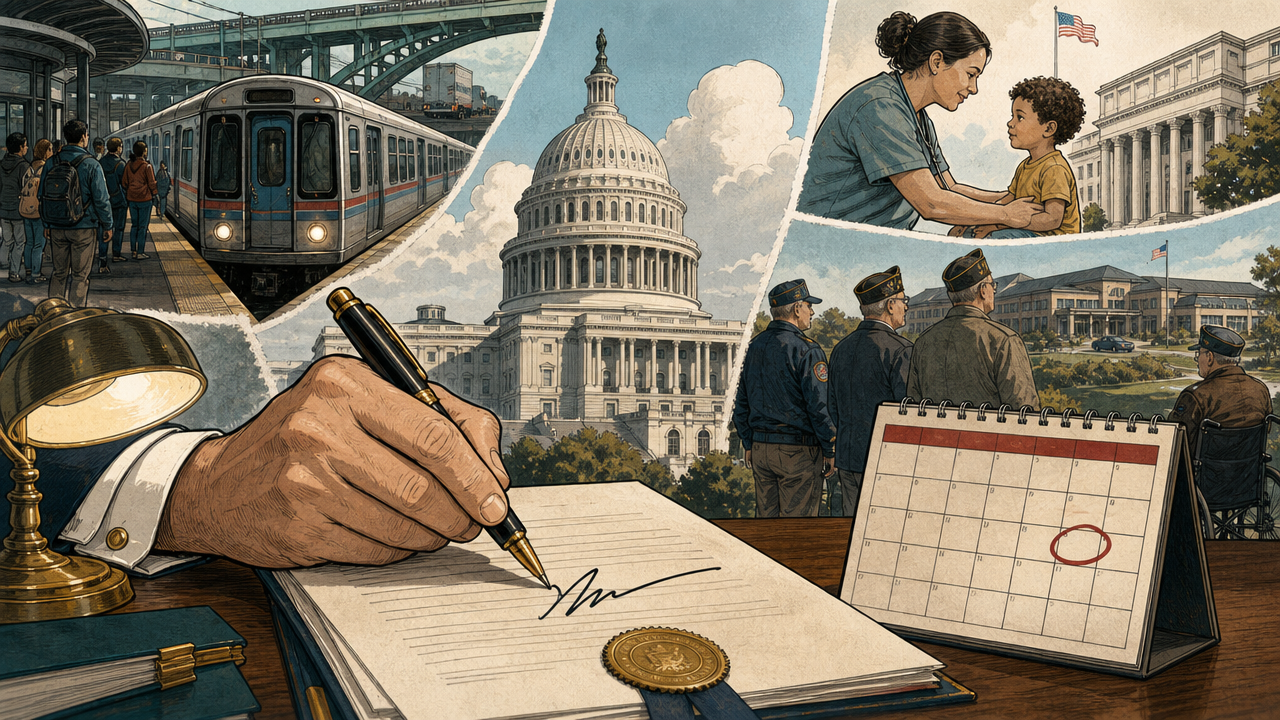
Stopgap federal funding bill is now law through December 11
What happened
President Trump signed H.R. 6500, the Continuing Appropriations and Extensions Act, 2027, on September 2. The law keeps most federal agencies funded through December 11, 2026, and extends a range of transportation and veterans’ authorities.
What it means for voters
This lowers the immediate risk of disrupted federal services, furloughs, and delayed work at agencies people rely on, including benefit offices and transportation programs. It also gives Congress roughly two more months to finish longer-term spending bills. The practical tradeoff is that many programs stay on temporary funding rather than getting clear full-year budgets, so state and local agencies that depend on federal money still face uncertainty after December 11.
Save stories & follow topics · Link to this story
Get the context & analysis
President Trump signed H.R. 6500, the Continuing Appropriations and Extensions Act, 2027, on September 2. The law keeps most federal agencies funded through December 11, 2026, and extends a range of transportation and veterans’ authorities. It prevents a funding lapse when the new federal fiscal year begins on October 1, but it does not settle the full-year budget.
What to watch
Congress must either pass regular spending bills or approve another extension before funding expires on December 11, 2026.
Context from earlier events
On September 1, the House accepted the Senate’s version of the bill. The new development is that the president signed it on September 2, making it law.
Check sources (2)
Paychecks, farm jobs, food supply, and federal court oversight Nationwide
Labor Department says some farmworkers could later be owed wage adjustments
What happened
The Labor Department gave notice on September 2 that employers using H-2A temporary agricultural workers may eventually have to make wage-adjustment payments to some H-2A workers and U.S. workers doing corresponding jobs. A federal court found the department’s current wage-setting method unlawful and ordered a replacement method.
What it means for voters
This could affect paychecks for farmworkers if future wage rates are higher and a court ultimately requires adjustments for work performed after September 2. Farmers do not have a new payment bill today, but they are being told to keep detailed worker contact and earnings records. Higher labor costs could affect farm-business budgets; there is not enough evidence yet to say whether this will change grocery prices or by how much.
Save stories & follow topics · Link to this story
Get the context & analysis
The Labor Department gave notice on September 2 that employers using H-2A temporary agricultural workers may eventually have to make wage-adjustment payments to some H-2A workers and U.S. workers doing corresponding jobs. A federal court found the department’s current wage-setting method unlawful and ordered a replacement method. Current wage rates remain in force for now, and no employer has been ordered to pay back wages yet.
What to watch
The Labor Department must publish a new H-2A wage method and new wage rates. The court could later decide whether back-pay obligations actually apply.
Context from earlier events
A federal judge ruled in late August that the 2025 wage formula was unlawful but left existing rates in place while the department develops a replacement.
Check sources (2)
Voting, mail ballots, election administration, and federal courts Boston, Massachusetts; nationwide
Federal judge hears challenge to Postal Service mail-ballot system
What happened
A federal judge heard arguments September 3 over whether to keep blocking the Postal Service from requiring states to use a new federal mail-ballot system for the November 2026 midterm election. The court already issued a temporary 14-day block last week.
What it means for voters
For voters, the immediate rule is that the new Postal Service system is not required while the temporary order remains in place. Election offices say late changes can mean new envelopes, computer work, staff training, and voter confusion. The case is about who controls election procedures: states generally run elections, while Congress can set rules for federal elections; a president or federal agency cannot simply create new authority on its own.
Save stories & follow topics · Link to this story
Get the context & analysis
A federal judge heard arguments September 3 over whether to keep blocking the Postal Service from requiring states to use a new federal mail-ballot system for the November 2026 midterm election. The court already issued a temporary 14-day block last week. The dispute centers on whether the federal executive branch can require states to use new ballot-envelope and voter-enrollment procedures.
What to watch
The judge could issue a longer preliminary order soon. The administration has already appealed earlier court action, so this fight may again reach higher courts as states begin mailing ballots.
Context from earlier events
The Supreme Court’s August 24 procedural decision said an earlier challenge came too soon because the Postal Service had not issued a final rule. After the rule was issued, states and voting groups filed again and won a temporary block.
Check sources (3)
Primary and independent sources
Prices, small businesses, technology, manufacturing, and presidential trade power Nationwide
New tariffs on many imported drones and key parts take effect today
What happened
A White House proclamation imposes new import duties beginning September 3 on listed unmanned aircraft systems, better known as drones, and certain parts. The stated rates are 100% for listed drones, docking stations, and critical components, and 25% for another group of listed drones.
What it means for voters
The immediate direct effect falls on importers. Retailers, contractors, farmers, photographers, public-safety agencies, and other drone users could face higher equipment or repair costs if businesses pass the added import tax along. Domestic manufacturers may gain some protection from foreign competition. Prices will not necessarily rise by the full tariff amount, and the order includes lower-rate limits for qualifying products from several allied trading partners.
Save stories & follow topics · Link to this story
Get the context & analysis
A White House proclamation imposes new import duties beginning September 3 on listed unmanned aircraft systems, better known as drones, and certain parts. The stated rates are 100% for listed drones, docking stations, and critical components, and 25% for another group of listed drones. A 25% tariff on additional listed components is scheduled for February 9, 2027.
What to watch
Watch for Customs guidance, importer certifications for lower allied-country rates, and whether the Commerce secretary adds more components to the tariff list.
Context from earlier events
:null
Check sources (1)
Primary and independent sources
Home and auto insurance, household bills, state regulation, and consumer protection Texas; state insurance-policy trend with national relevance
Texas insurance regulator warns companies against charging loyal customers more based on shopping behavior
What happened
The Texas Department of Insurance issued a bulletin September 2 reminding insurers that state law bars “price optimization.” That means setting a higher premium because a company thinks a customer is unlikely to shop around or will tolerate an increase, rather than because the person’s insurance risk or costs are higher.
What it means for voters
This does not freeze or cut anyone’s insurance premium. It does tell Texas home and auto insurers that they cannot use customer loyalty or predicted willingness to pay as a pricing factor. For households facing renewal increases, the bulletin may matter if an insurer’s rate method treats similar-risk customers differently for reasons unrelated to actual risk or expenses.
Save stories & follow topics · Link to this story
Get the context & analysis
The Texas Department of Insurance issued a bulletin September 2 reminding insurers that state law bars “price optimization.” That means setting a higher premium because a company thinks a customer is unlikely to shop around or will tolerate an increase, rather than because the person’s insurance risk or costs are higher. The bulletin covers insurers regulated by Texas and says enforcement action can follow violations.
What to watch
The department can examine rate filings and take enforcement action. Texas lawmakers do not return for their regular session until 2027, when additional insurance legislation could be considered.
Context from earlier events
:null
Check sources (2)
Housing costs, rural development, federal rulemaking, and state-local authority Nationwide, especially rural communities
USDA proposes dropping an older federal construction rule for USDA-financed rural housing
What happened
USDA Rural Development announced a proposal to remove a 1987 regulation covering some planning, construction, inspection, contracting, and warranty paperwork for USDA-financed single-family and multifamily housing. USDA says state and local building codes, along with its remaining program rules, would still apply.
What it means for voters
For rural builders, lenders, and housing providers using USDA financing, the agency says removing duplicate federal paperwork could reduce delays and administrative costs. But any savings for renters or homebuyers are uncertain and would depend on local projects and financing. State and local governments would remain responsible for enforcing their building codes, while USDA would still oversee whether its loans and grants meet federal program requirements.
Save stories & follow topics · Link to this story
Get the context & analysis
USDA Rural Development announced a proposal to remove a 1987 regulation covering some planning, construction, inspection, contracting, and warranty paperwork for USDA-financed single-family and multifamily housing. USDA says state and local building codes, along with its remaining program rules, would still apply. This is a proposal, not a completed rule change.
What to watch
The proposed rule must go through the federal rulemaking process, including public notice and comment, before it can take effect.
Context from earlier events
The regulation at issue dates to 1987, before many current state and local construction-code systems and USDA housing programs.
Jobs, energy and manufacturing costs, environmental review, and congressional power Washington, D.C.; nationwide
House passes bill to put more mining projects on a faster federal permitting track
What happened
The House passed H.R. 1501, the Protecting Domestic Mining Act, by a 218-201 vote on September 2. The bill would make mining and mineral-processing projects eligible for FAST-41, a federal process intended to coordinate and speed environmental reviews for major projects.
What it means for voters
Supporters say faster and more predictable reviews could help mining, construction, manufacturing, and supply-chain jobs, and could eventually support domestic production of materials used in vehicles, electronics, and the power grid. Critics argue that quicker permitting can weaken practical environmental oversight and place heavier burdens on nearby communities. The bill itself would not automatically approve a mine, and it would not create an immediate change in household utility bills or consumer prices.
Save stories & follow topics · Link to this story
Get the context & analysis
The House passed H.R. 1501, the Protecting Domestic Mining Act, by a 218-201 vote on September 2. The bill would make mining and mineral-processing projects eligible for FAST-41, a federal process intended to coordinate and speed environmental reviews for major projects. It has not passed the Senate and is not law.
What to watch
The Senate would need to pass the measure, in the same form or after negotiations, before it could go to the president. Watch whether senators take it up and whether project-specific safeguards become part of the debate.
Context from earlier events
:null,
Check sources (3)
Primary and independent sources
You're caught up on this briefing. Choose topics and save stories to return on your own schedule.
How this briefing was made
We used official records to verify government actions and independent reporting to add context. We also checked popular political videos on YouTube for topic leads. Popularity helped us decide what to investigate, but it was not treated as proof or public opinion. Every included claim still had to be checked against the linked sources.