The daily civic brief
U.S. Civic & Pocketbook Scan — October 23, 2026
Election rules are moving fast less than two weeks before the November 3 general election, with new court action affecting federal voter investigations and New Hampshire’s voter-ID rules. Today is also a hard deadline for some mail-ballot requests in Texas and Arizona. Outside voting, new federal housing actions could eventually affect mortgage and homebuilding costs, while fresh wage data show pay lagged inflation over the past year for the typical full-time wage-and-salary worker.
Estimated 5-minute catch-up · 6 stories
Today's audio briefing
Today's spoken briefing
Hear the latest national briefing and what to watch next for every headline. A restrained instrumental bed plays in the web player.
Read the audio transcript
Voting; election administration; federal courts; accountability California, Connecticut, Georgia, Missouri, Nevada, New York, Pennsylvania, Washington, and Wisconsin
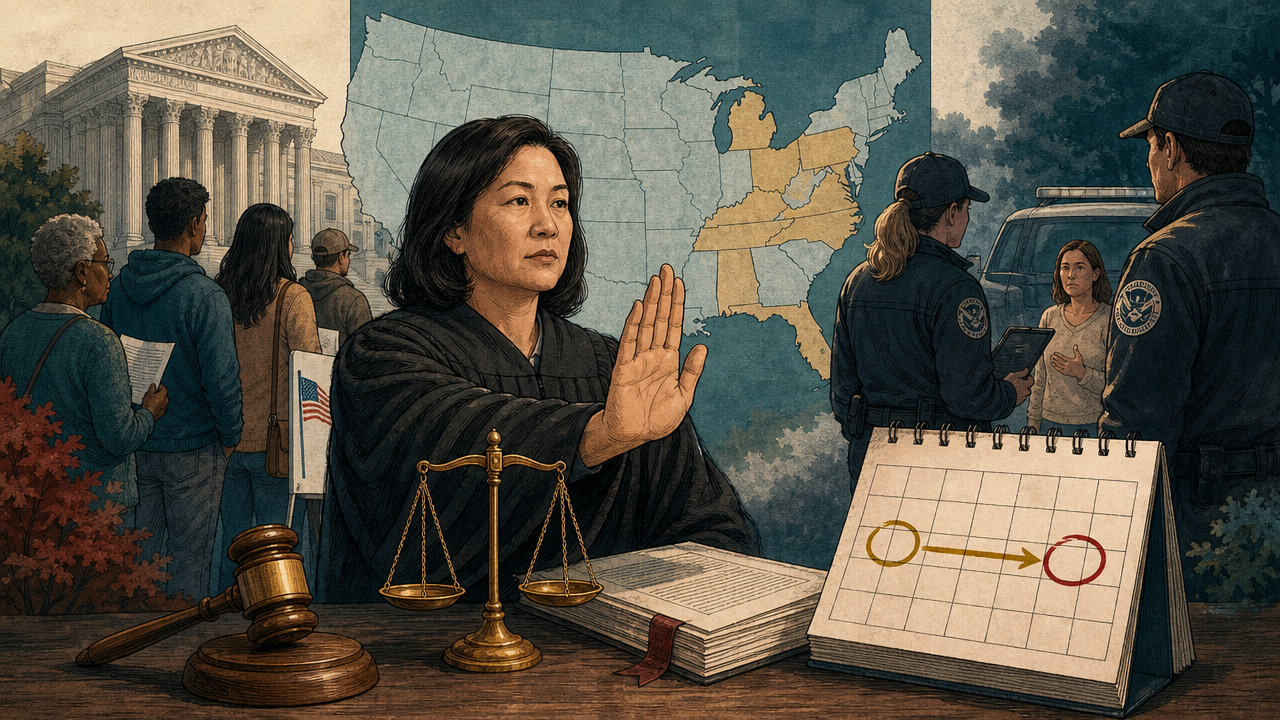
Federal judge restricts DHS voter-related field operations in nine states
Challenged in court: The October 21 preliminary injunction restricts specified DHS election-related field activity in nine states, but it is not a final ruling. The written order says it was stayed until 5 p.m. on October 23 and conditioned on a bond filing; the reviewed sources do not confirm that condition was satisfied. Verify status
What happened
A federal district judge on October 21 ordered the Department of Homeland Security and related officials not to conduct specified election-related field operations or interviews in nine states when they know, suspect, or reasonably should suspect the activity involves U.S. citizens. The order is limited: it does not decide the whole lawsuit or outlaw all investigation of illegal voting.
What it means for voters
For voters and community groups, the immediate issue is whether federal agents can question people about citizenship or voting during the final stretch of the election. The order covers nine named states, not the whole country. It may reduce the risk of voters or voter-assistance groups changing their plans because of a field inquiry, but it does not settle whether particular people voted illegally or whether DHS may pursue lawful investigations by other means. There is no direct paycheck or household-cost change in this order; the practical stake is access to a ballot and confidence that local election rules, rather than a surprise federal field operation, will govern voting.
Save stories & follow topics · Link to this story
Get the context & analysis
A federal district judge on October 21 ordered the Department of Homeland Security and related officials not to conduct specified election-related field operations or interviews in nine states when they know, suspect, or reasonably should suspect the activity involves U.S. citizens. The order is limited: it does not decide the whole lawsuit or outlaw all investigation of illegal voting. It says the restriction was stayed until 5 p.m. on October 23 and lasts through the close of polls on November 3 unless the court changes it; the order also required plaintiffs to post a $100 bond by October 22, and the sources reviewed do not confirm whether that filing occurred.
What to watch
As of 2026-10-23, watch for a filing confirming whether the required bond was posted, an appeal or request to pause the injunction, and any further order from the U.S. District Court for the Northern District of California before November 3.
Context from earlier events
The order follows federal and state disputes this month over federal lists identifying people as possible noncitizens on voter rolls. A list or an investigation is not itself a court finding that a person is ineligible to vote.
Check sources (2)
Primary and independent sources
Voting; voter identification; federal courts; state election administration New Hampshire
Supreme Court lets New Hampshire enforce its student-ID voting limits for November
In effect: As of October 23, the Supreme Court’s action allows New Hampshire to enforce the student-ID limits for the November 3 election while the underlying lawsuit continues. Verify status
What happened
The U.S. Supreme Court on October 22 allowed New Hampshire to enforce its current limits on using student identification cards to obtain a ballot in the November election. The action pauses a lower-court requirement that election workers consider student IDs along with other evidence when deciding a voter’s identity.
What it means for voters
A New Hampshire voter who planned to rely on a campus ID should not assume it will work as ID at the polls. Students, young workers, and people without a driver’s license may need time to check the state’s accepted-ID list or obtain the free voting-only photo ID available through the DMV. This is a state-specific rule, so it does not change ID requirements elsewhere.
Save stories & follow topics · Link to this story
Get the context & analysis
The U.S. Supreme Court on October 22 allowed New Hampshire to enforce its current limits on using student identification cards to obtain a ballot in the November election. The action pauses a lower-court requirement that election workers consider student IDs along with other evidence when deciding a voter’s identity. New Hampshire still requires voters to show an approved photo ID or follow the state’s procedures for voters without one.
What to watch
As of 2026-10-23, voters should check the New Hampshire Secretary of State’s election-day guidance before going to the polls. Watch for any further Supreme Court or lower-court order, but the state’s rule is the operative rule for now.
Context from earlier events
New Hampshire had previously accepted qualifying student IDs under its voter-ID framework. The dispute is over a newer state rule and related election guidance, not over whether students who meet residency and registration rules may vote.
Check sources (2)
Voting; mail ballots; election administration; voter access Texas and Arizona
Texas and Arizona mail-ballot request deadlines fall today
In effect: Texas’s official calendar lists October 23, 2026 as the received-by deadline for general-election mail-ballot applications. Arizona’s official election page lists October 23 as its last day to request a ballot by mail. Verify status
What happened
Friday, October 23 is the deadline for eligible Texas voters to have an application for a ballot by mail received by the early-voting clerk for the November 3 election. It is also Arizona’s last day to request a ballot by mail.
What it means for voters
For a worker juggling a shift, child care, or a long commute, missing a mail-ballot request deadline can remove one voting option. Texas mail voting is limited to voters who meet state eligibility rules, while Arizona’s rules and county procedures differ. A request is not the same as returning a completed ballot, so voters who already have a ballot should check their county’s return instructions and deadlines right away.
Save stories & follow topics · Link to this story
Get the context & analysis
Friday, October 23 is the deadline for eligible Texas voters to have an application for a ballot by mail received by the early-voting clerk for the November 3 election. It is also Arizona’s last day to request a ballot by mail. Texas has already begun in-person early voting, and Arizona’s official election page says voters should return mailed ballots by October 27 and may vote early in person through October 30.
What to watch
Today, October 23, is the action date for ballot requests in both states. In Arizona, October 27 is the state commission’s recommended mail-back date, and October 30 is the last day to vote early in person. In Texas, in-person early voting runs through October 30.
Context from earlier events
Texas began in-person early voting on October 19. Arizona began early voting on October 7, according to the state election commission’s calendar.
Check sources (2)
Primary and independent sources
Voting; federal courts; government; accountability Washington, D.C.; nationwide implications
Democratic groups and leaders file federal election-administration lawsuit
Challenged in court: This is a newly filed federal lawsuit seeking declaratory and injunctive relief. The complaint alleges unlawful federal interference; no final court decision was identified as of October 23. Verify status
What happened
The Democratic Senatorial Campaign Committee, Democratic Congressional Campaign Committee, Democratic Governors Association, Senate Minority Leader Chuck Schumer, House Minority Leader Hakeem Jeffries, the Nevada State Democratic Party, and one California voter filed a federal lawsuit on October 20 against the President, Justice Department, Homeland Security Department, and senior officials. They ask the court to bar federal actions they say could pressure state officials to remove registered voters, deny ballots, or segregate ballots.
What it means for voters
The lawsuit is about who gets to make practical decisions on registration lists, ballot access, and counting. For voters, the immediate rule remains the one issued by their own state and local election officials unless a court changes it. The filing itself does not remove a voter, change a ballot deadline, or block any federal action. It puts the issue before a federal judge, which could lead to a ruling before November 3.
Save stories & follow topics · Link to this story
Get the context & analysis
The Democratic Senatorial Campaign Committee, Democratic Congressional Campaign Committee, Democratic Governors Association, Senate Minority Leader Chuck Schumer, House Minority Leader Hakeem Jeffries, the Nevada State Democratic Party, and one California voter filed a federal lawsuit on October 20 against the President, Justice Department, Homeland Security Department, and senior officials. They ask the court to bar federal actions they say could pressure state officials to remove registered voters, deny ballots, or segregate ballots. Those are claims in a complaint, not findings by a judge. The Justice Department told the Associated Press that election integrity is a priority and that its actions are grounded in law and already under litigation.
What to watch
As of 2026-10-23, watch for a response from the federal defendants and any request for emergency relief in DSCC v. Trump, Case No. 1:26-cv-3674, in the U.S. District Court for the District of Columbia. No ruling on the merits was identified in the reviewed records.
Context from earlier events
The complaint comes amid several October disputes over federal citizenship-related voter investigations and California ballot handling. Those separate cases have different parties, records, and court orders.
Check sources (2)
Primary and independent sources
Housing; mortgages; executive branch; economic life Nationwide
White House order directs mortgage-insurance pilot and factory-built housing work
In effect: The October 22 executive order directs federal agencies to take specified steps, but it does not itself start a mortgage-insurance cancellation program or guarantee lower housing costs. Treasury’s related investor regulations are proposed, not final. Verify status
What happened
President Trump signed an executive order on October 22 directing the Federal Housing Finance Agency director, if the director makes required safety-and-soundness findings, to have Fannie Mae and Freddie Mac establish a pilot to identify some borrowers who may qualify for cancellation of mortgage insurance. The order also creates a federal task force on manufactured and factory-built housing and gives it 180 days to submit recommendations.
What it means for voters
Mortgage insurance can be a real monthly cost for some homeowners, but this order does not automatically cancel anyone’s insurance today. Any pilot would apply only to mortgages made after the pilot begins and would still require equity, payment-history, legal, contract, and safety conditions. For renters and first-time buyers, the factory-built housing work and investor rules may eventually affect supply and competition, but neither source establishes a near-term nationwide drop in rents, home prices, or mortgage payments. A hypothetical family of four earning $110,000 before taxes could be affected only if it is buying or refinancing a qualifying home; the order does not promise a specific savings amount.
Save stories & follow topics · Link to this story
Get the context & analysis
President Trump signed an executive order on October 22 directing the Federal Housing Finance Agency director, if the director makes required safety-and-soundness findings, to have Fannie Mae and Freddie Mac establish a pilot to identify some borrowers who may qualify for cancellation of mortgage insurance. The order also creates a federal task force on manufactured and factory-built housing and gives it 180 days to submit recommendations. Separately, Treasury issued proposed regulations for a law restricting certain large institutional investors from buying single-family homes beginning January 7, 2027, subject to exceptions described in the proposal.
What to watch
As of 2026-10-23, watch for FHFA to announce whether and when it will launch the mortgage-insurance pilot. The housing task force’s recommendation deadline is within 180 days of October 22. Treasury’s proposed investor regulations are not final, and the cited Treasury release says the statutory restrictions are scheduled to begin January 7, 2027.
Context from earlier events
The order builds on a March 2026 housing executive order focused on reducing barriers to home construction. Federal actions can shape financing and incentives, but local zoning and permitting rules remain major parts of the housing-cost picture.
Check sources (2)
Work and wages; inflation; household budgets; economic life Nationwide
Full-time workers’ median weekly pay rose 1.5%, while consumer prices rose 3.5%
In effect: These are official economic estimates, not a policy change. BLS says the earnings data come from a national household survey and are reported before taxes and other deductions. Verify status
What happened
The Bureau of Labor Statistics reported October 21 that median usual weekly earnings for 122.2 million full-time wage-and-salary workers were $1,232 in the third quarter of 2026, before taxes and other deductions. That was 1.5% higher than a year earlier.
What it means for voters
A raise that is smaller than price growth can still leave a household short on groceries, gas, rent, child care, or bills. The $1,232 figure is a worker-level median before taxes, not median family income and not take-home pay. It also excludes self-employed workers and does not tell us what any individual employer, state, or family experienced. For a hypothetical family of four earning about $110,000 before taxes, the report does not calculate a budget impact; it shows why a modest pay increase may not feel like progress if basic costs rise faster.
Save stories & follow topics · Link to this story
Get the context & analysis
The Bureau of Labor Statistics reported October 21 that median usual weekly earnings for 122.2 million full-time wage-and-salary workers were $1,232 in the third quarter of 2026, before taxes and other deductions. That was 1.5% higher than a year earlier. Over the same period, the Consumer Price Index for All Urban Consumers rose 3.5%, meaning the two measures point to purchasing power being under pressure for the typical full-time wage-and-salary worker. This is a broad survey measure, not a new wage law or a measure of every worker’s raise.
What to watch
As of 2026-10-23, BLS is scheduled to release its October Consumer Price Index and real-earnings data on November 10. It is also scheduled to release the Employment Cost Index for the third quarter on October 30, which will provide another look at wages and benefits.
Context from earlier events
BLS reported separately that real average hourly earnings for private workers fell in September when consumer prices rose faster than average hourly pay. The quarterly median-pay report points in the same general direction but uses a different measure and time period.
Check sources (2)
You're caught up on this briefing. Choose topics and save stories to return on your own schedule.
How this briefing was made
We used official records to verify government actions and independent reporting to add context. We also searched recent election-related videos on YouTube for topic leads. Search rank and popularity were not treated as proof or public opinion. Every included claim still had to be checked against the linked sources.