The daily civic brief
U.S. Civic Daily Scan — October 20, 2026
Voting deadlines and election administration lead today’s scan. The biggest new national development is a California federal case over alleged noncitizen voters: 28 people have been charged, but the government’s separate request to hold back ballots from more than 20,000 people remains an unresolved court request, not a finding. Workers also have new federal job-training resources to watch in 17 states, while a wage-and-hour court judgment shows how unpaid overtime cases can turn into real paychecks.
Estimated 5-minute catch-up · 6 stories
Today's audio briefing
Today's spoken briefing
Hear the latest national briefing and what to watch next for every headline. A restrained instrumental bed plays in the web player.
Read the audio transcript
Voting; election enforcement; accountability California, with national election-enforcement relevance
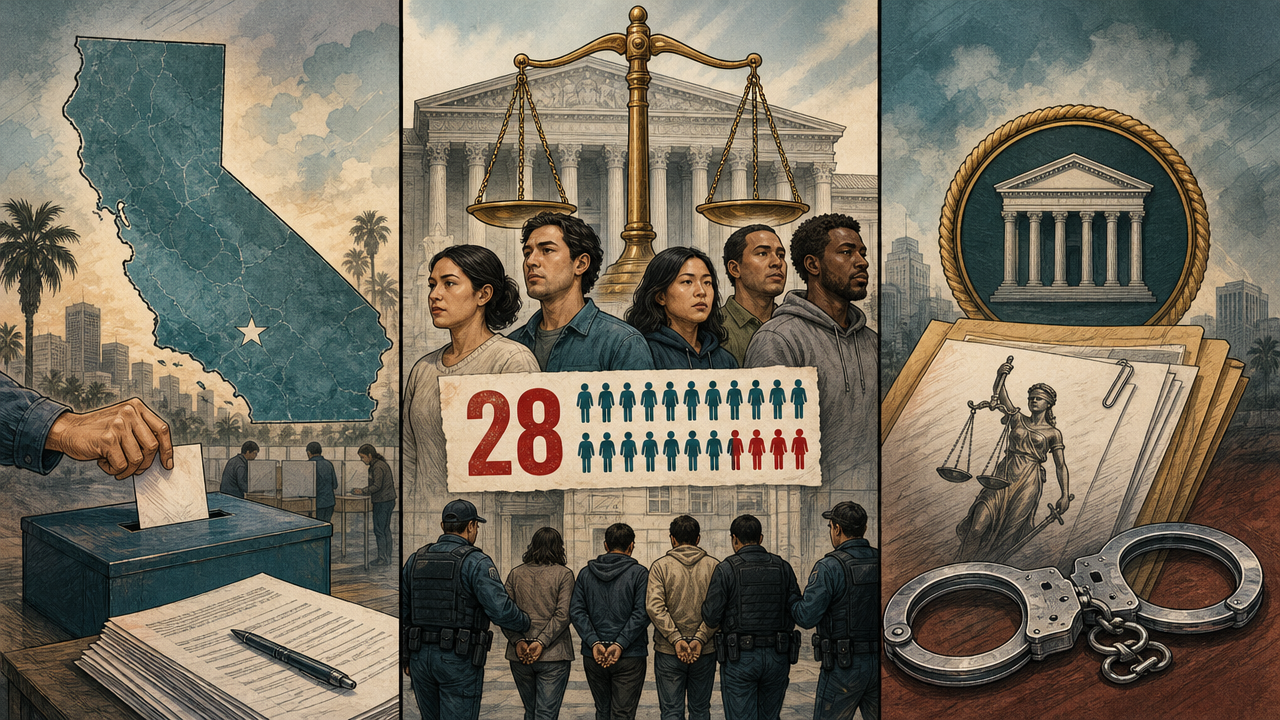
Justice Department charges 28 people in California with alleged illegal voting and related citizenship fraud
Challenged in court: The cases are pending criminal accusations as of October 20, 2026. The Justice Department states that complaints contain allegations and that defendants are presumed innocent unless guilt is proven in court. Verify status
What happened
On October 19, the Justice Department said 28 lawful permanent residents in California were charged in criminal complaints with alleged illegal voting, fraudulent voter registration, false claims of citizenship, or related false statements in naturalization matters. Eleven were arrested that day.
What it means for voters
Noncitizens cannot vote in federal elections, and proven violations can bring criminal penalties. But these cases involve named people and alleged acts, not proof of broad or outcome-changing fraud. For voters, the practical point is that election crimes are investigated through evidence and court process—not through social-media claims or assumptions about whole communities. The cases also arrive while California is already voting by mail, so officials and courts will be under pressure to distinguish documented individual cases from unverified claims about larger voter lists.
Save stories & follow topics · Link to this story
Get the context & analysis
On October 19, the Justice Department said 28 lawful permanent residents in California were charged in criminal complaints with alleged illegal voting, fraudulent voter registration, false claims of citizenship, or related false statements in naturalization matters. Eleven were arrested that day. These are criminal accusations; no defendant has been convicted, and each is presumed innocent unless proven guilty in court.
What to watch
As of 2026-10-20, watch the defendants’ initial court appearances, charging documents, and any plea or trial outcomes. Those records—not arrest announcements—will show what can be proved.
Context from earlier events
Federal law bars noncitizens from voting in elections for federal offices. The charges concern alleged conduct in earlier elections, including the November 2024 general election, rather than a finding about ballots in the November 3, 2026 election.
Check sources (3)
Primary and independent sources
- U.S. Department of Justice Justice Department Charges 28 Foreign Nationals in California for Election Crimes
- U.S. Attorney's Office, Central District of California 11 Foreign Nationals Arrested in California on Federal Charges Alleging They Illegally Registered and Voted in U.S. Elections
- Associated Press Justice Department charges more than 2 dozen in California sweep targeting alleged noncitizen voters
Voting; courts; voter registration; election administration California, with national election-administration relevance
California ballot-count lawsuit remains unresolved; Justice Department seeks to hold ballots from more than 20,000 flagged voters
Challenged in court: The United States filed its complaint on October 15, 2026 and requested an order to set aside specified mail ballots until citizenship can be confirmed. As of October 20, 2026, the cited materials do not show that a court granted that request. Verify status
What happened
The Justice Department’s October 15 lawsuit asks a federal court to stop California from counting mail ballots from more than 20,000 registered people whom federal agencies describe as likely noncitizens until citizenship can be checked. California officials dispute that the federal government has supplied enough evidence for that claim.
What it means for voters
A court order could affect whether particular mail ballots are counted and could require fast verification work during an election already underway. The tradeoff is real: officials must stop unlawful voting when there is evidence, while also avoiding wrongful barriers for eligible citizens who may be incorrectly flagged. For working voters using mail ballots around long shifts, childcare, or commute demands, clear rules and accurate notices matter because a late dispute can make it harder to know whether a ballot will count.
Save stories & follow topics · Link to this story
Get the context & analysis
The Justice Department’s October 15 lawsuit asks a federal court to stop California from counting mail ballots from more than 20,000 registered people whom federal agencies describe as likely noncitizens until citizenship can be checked. California officials dispute that the federal government has supplied enough evidence for that claim. As of October 20, no cited court order has granted the requested ballot hold, so the lawsuit is an unresolved request, not a change in California’s ballot-counting rules.
What to watch
Watch for a federal district-court hearing, an emergency ruling, or a California filing responding to the request. As of 2026-10-20, no hearing date or order was confirmed in the cited records.
Context from earlier events
California sends mail ballots to registered voters under state law. California’s attorney general recently reminded voters that eligible residents can still use same-day conditional voter registration after the regular registration deadline.
Check sources (4)
Primary and independent sources
- U.S. Department of Justice Filed U.S. Complaint Against California Voter-Roll Defendants
- U.S. Attorney's Office, Central District of California United States Sues California After Determining More Than 20,000 Likely Noncitizens Are Registered to Vote in the Golden State
- California Department of Justice Following Critical U.S. Supreme Court Victory, Attorney General Bonta Reaffirms Mail-In Voting Remains Safe and Secure for November General Election
- Associated Press California officials who process ballots from suspected noncitizens risk prosecution, US warns
Voting; voter access; election administration North Carolina
North Carolina’s absentee-ballot request deadline is today; early in-person voting continues through October 31
In effect: North Carolina lists October 20, 2026 as the absentee-ballot request deadline and October 15 through October 31 as the in-person early-voting period for the November 2026 general election. Verify status
What happened
October 20, 2026 is North Carolina’s deadline to request an absentee ballot for the November 3 general election. In-person early voting is already underway and continues through October 31.
What it means for voters
For North Carolina workers, today is a practical deadline: a voter who needs a mail ballot because of work hours, disability, travel, caregiving, or transportation should not wait past the request cutoff. People who miss it can still use early in-person voting through October 31 or vote on Election Day if eligible. Reporting a problem at the polling place right away gives local staff the best chance to fix issues involving check-in, identification, ballots, or accessibility.
Save stories & follow topics · Link to this story
Get the context & analysis
October 20, 2026 is North Carolina’s deadline to request an absentee ballot for the November 3 general election. In-person early voting is already underway and continues through October 31. The State Board of Elections also tells voters who encounter a problem while voting to report it to an election official at the site.
What to watch
The next confirmed statewide deadline is October 31, 2026, when North Carolina’s in-person early-voting period ends. Election Day is November 3, 2026.
Context from earlier events
North Carolina previously addressed a false online claim that ordinary election-worker markings automatically void ballots; the board says required handling marks generally do not disqualify a ballot unless they interfere with voting areas or timing marks.
Check sources (3)
Primary and independent sources
- North Carolina State Board of Elections North Carolina State Board of Elections home page and 2026 general-election calendar
- North Carolina State Board of Elections Encounter an Issue While Voting? Tell an Election Official
- North Carolina State Board of Elections Fact: In NC, Election Workers Often Do Have to Write on Your Ballot
Voting; voter access; elections Louisiana
Louisiana early voting opens today for the November 3 election
In effect: Louisiana’s official election page says early voting is open October 20 through October 27, 2026, excluding October 25, for the November 3 election. Verify status
What happened
Louisiana’s early-voting period for the November 3 election begins October 20 and runs through October 27, except Sunday, October 25. Early-voting hours are 8:30 a.m. to 6 p.m. The state says the absentee-ballot request deadline for most voters is October 30 at 4:30 p.m., and completed absentee ballots generally must reach registrars by November 2 at 4:30 p.m.
What it means for voters
Early voting gives people a chance to vote around shift work, caregiving, commuting, and unexpected Election Day problems. It does not eliminate every barrier: voters still need to confirm their parish location and make a plan during the available hours. For a household balancing work and family schedules, a seven-day window can be more useful than trying to fit voting into one Tuesday.
Save stories & follow topics · Link to this story
Get the context & analysis
What to watch
The next confirmed Louisiana deadline is October 30, 2026 at 4:30 p.m. for most absentee-ballot requests. Early voting ends October 27, and Election Day polls will be open November 3 from 6 a.m. to 8 p.m.
Context from earlier events
Louisiana’s 2026 election calendar establishes the November 3 general-election date and the early-voting window now underway.
Check sources (2)
Primary and independent sources
Work and wages; layoffs; job training; public services Nationwide; grants awarded in 17 states
Labor Department awards $95.5 million for rapid retraining after layoffs in 17 states
In effect: The Labor Department announced the grant awards on October 19, 2026. The funded projects are now awards, but local availability for individual workers depends on each recipient’s implementation and enrollment process. Verify status
What happened
The Labor Department announced October 19 that it awarded $95.5 million for 20 Rapid Reskill Dislocated Worker Grant projects in 17 states. The grants are meant to connect people affected by layoffs with training, credentials, paid work, apprenticeships, or structured on-the-job training in fields including manufacturing, aerospace, energy, and construction.
What it means for voters
This money is not an automatic check for every laid-off worker. It goes to state agencies, workforce boards, and nonprofit providers that will decide local enrollment and services. Still, it could give some workers a faster route to training, a recognized credential, or paid work after a layoff instead of leaving them to navigate unemployment and career changes alone. The real test is whether programs reach people quickly and lead to jobs with stable pay, not just a short class and a certificate.
Save stories & follow topics · Link to this story
Get the context & analysis
The Labor Department announced October 19 that it awarded $95.5 million for 20 Rapid Reskill Dislocated Worker Grant projects in 17 states. The grants are meant to connect people affected by layoffs with training, credentials, paid work, apprenticeships, or structured on-the-job training in fields including manufacturing, aerospace, energy, and construction. The department says projects aim to place participants into paid training or jobs within six months of enrollment.
What to watch
As of 2026-10-20, watch the listed state and local grant recipients for enrollment rules, training locations, eligibility requirements, and start dates. The Department of Labor has not announced one national participant application deadline.
Context from earlier events
National Dislocated Worker Grants are a time-limited workforce tool under the Workforce Innovation and Opportunity Act for major job losses and other workforce disruptions that exceed ordinary local program capacity.
Check sources (3)
Primary and independent sources
- U.S. Department of Labor US Department of Labor awards $95.5M in grants to support innovative programs for reskilling, reemploying dislocated workers
- U.S. Department of Labor National Dislocated Worker Grant Funding Opportunities
- U.S. Bureau of Labor Statistics Employment Situation News Release — September 2026
Work and wages; overtime; wage theft; accountability California
Federal consent judgment orders appliance company to pay $800,000 over unpaid overtime claims
In effect: The Labor Department states that it obtained a consent judgment requiring $800,000 in back wages and damages for 339 employees. That is a current court-enforced resolution, not a proposed overtime rule. Verify status
What happened
The Labor Department says it obtained a federal consent judgment requiring California-based home-appliance company Coway USA to pay $800,000 in back wages and damages to 339 employees. The department’s earlier lawsuit alleged that piece-rate service workers were not paid overtime for all hours worked, including time connected to customer calls, loading, warehouse trips, and mandatory training.
What it means for voters
For hourly and piece-rate workers, the rule is simple: being paid by the job does not erase the right to be paid for all work time or to receive overtime when federal law requires it. This judgment affects the workers in the case directly. For other workers, it is a reminder to keep records of off-the-clock calls, required meetings, loading time, travel between work tasks, and other job-related time that may not show up clearly on a pay stub.
Save stories & follow topics · Link to this story
Get the context & analysis
The Labor Department says it obtained a federal consent judgment requiring California-based home-appliance company Coway USA to pay $800,000 in back wages and damages to 339 employees. The department’s earlier lawsuit alleged that piece-rate service workers were not paid overtime for all hours worked, including time connected to customer calls, loading, warehouse trips, and mandatory training. A consent judgment is a court-approved resolution, not merely an agency accusation.
What to watch
As of 2026-10-20, the key next step is distribution of the court-ordered back wages and damages to affected workers. Workers who believe they are owed wages can check the Labor Department’s back-wage tools or contact the Wage and Hour Division.
Context from earlier events
The Labor Department filed its earlier public lawsuit against Coway USA in September 2024, alleging failures to account for all work time when calculating overtime for service and maintenance employees.
Check sources (3)
You're caught up on this briefing. Choose topics and save stories to return on your own schedule.
How this briefing was made
We used official records to verify government actions and independent reporting to add context. We also searched recent election-related videos on YouTube for topic leads. Search rank and popularity were not treated as proof or public opinion. Every included claim still had to be checked against the linked sources.