The daily civic brief
U.S. Civic Daily Scan — October 21, 2026
Voting deadlines and early-voting logistics are the biggest practical civic items today. Florida voters have one day left to request a mailed ballot, New Jersey’s sample-ballot mailing date is here, and Texas counties must post Saturday early-voting information. On the pocketbook side, a new federal labor report shows September joblessness changed little across most states, though conditions still vary a lot by where workers live.
Estimated 3-minute catch-up · 5 stories
Today's audio briefing
Today's spoken briefing
Hear the latest national briefing and what to watch next for every headline. A restrained instrumental bed plays in the web player.
Read the audio transcript
Voting; voter access; election administration Florida
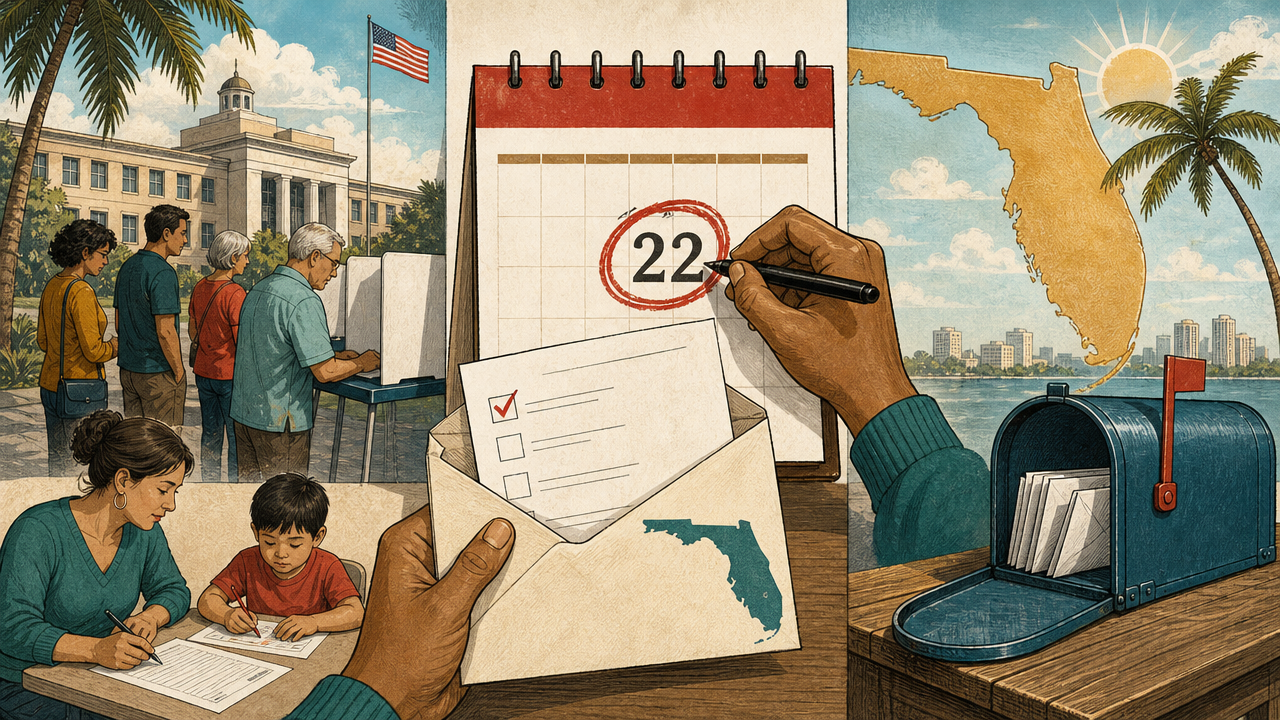
Florida mail-ballot request deadline is Thursday, October 22
In effect: Florida’s official 2026 election calendar lists October 22, 2026 as the deadline to request a mailed ballot for the November 3 general election, with mandatory early voting beginning October 24. Verify status
What happened
Florida’s statewide election calendar lists Thursday, October 22, 2026 as the deadline for a voter to request that a vote-by-mail ballot be mailed for the November 3 general election. Some counties are already offering optional early voting, while the state’s mandatory early-voting period begins October 24.
What it means for voters
For Floridians working long shifts, dealing with childcare, or expecting to be away from home, this is a near-term choice about how to vote. A mailed-ballot request is not the same as casting a ballot: voters still need to complete and return the ballot by their county’s deadline. If a voter misses the request deadline, in-person early voting or Election Day may still be options, depending on the county schedule.
Save stories & follow topics · Link to this story
Get the context & analysis
What to watch
As of 2026-10-21, the next statewide deadline is Thursday, October 22, 2026, for requesting a mailed ballot. Florida’s mandatory eight-day early-voting period begins Saturday, October 24; county supervisors set sites and may offer additional optional days.
Context from earlier events
: Florida’s voter-registration deadline for this general election was October 5, 2026, so the immediate question now is voting method and ballot return rather than new registration.
Check sources (2)
Voting; voter information; election administration New Jersey
New Jersey’s sample-ballot mailing date is today; early voting starts October 24
In effect: New Jersey’s official voter portal lists October 21, 2026 as the sample-ballot mailing date, October 24-November 1 for early voting, and October 27 as the by-mail application deadline for a mail-in ballot. Verify status
What happened
New Jersey’s Division of Elections lists October 21, 2026 as the general-election sample-ballot mailing date. Its statewide in-person early-voting period runs from October 24 through November 1.
What it means for voters
A sample ballot gives voters time to see the offices and questions they’ll face before getting to a polling place. That can help workers and families look up candidates, plan how long voting may take, and catch basic problems such as a wrong voting location early enough to contact county election staff. It is an informational mailing, not the voter’s actual ballot.
Save stories & follow topics · Link to this story
Get the context & analysis
New Jersey’s Division of Elections lists October 21, 2026 as the general-election sample-ballot mailing date. Its statewide in-person early-voting period runs from October 24 through November 1. The deadline to apply by mail for a mail-in ballot is October 27.
What to watch
As of 2026-10-21, watch for the start of in-person early voting on Saturday, October 24, 2026. The next mail-in voting deadline is Tuesday, October 27, 2026, for applications sent by mail.
Context from earlier events
: New Jersey’s registration deadline was October 13, 2026. Voters who are already registered now have multiple listed ways to cast a ballot: mail-in, early in person, or on Election Day.
Check sources (1)
Primary and independent sources
Voting; election administration; early voting Texas
Texas counties must post Saturday early-voting details today
In effect: Texas’s official election calendar requires the Saturday early-voting notice to be posted by October 21, 2026 and requires extended voting hours on the final Saturday of the early-voting period. Verify status
What happened
Texas’s election calendar makes October 21, 2026 the deadline for counties to post notice of Saturday early voting for October 24. The calendar says that on the last Saturday of early voting, every county must offer at least 12 consecutive hours at its main early-voting polling place; larger counties also have requirements for certain temporary branch locations.
What it means for voters
For workers who cannot get away during weekday business hours, weekend voting can be the most realistic option. Today’s posting deadline is meant to give voters advance notice of where and when Saturday voting will happen, instead of leaving them to guess after arranging rides, childcare, or time off.
Save stories & follow topics · Link to this story
Get the context & analysis
What to watch
As of 2026-10-21, Texas voters should check their county election office website for Saturday, October 24 hours and locations. The state calendar says Saturday must include at least 12 consecutive hours at the main early-voting site, and Sunday has separate minimum-hour rules.
Context from earlier events
: Texas in-person early voting began October 19, 2026. Today’s notice requirement concerns the next weekend option, not a change to the already-open early-voting period.
Check sources (2)
Primary and independent sources
Work and wages; jobs; economic life Nationwide
September unemployment rates fell in five states and held steady in most others
In effect: This is a current federal statistical release, published October 20, 2026, rather than a new employment or wage policy. BLS identifies the latest state estimates as preliminary. Verify status
What happened
The Bureau of Labor Statistics reported October 20 that unemployment rates fell in five states from August to September and were essentially unchanged in 45 states and the District of Columbia. Nationally, the September unemployment rate was 4.2%.
What it means for voters
A national number does not tell a worker much about the local job hunt. A family facing a layoff, reduced hours, or a job search is dealing with the labor market where it lives. The report does not show that anyone’s pay rose or that a household’s bills got easier, but it is a useful check on whether joblessness is moving sharply in a state.
Save stories & follow topics · Link to this story
Get the context & analysis
The Bureau of Labor Statistics reported October 20 that unemployment rates fell in five states from August to September and were essentially unchanged in 45 states and the District of Columbia. Nationally, the September unemployment rate was 4.2%. State rates ranged from 2.0% in South Dakota to 5.6% in the District of Columbia; the current state estimates are preliminary and can be revised.
What to watch
BLS is scheduled to publish October 2026 state employment and unemployment data on November 20, 2026. That release will show whether September’s mostly steady state picture continued.
Context from earlier events
: The national September jobs report, released October 2, showed unemployment at 4.2% and payroll employment up by 29,000. The October 20 state report adds the local breakdown for that same month.
Courts; voting; government; foundations Washington, D.C.
Justice Kagan criticizes the Court’s election rulings in a public speech
Challenged in court: No specific policy status applies to Kagan’s speech. The comments concern prior and ongoing legal disputes over election rules; the speech itself does not alter law or establish a court ruling. Verify status
What happened
Justice Elena Kagan said Tuesday that voting and election decisions by the Supreme Court’s conservative majority have contributed to political polarization and weakened democracy, according to Associated Press reporting on her speech. Her remarks were her own assessment; they did not create a court order, change an election rule, or decide a pending case.
What it means for voters
Supreme Court rulings can shape the ground rules for voting, redistricting, campaign rules, and how much room states have to write election laws. But a justice’s speech is not itself a legal decision. For voters, the practical point is to separate the Court’s actual opinions and orders from criticism or praise of those opinions.
Save stories & follow topics · Link to this story
Get the context & analysis
What to watch
As of 2026-10-21, no specific new Supreme Court election ruling was identified in connection with the speech. Watch the Court’s future orders and opinions for any actual change in federal election law before treating a political debate about the Court as a rule change.
Context from earlier events
: The Supreme Court has long been a major referee of election-law disputes, but its decisions apply through written opinions and orders, not through individual justices’ speeches.
Check sources (2)
You're caught up on this briefing. Choose topics and save stories to return on your own schedule.
How this briefing was made
We used official records to verify government actions and independent reporting to add context. We also searched recent election-related videos on YouTube for topic leads. Search rank and popularity were not treated as proof or public opinion. Every included claim still had to be checked against the linked sources.