The daily civic brief
U.S. Civic Daily Scan — October 22, 2026
Election access is the main practical development today: early voting opens in Delaware and Maryland, while Texas voters who need a mail ballot have one day left to apply. Beyond voting, newly published White House action directs federal health agencies to build a women’s-health division and task force, while the latest federal data show paychecks lost buying power in September as prices rose faster than wages.
Estimated 5-minute catch-up · 7 stories
Today's audio briefing
Today's spoken briefing
Hear the latest national briefing and what to watch next for every headline. A restrained instrumental bed plays in the web player.
Read the audio transcript
Voting; election administration; voter access Delaware
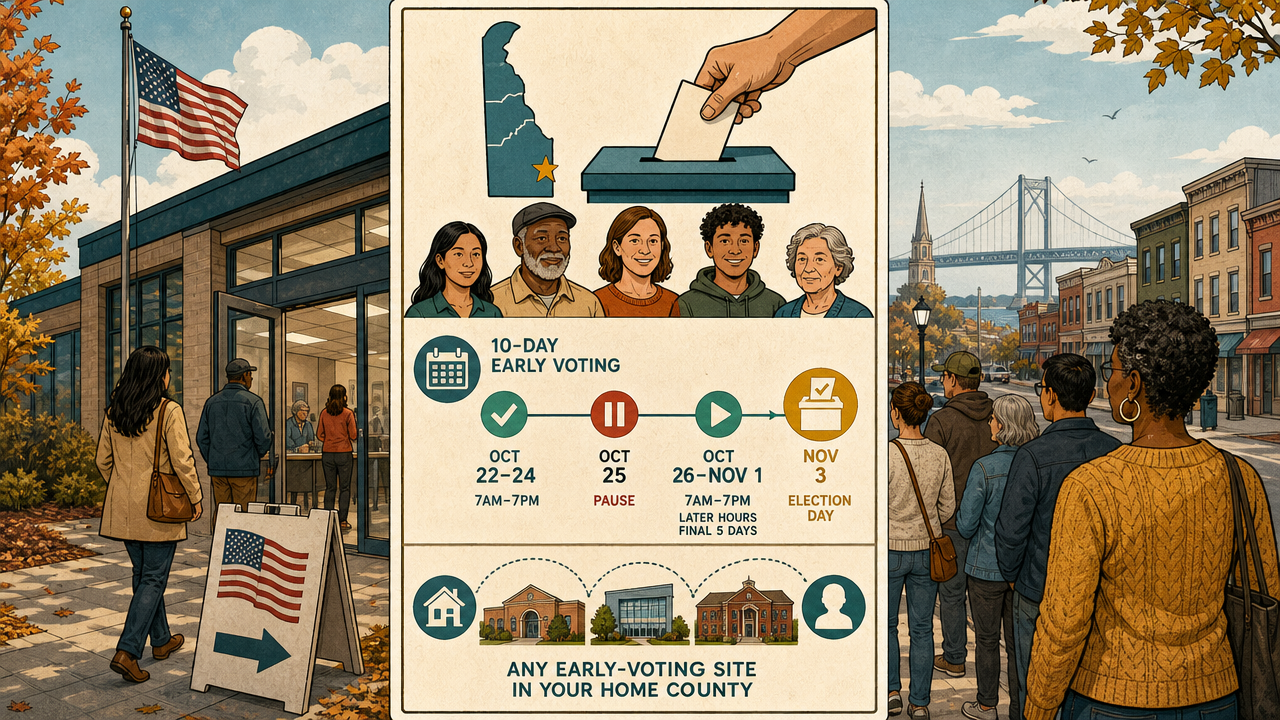
Delaware early voting opens today, with countywide site choice
In effect: Delaware’s official election information lists October 22 through November 1, 2026 as the general-election early-voting period, with no voting on October 25 and varying hours by date. Verify status
What happened
Delaware’s 10-day early-voting period for the November 3 general election begins Thursday, October 22. Registered voters may use any early-voting site in their home county.
What it means for voters
For people juggling shifts, commutes, and child care, being able to vote before Election Day and at any early-voting site in their county can give more scheduling options. Delaware says voters may show ID, but if they do not have it, election workers can verify registration and allow voting after an identity affidavit. The absentee-ballot request deadline is October 30, and a completed absentee ballot must reach election officials by 8 p.m. on November 3.
Save stories & follow topics · Link to this story
Get the context & analysis
Delaware’s 10-day early-voting period for the November 3 general election begins Thursday, October 22. Registered voters may use any early-voting site in their home county. Voting runs 7 a.m. to 7 p.m. through October 24, pauses October 25, then resumes through November 1 with later-day hours for the final five days.
What to watch
As of 2026-10-22, the next statewide deadline is Friday, October 30, 2026, for a request to have a general-election absentee ballot mailed. The Delaware Department of Elections is the responsible agency.
Context from earlier events
Delaware’s early-voting schedule keeps Election Day on Tuesday, November 3, 2026, but gives voters several earlier days to cast a ballot.
Check sources (2)
Voting; voter access; election administration Maryland
Maryland early voting begins today; mail-ballot request deadlines remain
In effect: Maryland’s official voter page lists October 22-29, 2026 for early voting, with centers open 7 a.m. to 8 p.m. Verify status
What happened
Maryland early voting starts Thursday, October 22 and continues through October 29. Early-voting centers are open from 7 a.m. to 8 p.m., and a voter who is in line by 8 p.m. can vote.
What it means for voters
This gives Maryland workers eight days to vote before Election Day, which can matter when a long shift, a commute, or family duties get in the way. For people who still need a mail-in ballot, the request must be received by October 27 for mail or fax delivery, or submitted online by October 30 for email delivery. A completed mail-in ballot can be handed to an approved drop box or local board by 8 p.m. on November 3, or mailed with a November 3 postmark.
Save stories & follow topics · Link to this story
Get the context & analysis
Maryland early voting starts Thursday, October 22 and continues through October 29. Early-voting centers are open from 7 a.m. to 8 p.m., and a voter who is in line by 8 p.m. can vote. Maryland also allows in-person voter registration on Election Day, November 3.
What to watch
As of 2026-10-22, watch Tuesday, October 27, 2026: it is Maryland’s deadline for requests to receive a mail-in ballot by mail or fax. The Maryland State Board of Elections administers the statewide rules through local boards.
Context from earlier events
Maryland’s online and mail registration deadline was October 13, but the state says in-person registration remains available on Election Day.
Check sources (1)
Primary and independent sources
Voting; mail ballots; election administration Texas
Texas mail-ballot application deadline is Friday, October 23
In effect: Texas’s official November 3 election calendar identifies October 23, 2026 as the last day for the early-voting clerk to receive mail-ballot applications and identifies October 22 as the deadline for counties to post Sunday early-voting notice. Verify status
What happened
Texas voters who are eligible to vote by mail have until Friday, October 23, for their county early-voting clerk to receive an application for a ballot by mail. The state calendar says the application must arrive before the close of regular business or noon, whichever is later.
What it means for voters
For a Texas voter who qualifies to vote by mail, this is a hard timing issue: an application sent too late may not lead to a ballot being mailed. The rule matters for workers who may be away, sick, disabled, older, or otherwise eligible under Texas law. It is separate from in-person early voting, which continues later; counties have required extended early-voting hours on October 24 and October 25.
Save stories & follow topics · Link to this story
Get the context & analysis
Texas voters who are eligible to vote by mail have until Friday, October 23, for their county early-voting clerk to receive an application for a ballot by mail. The state calendar says the application must arrive before the close of regular business or noon, whichever is later. Texas also requires counties to post notice of Sunday early-voting hours by October 22.
What to watch
As of 2026-10-22, Friday, October 23, 2026 is the mail-ballot application receipt deadline. County early-voting clerks administer applications, and Texas county election offices should provide their local delivery details.
Context from earlier events
Texas’s calendar also requires at least 12 consecutive hours of early voting at the main site on Saturday, October 24, and at least six consecutive hours on Sunday, October 25.
Check sources (1)
Primary and independent sources
Voting; ballot measures; election rules Nationwide
Voter-ID and election-rule questions are on ballots in multiple states
Proposed: The voting-policy changes discussed are ballot measures awaiting voter decisions in particular states on November 3, 2026. A ballot question is not an enacted statewide rule unless and until it passes and any required certification or implementation steps occur. Verify status
What happened
An Associated Press review published October 22 found about 30 state ballot questions this November that concern voting or election policy. The measures include voter-ID proposals affecting mail voting or in-person voting in several states, citizenship-voting amendments, changes to primary systems, redistricting questions, and rules for citizen ballot initiatives.
What it means for voters
These questions are not federal laws and they do not change voting rules everywhere. They matter because state constitutional amendments and ballot measures can change the rules that govern who votes, how a mail ballot is verified, how districts are drawn, or how citizens can make policy directly. Any effect depends on the specific state measure and whether voters approve it on November 3.
Save stories & follow topics · Link to this story
Get the context & analysis
What to watch
As of 2026-10-22, voters should check their own state election office for the exact ballot wording, fiscal notes, and election-law effect of each measure. Results on Election Night are unofficial until each state completes its canvass and certification process.
Context from earlier events
The AP review notes that most states already use signature verification for mail ballots, while a smaller group require an identification number with mail ballots.
Check sources (1)
Primary and independent sources
Voting; courts; election administration; accountability California
California officials who process ballots from suspected noncitizens risk prosecution, US warns
Challenged in court: The federal government has sought a court order affecting the handling of identified California mail ballots. California officials dispute the factual basis, and the cited reporting does not show that a court had granted the request as of October 22, 2026. Verify status
What happened
The Justice Department has warned California election officials that knowingly tabulating ballots from noncitizens could expose them to investigation or prosecution. The warning follows the federal government’s lawsuit seeking to stop California from counting mail ballots linked to people it calls likely noncitizens until their citizenship is checked.
What it means for voters
This is not a rule telling California voters that their ballots have been thrown out. It is an unresolved federal court dispute over a requested remedy. For voters and election workers, the near-term concern is whether a court changes ballot-processing procedures before November 3. The bigger civic stake is making sure eligibility checks follow evidence and due process while lawful ballots are counted under state rules.
Save stories & follow topics · Link to this story
Get the context & analysis
The Justice Department has warned California election officials that knowingly tabulating ballots from noncitizens could expose them to investigation or prosecution. The warning follows the federal government’s lawsuit seeking to stop California from counting mail ballots linked to people it calls likely noncitizens until their citizenship is checked. California election officials say the federal assertions have not been verified and should be resolved in court; no cited court order has granted the federal request as of October 22.
What to watch
As of 2026-10-22, watch for an order from the federal district court on the Justice Department’s request to set aside specified mail ballots. No hearing date or order was confirmed in the cited records.
Context from earlier events
The Justice Department’s recent California operation produced criminal allegations against 28 people, but charges are not convictions. The separate lawsuit concerns a larger list of voters described by the federal government as likely noncitizens.
Healthcare; government; research policy Nationwide
White House order directs a new NIH women’s-health division and federal task force
In effect: Executive Order 14437 was signed October 19 and scheduled for Federal Register publication on October 22, 2026. It directs HHS and NIH to take specified organizational steps, while stating implementation is subject to applicable law and available appropriations. Verify status
What happened
An executive order published October 22 directs the Department of Health and Human Services, through the National Institutes of Health, to establish a Women’s Health Division within 90 days. It also creates a White House Women’s Health Task Force and revokes a 2024 executive order and a 2023 presidential memorandum on women’s-health research.
What it means for voters
This does not change health-insurance coverage, prescription prices, paid leave, or a patient’s care today. It directs federal research and coordination work, subject to available funding and existing law. For working families, any practical effect on diagnosis, treatment, or access to specialized care would depend on later agency decisions, research funding, and how health systems use the work.
Save stories & follow topics · Link to this story
Get the context & analysis
What to watch
As of 2026-10-22, the order gives HHS and NIH up to 90 days to establish the new division. Watch for NIH or HHS announcements identifying the division’s structure, leadership, funding, and first actions.
Context from earlier events
The order replaces named 2023 and 2024 White House actions rather than simply adding another program alongside them.
Check sources (1)
Primary and independent sources
Work and wages; everyday prices; economic life Nationwide
September data show inflation outpaced wage growth, cutting real pay
In effect: This is an official federal statistical release, not a new policy. BLS labels the September 2026 estimates preliminary. Verify status
What happened
The Bureau of Labor Statistics reported that real average hourly earnings for all private nonfarm employees fell 0.5% from August to September after a 0.1% increase in average hourly pay was outweighed by a 0.6% increase in consumer prices. Real average weekly earnings also fell 0.5%.
What it means for voters
This is about buying power, not just the dollar amount on a paycheck. When prices rise faster than pay, workers can feel squeezed at the grocery store, gas pump, rent payment, or doctor’s office even if their nominal wage went up. These are national averages, so they do not measure every job, city, or family budget. A hypothetical family of four earning about $110,000 before taxes could still feel the squeeze differently depending on housing, commuting, health-care, and debt costs.
Save stories & follow topics · Link to this story
Get the context & analysis
The Bureau of Labor Statistics reported that real average hourly earnings for all private nonfarm employees fell 0.5% from August to September after a 0.1% increase in average hourly pay was outweighed by a 0.6% increase in consumer prices. Real average weekly earnings also fell 0.5%. For production and nonsupervisory workers, real hourly earnings fell 0.6% in September.
What to watch
As of 2026-10-22, BLS is scheduled to release October 2026 real-earnings data on November 10, 2026. That release will show whether September’s decline in purchasing power continued.
Context from earlier events
Over the 12 months through September, real average hourly earnings fell 0.7% for all employees and 0.6% for production and nonsupervisory workers, according to the seasonally adjusted BLS series.
Check sources (1)
Primary and independent sources
You're caught up on this briefing. Choose topics and save stories to return on your own schedule.
How this briefing was made
We used official records to verify government actions and independent reporting to add context. We also searched recent election-related videos on YouTube for topic leads. Search rank and popularity were not treated as proof or public opinion. Every included claim still had to be checked against the linked sources.