The daily civic brief
U.S. Civic Daily Scan — October 24, 2026
Early voting expands today in several large states, while the Postal Service begins special ballot-handling measures nationwide. The biggest election-administration developments also include a planned Justice Department monitoring presence in Multnomah County, Oregon; a newly filed federal case over Alaska’s Senate ballot; and restored voting eligibility for 25 people in Maricopa County, Arizona. For household budgets, the latest federal data still show inflation running ahead of many workers’ pay gains.
Estimated 5-minute catch-up · 7 stories
Today's audio briefing
Today's spoken briefing
Hear the latest national briefing and what to watch next for every headline. A restrained instrumental bed plays in the web player.
Read the audio transcript
Voting; federal courts; Senate election; election certification Alaska
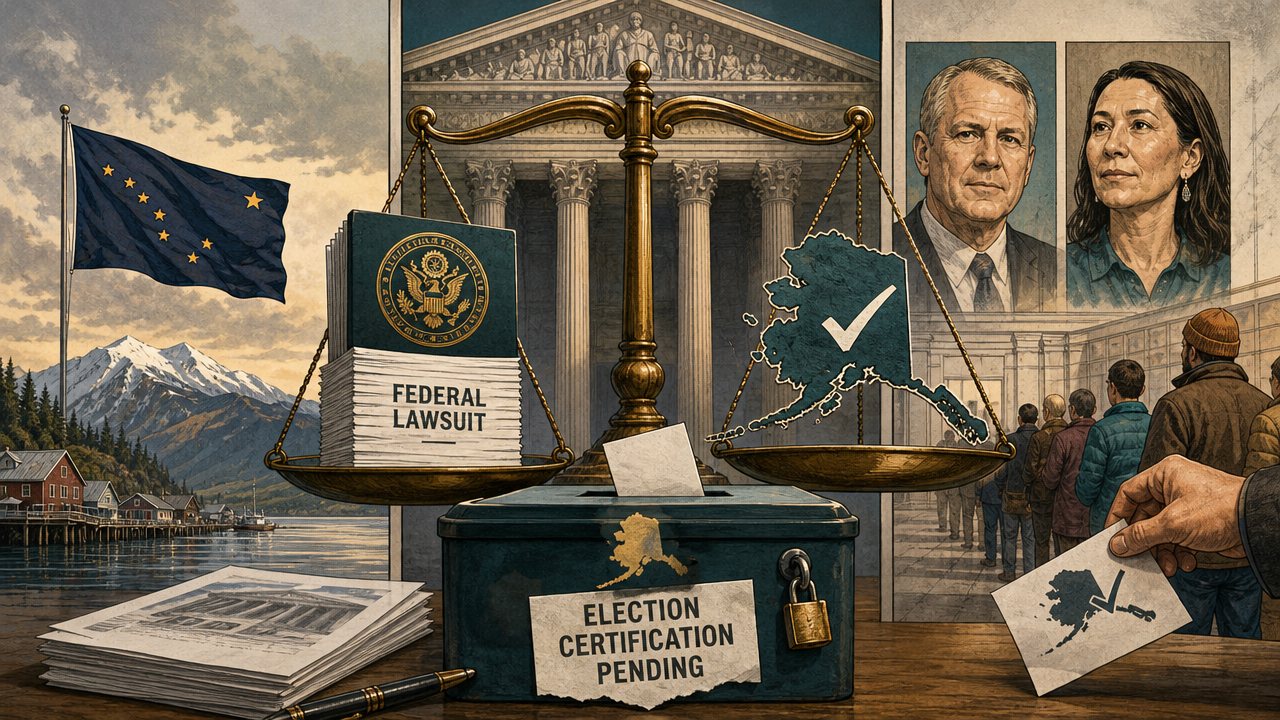
Justice Department lawsuit seeks to block certification of an Alaska Senate result under a stated condition
Challenged in court: The Justice Department’s request is a newly reported federal lawsuit concerning possible certification of the Alaska Senate result. As of October 24, no cited source shows that a court had granted the requested block. Verify status
What happened
The U.S. Justice Department filed a federal lawsuit involving Alaska’s U.S. Senate race. According to Associated Press reporting, the suit seeks to prevent Alaska from certifying a win by Mary Peltola if Daniel J.
What it means for voters
This is about whether voters get a certified result from the ballot rules already in place. Alaska voters have 11 days until the November 3 election, and a lawsuit does not cancel votes or change the ballot by itself. A post-election court fight could delay certainty about representation in the Senate, but the federal judge—not the White House or either campaign—would decide whether any requested court relief is legal.
Save stories & follow topics · Link to this story
Get the context & analysis
The U.S. Justice Department filed a federal lawsuit involving Alaska’s U.S. Senate race. According to Associated Press reporting, the suit seeks to prevent Alaska from certifying a win by Mary Peltola if Daniel J. Sullivan Jr. remains on the ballot. The state election division lists both incumbent Sen. Dan Sullivan and Daniel J. Sullivan Jr. as certified Senate candidates. No court order granting the Justice Department’s request was identified as of 2026-10-24.
What to watch
As of 2026-10-24, watch for the federal court’s docket to show a hearing, an emergency request, or an order. Alaska’s Division of Elections remains responsible for conducting the election and the state’s canvass process unless a court orders otherwise.
Context from earlier events
Alaska election officials previously reviewed Daniel J. Sullivan Jr.’s candidacy. The state’s current candidate list shows him as certified, while the incumbent is separately listed as Dan Sullivan.
Check sources (2)
Voting; election administration; federal-state authority Multnomah County, Oregon
Oregon says Justice Department plans Election Day monitors in Multnomah County
Proposed: Oregon’s Secretary of State said the Justice Department informed it that monitors would be deployed on Election Day. The cited record confirms an announced plan, not a completed deployment or a new Oregon voting rule. Verify status
What happened
Oregon Secretary of State Tobias Read’s office said on October 23 that the U.S. Justice Department’s Civil Rights Division told the state it would deploy election monitors to Multnomah County on Election Day, November 3. The state statement says observers may watch the election process but may not interfere with Oregon’s elections.
What it means for voters
Election monitors can raise understandable questions for voters and poll workers, especially in a large county. The verified point right now is narrower: Oregon says federal monitors are planned, and state officials say Oregon’s normal election rules still apply. For workers voting around shifts, the practical move is to keep using official county or state voting information rather than relying on rumors about what a monitor can do at a voting site.
Save stories & follow topics · Link to this story
Get the context & analysis
Oregon Secretary of State Tobias Read’s office said on October 23 that the U.S. Justice Department’s Civil Rights Division told the state it would deploy election monitors to Multnomah County on Election Day, November 3. The state statement says observers may watch the election process but may not interfere with Oregon’s elections. The state announcement does not describe a specific finding of wrongdoing in Multnomah County.
What to watch
As of 2026-10-24, watch for a public Justice Department statement explaining the monitors’ assignment and for Multnomah County election officials to publish any voter-facing guidance before November 3.
Context from earlier events
Federal observers have a different role from county poll workers and election officials: observing or enforcing federal law does not transfer control of Oregon’s election administration to Washington.
Voting; early voting; voter access; election administration Florida; New Jersey; New York
Early in-person voting opens today in Florida, New Jersey and New York
In effect: Florida’s required early-voting period begins October 24 and runs through October 31. New Jersey and New York list October 24 through November 1 as their statewide early-voting windows for the November 3 general election. Verify status
What happened
Saturday, October 24, is the first day of required statewide early voting in Florida and the first day of New Jersey’s and New York’s statewide early-voting windows for the November 3 general election. Florida’s mandatory period runs October 24 through October 31.
What it means for voters
For people juggling work shifts, a long commute, childcare, or Election Day responsibilities, early voting can give more choices about when to cast a ballot. It does not mean every site has the same hours or that a person can vote at any location in every state. Check the county election office before leaving home, especially if you are using a mail ballot, since return rules differ by state.
Save stories & follow topics · Link to this story
Get the context & analysis
Saturday, October 24, is the first day of required statewide early voting in Florida and the first day of New Jersey’s and New York’s statewide early-voting windows for the November 3 general election. Florida’s mandatory period runs October 24 through October 31. New Jersey and New York run early voting through November 1, though site locations and hours vary by county.
What to watch
As of 2026-10-24, New Jersey’s by-mail application deadline is October 27. Florida’s mandatory early-voting period ends October 31. New Jersey and New York early voting end November 1; Election Day is November 3.
Context from earlier events
These are regular early-voting periods established under each state’s election system, not a change in who is eligible to vote.
Check sources (3)
Voting; voter registration; early voting; election administration California
California vote centers begin opening; same-day registration remains available
In effect: California’s official general-election page says the first vote centers in all Voter’s Choice Act counties open October 24 and that same-day voter registration is available through Election Day at specified in-person locations. Verify status
What happened
California says the first vote centers in counties using the Voter’s Choice Act open today, October 24, for the November 3 general election. The state also says eligible citizens who missed the October 19 online-registration deadline can use same-day voter registration through Election Day at a county elections office or an in-person voting location in their county.
What it means for voters
This gives some Californians a practical backup if work, a move, or a missed deadline got in the way. Same-day registration is not automatic: a person still has to be eligible and complete the process at a county elections office or in-person voting location. For a family balancing a Saturday shift or kids’ activities, voting early can be simpler than waiting for Election Day.
Save stories & follow topics · Link to this story
Get the context & analysis
What to watch
As of 2026-10-24, additional California in-person early-voting locations are scheduled to be open statewide on October 31. November 3 is the deadline to return a ballot by 8 p.m. or vote in person; mailed ballots must be postmarked on or before November 3.
Context from earlier events
California mailed ballots beginning October 5 and opened secure ballot drop-off locations by that date. Today’s opening concerns the first in-person vote centers in counties using the Voter’s Choice Act model.
Check sources (1)
Primary and independent sources
Voting; mail ballots; public services; election administration Nationwide
Postal Service begins special ballot-mail measures today
In effect: USPS says its extraordinary Election Mail measures begin October 24, 2026. The measures are operational steps by USPS; they do not change state ballot deadlines or counting rules. Verify status
What happened
The U.S. Postal Service says its special Election Mail measures begin today, October 24, and will continue through each state’s last day for timely acceptance of completed mail ballots. USPS says the measures can include extra deliveries and collections, special pickups, faster sorting plans, and local handling to speed ballot delivery when a mailpiece can be identified as a ballot.
What it means for voters
For voters using mail ballots, this is helpful operational support, but it is not a promise that a ballot mailed at the last minute will count. State deadlines still control. A voter should use an official drop box or return ballots as early as possible when that is available, and should check the state or county tracker if one exists. That matters for workers who can’t easily make it to a voting site on Election Day.
Save stories & follow topics · Link to this story
Get the context & analysis
What to watch
As of 2026-10-24, watch each state’s ballot-receipt and postmark rules. USPS says its special measures continue until the last timely-acceptance date in each state, which is not the same date everywhere.
Context from earlier events
USPS says it used comparable special measures in prior election cycles and reported that 99.6% of voter-to-election-office ballots in the 2024 general election were delivered within three days.
Check sources (2)
Voting; voter registration; accountability; election administration Maricopa County, Arizona
Maricopa County restores eligibility for 25 voters wrongly flagged as noncitizens
In effect: The reported restoration of registration status applies to the 25 identified voters. It resolves their immediate eligibility issue but does not, on the cited record, create a new statewide rule for all Arizona voters. Verify status
What happened
Maricopa County Recorder Justin Heap restored the voting eligibility of 25 people after Arizona’s attorney general and secretary of state sued, saying the voters had been wrongly classified as noncitizens. Arizona Mirror reported October 23 that the restoration ended the lawsuit.
What it means for voters
For the people involved, this is direct: they can again participate in the November 3 election rather than being blocked by a database flag. It is also a reminder that citizenship-screening systems can produce errors, so election offices need a way to correct records quickly before an election. The resolution does not establish that every citizenship-related flag is wrong, and it does not itself prove wider fraud or wider misconduct.
Save stories & follow topics · Link to this story
Get the context & analysis
Maricopa County Recorder Justin Heap restored the voting eligibility of 25 people after Arizona’s attorney general and secretary of state sued, saying the voters had been wrongly classified as noncitizens. Arizona Mirror reported October 23 that the restoration ended the lawsuit. Earlier reporting said county investigators had determined the 25 people were U.S. citizens.
What to watch
As of 2026-10-24, the immediate lawsuit has reportedly ended after the registrations were restored. Watch for county and state officials to explain whether any broader review or correction process will be used for other voters flagged through the same system.
Context from earlier events
Arizona has dealt with voter-status problems tied to older motor-vehicle records before. A recent Arizona attorney general opinion describes prior litigation and the need to distinguish evidence of authorized presence from proof of U.S. citizenship.
Check sources (3)
Primary and independent sources
- Arizona Mirror Maricopa County recorder restores 25 voters wrongly flagged as noncitizens, ending lawsuit
- KJZZ Arizona officials sue Maricopa County recorder to restore voting access for 25 U.S. citizens
- Arizona Attorney General’s Office Treatment of Voters with Legacy MVD Credentials Who May Not Have Provided Proof of Authorized Presence to MVD
Work and wages; inflation; household budgets; economic life Nationwide
Inflation cut into real pay in September, including for many hourly and frontline workers
In effect: This is an official statistical release describing preliminary September 2026 estimates. It is not a policy change and does not itself change wages, taxes, or benefits. Verify status
What happened
The Bureau of Labor Statistics’ latest real-earnings release shows that real average hourly earnings for private nonfarm workers fell 0.5% from August to September 2026 and 0.6% from September 2025 to September 2026, after adjusting for inflation. For production and nonsupervisory workers—a group covering about four-fifths of private nonfarm payroll employment—real average hourly earnings fell 0.6% in September and 0.6% over the year.
What it means for voters
A paycheck can rise in dollar terms while buying less at the grocery store, gas station, pharmacy, or rent payment. BLS reports average pay measures, not every household’s personal experience, but the direction is clear in this release: September price growth outpaced the average wage increase used in the calculation. For a hypothetical family of four earning about $110,000 before taxes, this does not calculate an exact loss, but it points to tighter purchasing power if their own pay did not keep up with prices.
Save stories & follow topics · Link to this story
Get the context & analysis
The Bureau of Labor Statistics’ latest real-earnings release shows that real average hourly earnings for private nonfarm workers fell 0.5% from August to September 2026 and 0.6% from September 2025 to September 2026, after adjusting for inflation. For production and nonsupervisory workers—a group covering about four-fifths of private nonfarm payroll employment—real average hourly earnings fell 0.6% in September and 0.6% over the year. These are preliminary estimates, not a new law or benefit change.
What to watch
As of 2026-10-24, BLS is scheduled to release October real-earnings data on November 10, 2026. The Employment Cost Index, due October 30, will provide another view of wage-and-benefit costs paid by employers.
Context from earlier events
The release follows BLS’s September inflation data, which showed the Consumer Price Index for All Urban Consumers rose 0.6% during the month used in the real-earnings calculation.
Check sources (2)
Primary and independent sources
You're caught up on this briefing. Choose topics and save stories to return on your own schedule.
How this briefing was made
We used official records to verify government actions and independent reporting to add context. We also searched recent election-related videos on YouTube for topic leads. Search rank and popularity were not treated as proof or public opinion. Every included claim still had to be checked against the linked sources.