The daily civic brief
U.S. Civic & Pocketbook Scan — August 24, 2026
This scan puts the biggest practical developments first: a court ruling affecting legal immigration and family reunification, a finalized but blocked Postal Service mail-ballot rule, and federal policy moves tied to housing, childcare, and rural health care. A common thread is that many decisions are now made, but their real-world effect still depends on agency rollout, court action, or state and local implementation.
Estimated 4-minute catch-up · 5 stories
Today's audio briefing
Today's spoken briefing
Hear the latest national briefing and what to watch next for every headline. A restrained instrumental bed plays in the web player.
A verbatim transcript is unavailable for this edition. Read the written briefing below.
Legal immigration, family budgets, public benefits, jobs, and court oversight Nationwide; U.S. consulates abroad
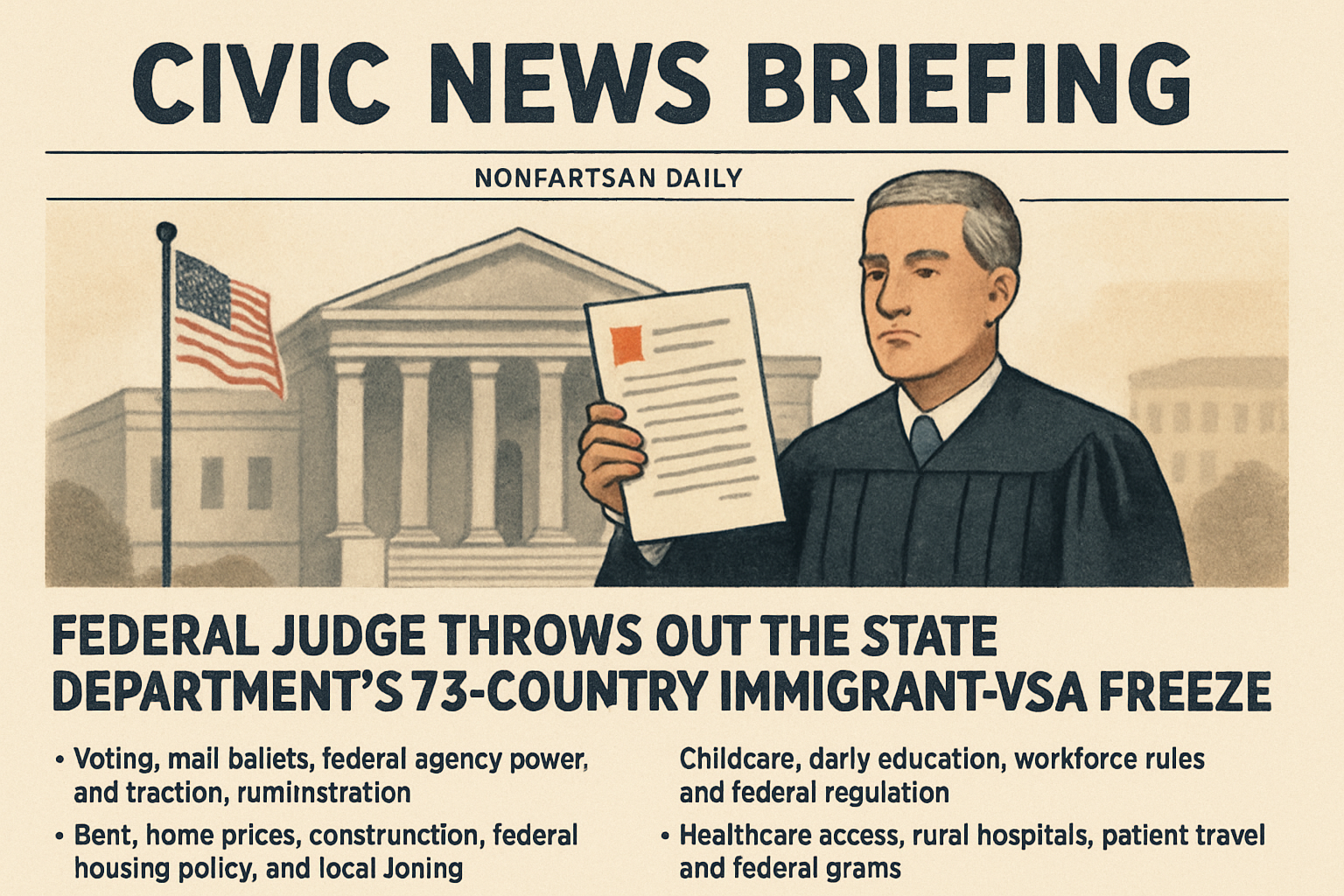
Federal judge throws out the State Department’s 75-country immigrant-visa freeze
What happened
On Friday, August 21, a federal judge vacated a State Department policy that had stopped immigrant-visa processing for people from 75 countries based on a blanket concern that they might use public benefits. The court said the policy exceeded the Secretary of State’s authority and conflicted with the immigration law’s case-by-case visa process.
What it means for voters
For U.S. citizens, lawful residents, and employers waiting on family-based or employment-based immigrant visas, this can reopen a path that had been frozen. It does not guarantee a visa: applicants still must meet the normal legal requirements, and the government can appeal or seek to pause the ruling. The decision also draws a line between an individual review of whether someone may become dependent on public aid and a rule that automatically treats nationality as the deciding factor. The federal judiciary made this decision; the State Department controls the next operational steps.
Save stories & follow topics · Link to this story
Get the context & analysis
On Friday, August 21, a federal judge vacated a State Department policy that had stopped immigrant-visa processing for people from 75 countries based on a blanket concern that they might use public benefits. The court said the policy exceeded the Secretary of State’s authority and conflicted with the immigration law’s case-by-case visa process. The ruling also set aside refusals based only on that policy.
What to watch
Watch for updated State Department instructions to consulates, any government appeal, and whether previously refused applications are reconsidered promptly.
Context from earlier events
The 75-country policy began taking effect in January 2026 as part of the administration’s broader public-charge approach to immigration screening.
Voting, mail ballots, federal agency power, and election administration Nationwide
Postal Service finalizes a mail-ballot rule, but courts still block it for now
What happened
The U.S. Postal Service published a final rule on August 21 that would add federal requirements for mail ballots in federal elections. If allowed to take effect, states would have to provide the Postal Service with voter and ballot-barcode information, and use specified ballot-envelope standards.
What it means for voters
Nothing changes for a voter today because the rule is blocked. If the injunctions are lifted, state and local election offices could face a fast, costly systems change just weeks before Election Day. The rule could especially matter in places where voters rely heavily on absentee or all-mail voting. States set most election procedures, Congress can set federal-election rules, and the courts are now deciding whether this executive-branch and Postal Service approach can lawfully take effect.
Save stories & follow topics · Link to this story
Get the context & analysis
The U.S. Postal Service published a final rule on August 21 that would add federal requirements for mail ballots in federal elections. If allowed to take effect, states would have to provide the Postal Service with voter and ballot-barcode information, and use specified ballot-envelope standards. But federal court injunctions currently prevent the rule from being used for the November 3, 2026 election unless a court lifts those orders.
What to watch
The Supreme Court has an emergency request from the administration in a related case. Also watch for the Federal Register publication scheduled for August 26 and for state election offices’ guidance to voters.
Context from earlier events
The White House election order behind the rule was issued in March. Lower courts have blocked key parts of it, including the mail-ballot changes, while litigation continues.
Check sources (3)
Primary and independent sources
Rent, home prices, construction, federal housing policy, and local zoning Nationwide
New federal housing law is on the books; the hard part is local follow-through
What happened
The 21st Century ROAD to Housing Act became Public Law 119-101 on July 11. The law is meant to increase housing supply through changes that include cutting some federal housing rules, shortening parts of the review process, and addressing large-scale corporate purchases of single-family homes.
What it means for voters
More homes could eventually ease pressure on rents and purchase prices, but this is not an immediate rent cut or a promise that a home will be built in every community. Much of the practical result will depend on federal agencies writing rules and on state and local governments, which control many zoning, permitting, infrastructure, and building decisions. Supporters say the law can make building easier; its limits are also clear: it does not by itself solve labor shortages, high insurance costs, or the cost of borrowing.
Save stories & follow topics · Link to this story
Get the context & analysis
The 21st Century ROAD to Housing Act became Public Law 119-101 on July 11. The law is meant to increase housing supply through changes that include cutting some federal housing rules, shortening parts of the review process, and addressing large-scale corporate purchases of single-family homes. It is now law, not just a proposal.
What to watch
Watch for HUD and other agencies’ implementation notices, grant programs, and rule changes, plus whether cities and states change local rules that limit housing construction.
Context from earlier events
Congress passed the measure with large bipartisan majorities before it became law without the president’s signature.
Check sources (2)
Childcare, early education, workforce rules, and federal regulation Nationwide
HHS proposes broad Head Start rule changes that could affect childcare programs and workers
What happened
The Department of Health and Human Services published a proposed rewrite of Head Start program rules on August 7. The proposal would remove a number of detailed federal requirements and give local Head Start programs more flexibility.
What it means for voters
For families using Head Start, this is not a change in services today. For workers, providers, and parents, it could change workplace standards and how programs serve families who speak languages other than English. HHS says statutory child-safety, disability-rights, and education requirements would remain. The tradeoff is straightforward: supporters of the proposal may see less paperwork and more local control; critics may argue that fewer federal floor rules can mean less consistent support for staff and families. HHS, an executive-branch agency, controls this rulemaking, but public comments and a final rule are still needed.
Save stories & follow topics · Link to this story
Get the context & analysis
The Department of Health and Human Services published a proposed rewrite of Head Start program rules on August 7. The proposal would remove a number of detailed federal requirements and give local Head Start programs more flexibility. Among other changes, it would remove some requirements concerning staff breaks, staff health exams, staff mental-health information, and a requirement for a classroom worker or home visitor to speak the main non-English language used by most children in a class.
What to watch
Watch the public-comment deadline, changes in the final rule, and whether local Head Start providers say the proposal would alter staffing, family outreach, or program costs.
Context from earlier events
Head Start is federally funded but run through local grantees, so national rules can affect programs differently from one community to another.
Check sources (1)
Primary and independent sources
Healthcare access, rural hospitals, patient travel, and federal grants West Virginia, North Dakota, Pennsylvania, and South Dakota
CMS announces recent rural-health investments in four states
What happened
CMS announced several recent federal health-care investments: $4.2 million for medical transportation in West Virginia, care-coordination funding in North Dakota, $35 million for rural health facilities and transportation-related improvements in Pennsylvania, and $90 million for health-information technology and care coordination in South Dakota. These are federal grants and program investments, not nationwide changes to Medicare or Medicaid eligibility.
What it means for voters
For people in rural areas, getting to a specialist, hospital, or treatment can mean missed work, long drives, and delayed care. These investments may improve transportation, equipment, operating rooms, and the sharing of medical information among providers. Still, the dollar amounts do not guarantee lower bills or equal access everywhere. State agencies, hospitals, clinics, and transportation providers will determine when projects begin and which communities benefit.
Save stories & follow topics · Link to this story
Get the context & analysis
What to watch
Watch for grant agreements, project timelines, and local announcements that identify which hospitals, clinics, transportation routes, or patients will be included.
Context from earlier events
Rural health access often depends on a mix of federal funding, state Medicaid policy, local providers, and transportation systems.
Check sources (1)
Primary and independent sources
You're caught up on this briefing. Choose topics and save stories to return on your own schedule.
How this briefing was made
We used official records to verify government actions and independent reporting to add context. We also checked popular political videos on YouTube for topic leads. Popularity helped us decide what to investigate, but it was not treated as proof or public opinion. Every included claim still had to be checked against the linked sources.