The daily civic brief
U.S. Politics Daily Scan — Tuesday, August 18, 2026
Today’s biggest civic action is a group of primaries and a California House special election that will shape the November midterms. Also in focus: a Supreme Court fight over White House construction, a still-pending dispute over federal election rules, FEMA’s new leader, federal funding, and new Canada tariffs scheduled for Wednesday.
Estimated 5-minute catch-up · 8 stories
Today's audio briefing
Today's spoken briefing
Hear the latest national briefing and what to watch next for every headline. A restrained instrumental bed plays in the web player.
A verbatim transcript is unavailable for this edition. Read the written briefing below.
Redistricting and the 2026 midterms Florida
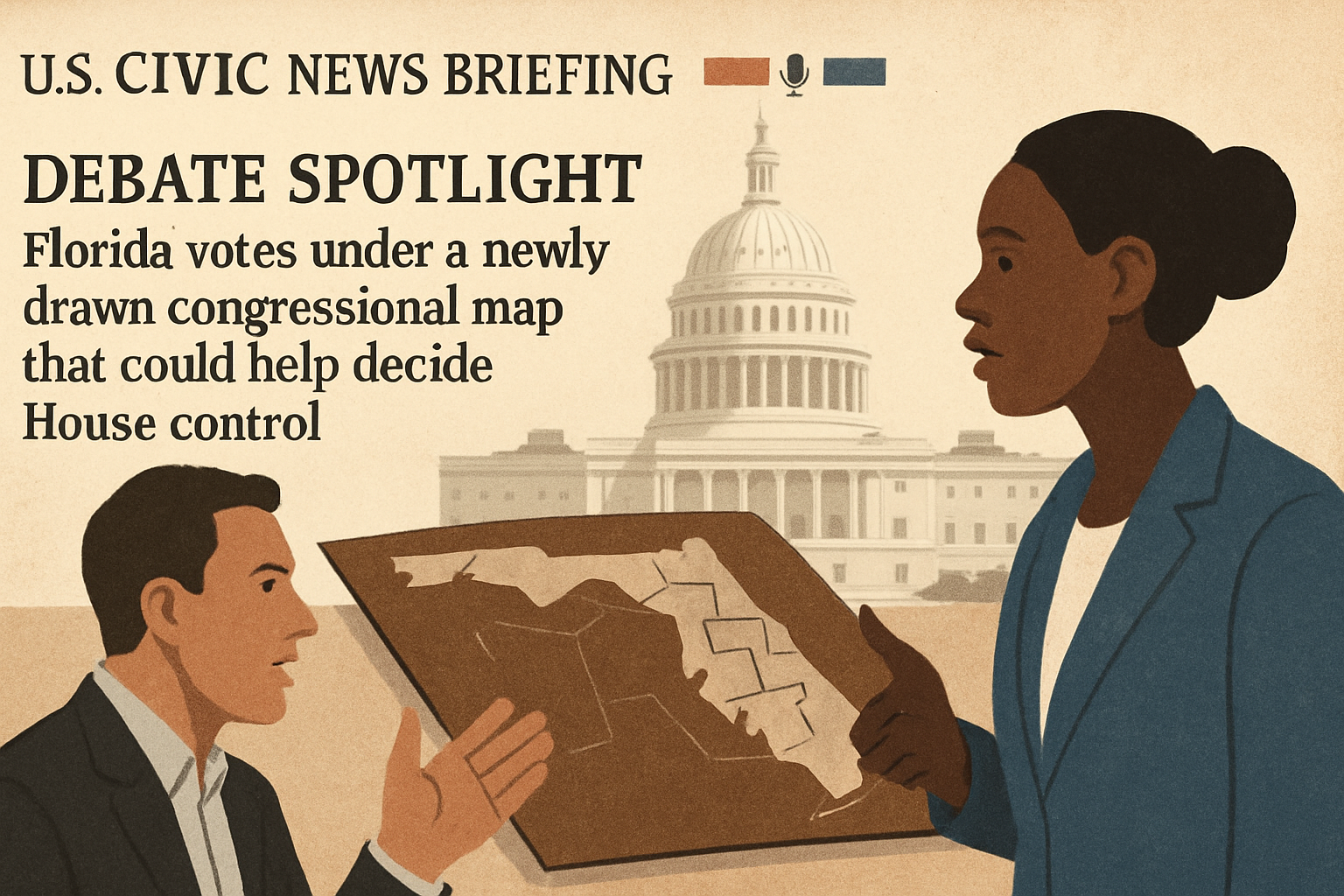
Debate spotlight: Florida votes under a newly drawn congressional map that could help decide House control
What happened
Florida holds its state and congressional primaries today, August 18, using a new U.S. House map approved during a special legislative session and allowed to take effect by the Florida Supreme Court. Republicans already hold 20 of the state’s 28 House seats.
What it means for voters
This is bigger than one state’s primary. The House margin is narrow, so even a few changed districts can affect which party controls Congress in 2027. Supporters of the map say it is lawful and does not use racial data. Opponents say it weakens minority communities’ ability to elect candidates of their choice and amounts to partisan mapmaking. Today’s primaries decide who will compete in the first federal election held under these boundaries.
Save stories & follow topics · Link to this story
Get the context & analysis
Florida holds its state and congressional primaries today, August 18, using a new U.S. House map approved during a special legislative session and allowed to take effect by the Florida Supreme Court. Republicans already hold 20 of the state’s 28 House seats. Reporting on the new map says it could improve Republican prospects in as many as four more seats, though the final results will depend on the candidates and November voters.
What to watch
County results are expected after polls close today. The larger legal challenge to the map may continue even as the November 3 election moves ahead.
Context from earlier events
Florida lawmakers approved the map on April 29, 2026. The Florida Supreme Court declined to stop its use in June, after which candidates prepared for the August 18 primary.
Check sources (3)
Federal elections and ranked-choice voting Alaska
Alaska’s top-four primary begins the state’s ranked-choice path to November
What happened
Alaska voters are holding their statewide primary today. Candidates for each race appear on one ballot, and the top four finishers generally advance to the November 3 general election, when voters rank candidates.
What it means for voters
Alaska’s system gives voters a wider initial field than a standard party primary, then uses ranked ballots in November. Today does not elect a senator or House member, but it determines which candidates make the November ballot. That matters because the Senate race and Alaska’s single House seat can affect national party strategy and control of Congress.
Save stories & follow topics · Link to this story
Get the context & analysis
Alaska voters are holding their statewide primary today. Candidates for each race appear on one ballot, and the top four finishers generally advance to the November 3 general election, when voters rank candidates. The U.S. Senate race includes incumbent Sen. Dan Sullivan and another candidate with the same name, Daniel “Dan” Sullivan, along with former U.S. Rep. Mary Peltola and others.
What to watch
Election-night results are unofficial. Watch which four candidates advance in the Senate and at-large House races, and whether close fourth-place contests lead to later ballot counting changes.
Context from earlier events
Alaska adopted its nonpartisan top-four primary and ranked-choice general election system after a 2020 ballot measure.
Congressional representation and special elections Alameda County, California
California’s 14th District picks a temporary House representative today
What happened
Voters in California’s 14th Congressional District are choosing a replacement for former Rep. Eric Swalwell in a special general election today. The finalists are Democratic state Sen. Aisha Wahab and Melissa Hernandez, a Bay Area Rapid Transit board leader.
What it means for voters
A vacancy means the district has no voting representative in the House. The winner will be able to vote on federal laws, spending bills, and oversight for the remainder of this Congress. In a closely divided House, even one seat can matter on procedural and closely contested votes, although the district itself strongly favors Democrats.
Save stories & follow topics · Link to this story
Get the context & analysis
Voters in California’s 14th Congressional District are choosing a replacement for former Rep. Eric Swalwell in a special general election today. The finalists are Democratic state Sen. Aisha Wahab and Melissa Hernandez, a Bay Area Rapid Transit board leader. The winner will serve the rest of the current congressional term; both candidates are also running in the regular election for the next full term.
What to watch
Initial Alameda County returns will show the direction of the race, but California’s official count can take longer because of mail ballots. The winner then heads to Washington for the remainder of the term and continues campaigning for the November election.
Context from earlier events
The vacancy followed Swalwell’s resignation. In the June 16 special primary, Wahab and Hernandez finished first and second and advanced to today’s runoff.
Check sources (3)
Primary and independent sources
Presidential power, public property, and federal courts Washington, D.C.
Supreme Court response is due in the White House ballroom construction dispute
What happened
Opponents of President Trump’s planned White House ballroom must respond to the administration’s Supreme Court request today. The administration wants the Court to let construction continue while it appeals a D.C. Circuit ruling that said Congress had not authorized the project.
What it means for voters
The case is about more than a building. It tests how much power a president has to reshape federally owned public property without a specific act of Congress. The administration says the project is privately funded and needed for secure events; preservation groups and the appeals-court majority say congressional approval is required. The immediate result could determine whether visible construction continues this week.
Save stories & follow topics · Link to this story
Get the context & analysis
Opponents of President Trump’s planned White House ballroom must respond to the administration’s Supreme Court request today. The administration wants the Court to let construction continue while it appeals a D.C. Circuit ruling that said Congress had not authorized the project. Unless a higher court intervenes, the appeals court’s halt on aboveground work is scheduled to take effect August 21.
What to watch
Watch for the challengers’ filing today and any rapid action by the Supreme Court before the August 21 deadline.
Context from earlier events
A federal district judge first halted aboveground work in April 2026 while allowing some underground work. The D.C. Circuit later upheld the stop on aboveground construction.
Federal elections, mail voting, and presidential authority Washington, D.C.; nationwide
Mail-voting limits remain in place while the Supreme Court considers the administration’s request
What happened
The Supreme Court docket showed no order as of August 18 on the Trump administration’s request to revive parts of its March election order. Lower federal courts have blocked key provisions.
What it means for voters
The case affects who sets election rules for the November 3 midterms: Congress and the states, or the president acting through federal agencies. For now, the court orders mean states do not have to change their mail-ballot practices under the blocked federal plan. A Supreme Court stay could still change the legal landscape close to Election Day, although it would not itself decide the full case.
Save stories & follow topics · Link to this story
Get the context & analysis
The Supreme Court docket showed no order as of August 18 on the Trump administration’s request to revive parts of its March election order. Lower federal courts have blocked key provisions. A Boston federal judge also recently barred the Postal Service from taking steps this year to carry out parts of the order involving mail ballots.
What to watch
The next major event is a Supreme Court order on the emergency stay request. Separately, the underlying cases will continue in lower courts.
Context from earlier events
President Trump signed the election order in March 2026. Federal courts have repeatedly limited it, including a June merits ruling and the August injunction involving Postal Service actions.
Check sources (2)
Trade policy and consumer costs Nationwide; U.S.-Canada trade
New 50% duties on selected Canadian goods are scheduled to start Wednesday
What happened
An additional 50% duty on specified Canadian dairy imports is scheduled to take effect at 12:01 a.m. Eastern on Wednesday, August 19. The White House issued related actions covering selected Canadian motor-vehicle and alcohol-related goods.
What it means for voters
The importer pays a tariff at the border, and companies may absorb that cost, pass some of it to customers, or change suppliers. That means the effect on household prices will vary by product and seller. The administration says the duties answer Canadian trade barriers and could help U.S. producers; critics of tariffs generally warn that higher import costs can also raise costs for U.S. businesses and consumers. Canada could also respond with its own trade action.
Save stories & follow topics · Link to this story
Get the context & analysis
An additional 50% duty on specified Canadian dairy imports is scheduled to take effect at 12:01 a.m. Eastern on Wednesday, August 19. The White House issued related actions covering selected Canadian motor-vehicle and alcohol-related goods. The duties apply to listed products, not every import from Canada.
What to watch
Watch whether U.S. Customs and Border Protection issues implementation guidance, whether Canadian officials announce a response, and whether affected companies change prices or supply plans.
Context from earlier events
The White House signed the three Canada-related proclamations in July and set a 30-day lead time before the August 19 effective date.
Disaster response and federal-state responsibilities Washington, D.C.; nationwide
Senate-confirmed FEMA chief takes over as federal disaster policy is being reworked
What happened
The Senate confirmed Cameron Hamilton to lead the Federal Emergency Management Agency on August 7. He becomes FEMA’s first permanent administrator of Trump’s second term as the administration and a presidential review council push for a smaller federal role in many disasters and more responsibility for states and local governments.
What it means for voters
FEMA decisions affect disaster survivors, local governments, roads, schools, and recovery bills after fires, floods, storms, and other emergencies. Hamilton has said states should lead and FEMA should focus on the most serious events. That could reduce red tape and clarify responsibilities in some cases, but it could also leave states and smaller communities facing more costs or less federal help if reforms narrow eligibility. Many major changes would require Congress, not just agency action.
Save stories & follow topics · Link to this story
Get the context & analysis
What to watch
Watch for Hamilton’s swearing-in, agency directives before peak hurricane season, and whether Congress advances legislation changing FEMA’s role or disaster-aid formulas.
Context from earlier events
Hamilton briefly led FEMA in 2025 before being removed after publicly opposing eliminating the agency. His June 2026 Senate testimony called for state-led, federally supported disaster response.
Federal spending and government operations Washington, D.C.; nationwide
Congress still needs a final funding deal before the September 30 deadline
What happened
The Senate has passed a temporary funding bill, H.R. 6500, that would generally keep the federal government operating through December 11. The measure has not become law because the House has not approved the Senate’s version.
What it means for voters
If Congress and the president do not enact a funding bill or another temporary extension by October 1, many federal operations could face a shutdown. That can disrupt pay and services for federal workers and affect permits, grants, inspections, and some public-facing offices. Essential work continues, but a shutdown does not leave the public untouched.
Save stories & follow topics · Link to this story
Get the context & analysis
The Senate has passed a temporary funding bill, H.R. 6500, that would generally keep the federal government operating through December 11. The measure has not become law because the House has not approved the Senate’s version. The current federal funding authority expires September 30.
What to watch
The House and Senate are in August recess. Watch what version House leaders bring up after lawmakers return and whether the chambers can settle differences before September 30.
Context from earlier events
The Senate passed its version of the stopgap bill on August 8. The House had earlier passed a separate proposal with a different expiration date.
Check sources (3)
You're caught up on this briefing. Choose topics and save stories to return on your own schedule.
How this briefing was made
We used official records to verify government actions and independent reporting to add context. We also checked popular political videos on YouTube for topic leads. Popularity helped us decide what to investigate, but it was not treated as proof or public opinion. Every included claim still had to be checked against the linked sources.