The daily civic brief
U.S. civic news scan — Friday, August 21, 2026
The clearest pocketbook item is the temporary pause on proposed 50% tariffs on selected Canadian imports, which gives businesses and shoppers a little more time before a possible new cost increase. Housing and immigration rules are also moving: HUD has proposed giving local providers more room to set work requirements in some assisted housing, while DHS has issued guidance for a broader public-charge test that starts September 18. Election rules remain a major civic story, with new state and federal court actions shaping mail voting, congressional maps, and ballot-counting rules before November.
Estimated 5-minute catch-up · 7 stories
Today's audio briefing
Today's spoken briefing
Hear the latest national briefing and what to watch next for every headline. A restrained instrumental bed plays in the web player.
A verbatim transcript is unavailable for this edition. Read the written briefing below.
Trade policy, groceries and consumer prices Nationwide; U.S.-Canada trade
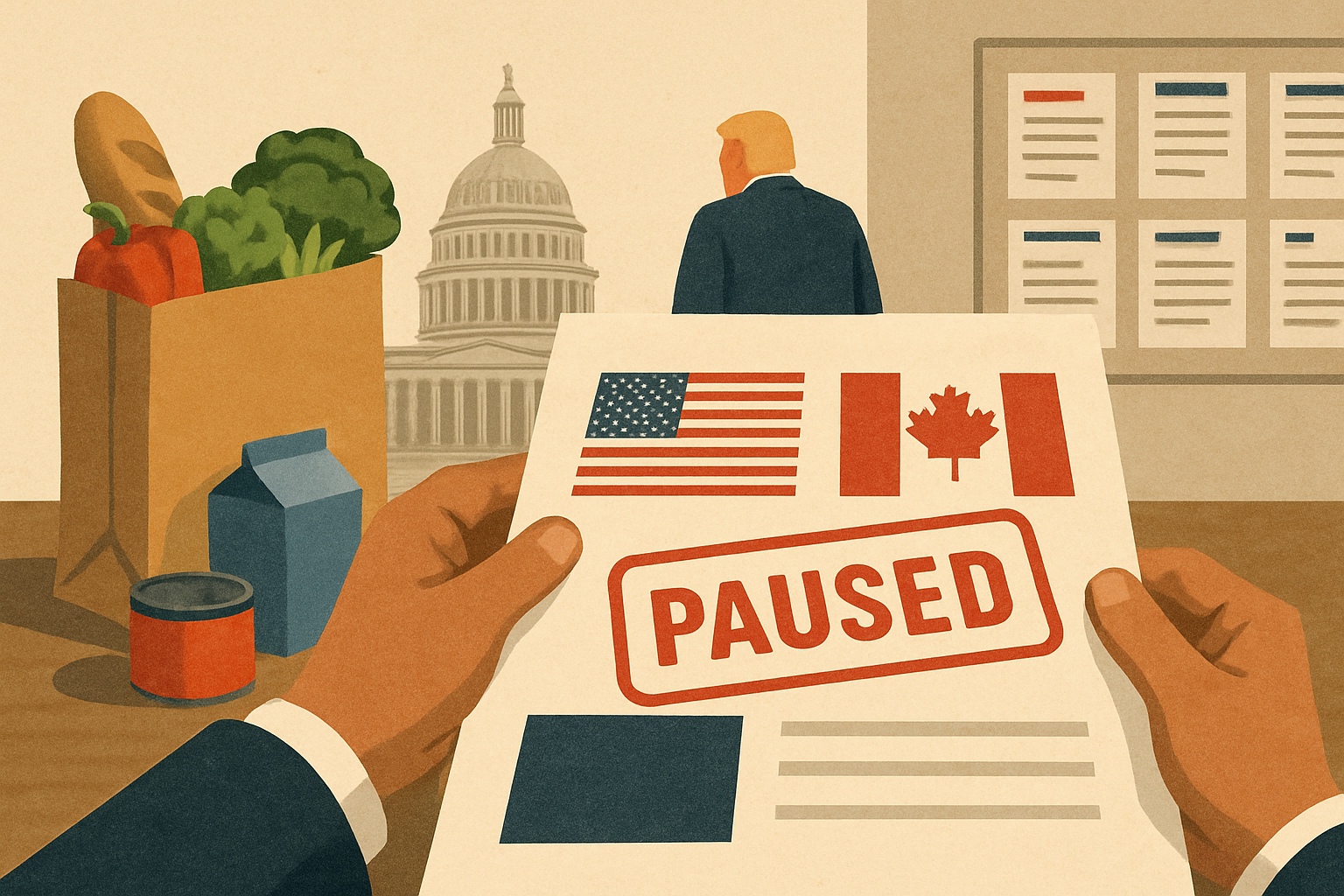
Three-day pause on planned Canada tariffs leaves prices and businesses in limbo
What happened
President Donald Trump paused planned 50% tariffs on about $20 billion in selected Canadian imports shortly before they were due to begin. The pause was announced as a three-day window for the United States and Canada to finish documents for a possible agreement; the final terms were not public in the reporting reviewed for this scan.
What it means for voters
A tariff is a federal import tax paid first by the U.S. company bringing goods into the country. Companies may absorb it, pass some of it on through prices, or change suppliers. The pause avoids an immediate new cost on the covered products, but it does not settle the issue. Households could still see effects later in prices for affected goods, while workers and businesses tied to trade face continued uncertainty. The White House acts under authority Congress has provided in tariff laws; Congress can also change that authority.
Save stories & follow topics · Link to this story
Get the context & analysis
What to watch
Whether the administration publishes a signed U.S.-Canada agreement, extends the pause, lets the tariffs take effect, or identifies exactly which products and exemptions are covered.
Context from earlier events
The administration had planned to use Section 338 of the Tariff Act of 1930, a seldom-used law that permits tariffs of up to 50% against countries the president finds are discriminating against U.S. commerce.
Immigration, benefits, healthcare and household stability Nationwide
DHS guidance fills in parts of the new public-charge rule due September 18
What happened
The Department of Homeland Security released guidance on August 18 for officers applying its new public-charge rule. The rule takes effect September 18 for covered green-card and admission applications filed on or after that date.
What it means for voters
This does not change benefits eligibility for every household, and it does not apply to every immigrant or every immigration application. But it matters to some families deciding whether to seek health coverage, food aid, housing help, or other support while pursuing a covered immigration case. The rule says benefits received before September 18 are handled under the earlier rule. DHS, an executive-branch agency, wrote the regulation; Congress wrote the underlying immigration law.
Save stories & follow topics · Link to this story
Get the context & analysis
The Department of Homeland Security released guidance on August 18 for officers applying its new public-charge rule. The rule takes effect September 18 for covered green-card and admission applications filed on or after that date. It replaces the 2022 framework and gives immigration officers broader room to weigh an applicant’s financial circumstances and receipt of means-tested public benefits as part of an overall case-by-case decision.
What to watch
USCIS policy materials, staff training, and any lawsuits challenging the rule before its September 18 effective date. Families with an immigration case should get advice from a qualified immigration lawyer or recognized nonprofit rather than relying on rumors about which benefits count.
Context from earlier events
The final rule was published July 20 and formally rescinds the 2022 public-charge regulation. DHS says the new approach restores broader officer discretion; health-policy researchers say the new guidance still leaves important terms unclear.
Rent, housing assistance and jobs Nationwide
HUD proposes optional work requirements and time limits in some assisted housing
What happened
HUD announced a proposed rule that would let public-housing agencies and owners of some project-based Section 8 housing adopt work requirements and time limits for non-elderly, non-disabled adults whom they consider able to work. It is a proposal, not a rule now in force.
What it means for voters
For families receiving affected housing help, rent assistance can be the difference between staying housed and losing a home. If the proposal becomes final, the practical rules could vary by local housing agency or property owner, so people in one community could face different conditions than people elsewhere. Supporters say local flexibility could help move households from waiting lists into available units. Critics are likely to focus on whether work, childcare, transportation, health, and local job conditions make the requirements realistic. HUD controls the federal program rules, but local housing agencies would make many on-the-ground choices.
Save stories & follow topics · Link to this story
Get the context & analysis
What to watch
Publication of the proposed rule in the Federal Register, the public-comment period, and whether HUD changes the plan before issuing any final rule. No household should assume its current voucher or lease terms have changed unless it receives an official notice from its housing agency or landlord.
Context from earlier events
HUD says the proposal would apply to public housing authorities and owners in the Section 8 project-based rental-assistance program, while preserving protections for elderly and disabled households.
Voting access and the Twenty-Sixth Amendment South Carolina; Fourth Circuit
Appeals court invalidates South Carolina’s age-based mail-voting rule
What happened
A three-judge panel of the U.S. Court of Appeals for the Fourth Circuit ruled that South Carolina cannot give every voter age 65 or older no-excuse absentee voting while requiring most younger voters to provide a qualifying reason. The court held that this age distinction abridges younger adults’ voting rights under the Twenty-Sixth Amendment.
What it means for voters
This ruling could make voting by mail easier for South Carolinians under age 65, including people with work schedules, caregiving duties, transportation problems, or unexpected conflicts. It does not create a nationwide mail-voting rule. States run elections in the first instance, but federal courts can strike down state rules that conflict with the U.S. Constitution. The decision may matter beyond South Carolina because courts in other regions have taken different approaches to age-based absentee-voting rules.
Save stories & follow topics · Link to this story
Get the context & analysis
What to watch
Whether South Carolina seeks a rehearing or Supreme Court review, and what instructions the lower court gives state election officials before the November 3 election.
Context from earlier events
The Twenty-Sixth Amendment, ratified in 1971, bars denying or abridging the voting rights of citizens age 18 or older on account of age.
Check sources (2)
Redistricting, ballot measures and U.S. House representation Missouri
Missouri Supreme Court sets September 2 argument over congressional-map referendum
What happened
The Missouri Supreme Court set September 2 arguments in appeals involving proposed ballot measures, including a referendum effort aimed at the state’s new congressional map. A Cole County judge ruled this week that the referendum could not go before voters and that the map could remain in use for November while appeals continue.
What it means for voters
Congressional districts decide which voters are grouped together to elect each U.S. House member. That affects representation in Washington and can affect control of the House. Missouri’s legislature draws congressional maps under state law, while state courts decide disputes under the state constitution. Voters do not get a referendum on the map unless the courts allow the ballot measure to proceed.
Save stories & follow topics · Link to this story
Get the context & analysis
What to watch
The Missouri Supreme Court’s September 2 arguments and any fast ruling afterward. Election administrators need a final answer soon because the November election calendar is already underway.
Context from earlier events
The new districts were already used in Missouri’s August primaries, which increases the pressure for a quick final answer before the general election.
Federal property, spending authority and court oversight Washington, D.C.
Supreme Court docket shows no posted decision yet in White House ballroom emergency request
What happened
The Supreme Court docket in National Park Service v. National Trust for Historic Preservation shows that the preservation group filed its response on August 18 to the administration’s emergency request to keep the White House ballroom project moving during the appeal.
What it means for voters
The fight is not just about a building. It tests who can authorize changes to federal property and spending: Congress, which controls appropriations and has major authority over federal property, or the executive branch acting on its own. The direct effect on family budgets is limited, but the legal answer can matter for how public money and public landmarks are managed in future projects.
Save stories & follow topics · Link to this story
Get the context & analysis
The Supreme Court docket in National Park Service v. National Trust for Historic Preservation shows that the preservation group filed its response on August 18 to the administration’s emergency request to keep the White House ballroom project moving during the appeal. As of the docket update reviewed today, no Supreme Court order was listed.
What to watch
A Supreme Court order on the emergency request, and any further action in the D.C. Circuit. An emergency order would address whether work can continue during the case, not necessarily the final legal merits.
Context from earlier events
The administration sought Supreme Court intervention after a divided D.C. Circuit panel concluded that Congress had not authorized the project and ordered a halt to aboveground construction unless a higher court intervened.
Voting, ballot counting and state authority Nationwide
Supreme Court decision leaves late-arriving mail-ballot rules to the states
What happened
The Supreme Court ruled last month that states may count mail ballots that arrive after Election Day when state law allows it. The ruling rejected a challenge backed by President Trump and left those state ballot-receipt rules in place for the 2026 midterms.
What it means for voters
For voters, the practical rule still depends on their state. In some places, a ballot must arrive by Election Day; in others, it can be counted if it is mailed or postmarked on time and arrives later. Voters should not assume a national deadline applies. State legislatures set most election procedures, state and local election officials run them, and federal courts decide whether those rules comply with federal law and the Constitution.
Save stories & follow topics · Link to this story
Get the context & analysis
What to watch
Your state election office’s deadline for requesting, returning, curing, and tracking a mail ballot. With November 3 approaching, returning a ballot well before the deadline remains the safest way to avoid delivery problems.
Context from earlier events
Mail-ballot receipt deadlines have been repeatedly litigated since 2020, often raising questions about how much authority states have to set rules for federal elections.
Check sources (2)
You're caught up on this briefing. Choose topics and save stories to return on your own schedule.
How this briefing was made
We used official records to verify government actions and independent reporting to add context. We also checked popular political videos on YouTube for topic leads. Popularity helped us decide what to investigate, but it was not treated as proof or public opinion. Every included claim still had to be checked against the linked sources.