The daily civic brief
U.S. Civic News Scan — August 23, 2026
The biggest fresh pocketbook development is that new federal tariffs on selected Canadian imports took effect on August 22, after last-minute trade talks failed. This scan also tracks a Medicare prescription-drug decision that could affect some seniors’ 2027 premiums, the federal debt passing $40 trillion, a state utility-cost rule that reflects a growing national fight over data centers, and a newly decided House special election.
Estimated 4-minute catch-up · 5 stories
Today's audio briefing
Today's spoken briefing
Hear the latest national briefing and what to watch next for every headline. A restrained instrumental bed plays in the web player.
A verbatim transcript is unavailable for this edition. Read the written briefing below.
Groceries, vehicles, building materials, jobs, and presidential tariff power Nationwide; U.S.-Canada trade
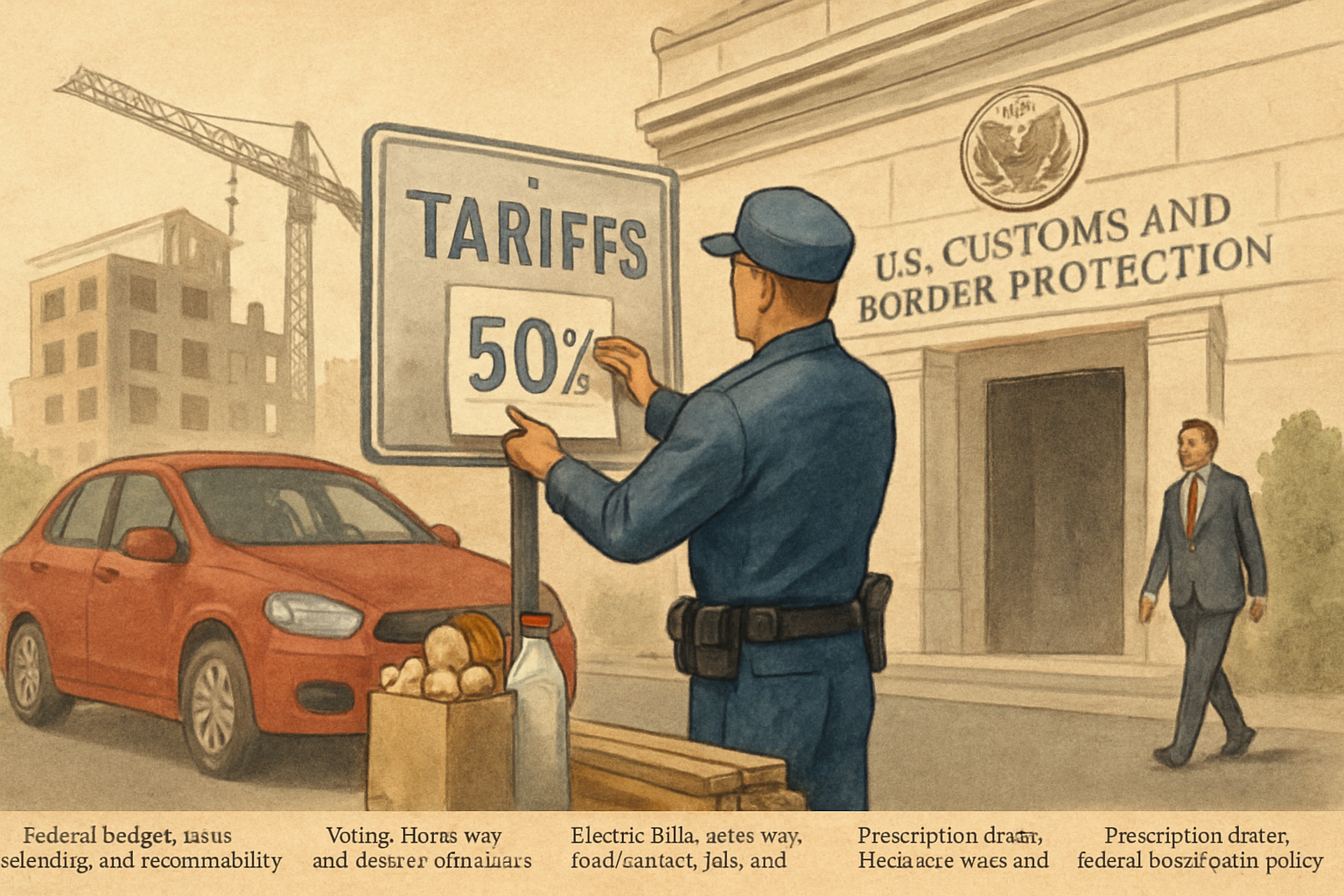
New 50% tariffs on selected Canadian imports are now in effect
What happened
The additional 50% federal duties on listed Canadian products took effect at 12:01 a.m. Eastern on Saturday, August 22. They apply to specified imports in the alcohol, dairy, and motor-vehicle lists, rather than everything imported from Canada.
What it means for voters
The importer pays the tariff at the border, then may absorb it, pass some or all of it along in prices, or switch suppliers. That can touch some grocery items, alcohol, car-related goods, construction inputs, and the jobs tied to cross-border supply chains. The immediate rule is federal and is already in force; it does not mean every Canadian product faces the new 50% charge. Canada has said it plans retaliatory tariffs beginning September 8, which could also affect U.S. exporters and workers.
Save stories & follow topics · Link to this story
Get the context & analysis
The additional 50% federal duties on listed Canadian products took effect at 12:01 a.m. Eastern on Saturday, August 22. They apply to specified imports in the alcohol, dairy, and motor-vehicle lists, rather than everything imported from Canada. The White House had delayed the start for three days while negotiations continued; U.S. Customs and Border Protection issued implementation guidance after talks failed.
What to watch
Watch for the exact Canadian retaliation list, the September 8 date Canada announced, any resumed negotiations, and whether U.S. retailers or manufacturers report price or supply changes. Congress could change the underlying tariff law, but these duties were imposed by the president under Section 338 of the Tariff Act of 1930.
Context from earlier events
Section 338 is a long-unused 1930 law that lets a president impose duties of up to 50% after finding that another country discriminates against U.S. commerce. The White House used it for these product-specific Canada tariffs after the broader U.S.-Canada trade dispute escalated.
Check sources (3)
Primary and independent sources
- The White House Temporary Suspension of Additional Duties to Offset Canadian Discrimination With Respect to Alcoholic Beverages, Dairy, and Motor Vehicles
- U.S. Customs and Border Protection GUIDANCE: Section 338 Additional Duties on Certain Goods of Canada
- The Associated Press US and Canada fall deeper into a trade war with new tariffs as talks collapse and blame is spread
Federal budget, taxes, borrowing, and accountability Nationwide
The national debt has passed $40 trillion
What happened
Treasury data showed total federal debt outstanding reached about $40.05 trillion on August 18, crossing $40 trillion for the first time. This is a measure of accumulated federal borrowing, not a bill that households must pay immediately or equally.
What it means for voters
There is no automatic change to a family’s taxes, benefits, mortgage, or grocery bill because the total crossed this number. Still, interest payments on federal borrowing compete with other budget choices over time, including taxes, health programs, schools, transportation, defense, and other services. Congress writes tax and spending laws, while the Treasury Department carries out the borrowing needed to pay obligations created by those laws.
Save stories & follow topics · Link to this story
Get the context & analysis
Treasury data showed total federal debt outstanding reached about $40.05 trillion on August 18, crossing $40 trillion for the first time. This is a measure of accumulated federal borrowing, not a bill that households must pay immediately or equally. It reflects years of decisions by Congress and presidents on spending, taxes, emergency aid, and borrowing.
What to watch
Watch the House’s action on the Senate-passed temporary funding bill before the September 30 funding deadline, and later budget and tax debates. Those decisions, not the $40 trillion marker by itself, determine future borrowing and which programs receive money.
Context from earlier events
Treasury publishes daily debt totals through its Debt to the Penny dataset. The total includes debt held by the public and debt held within federal government accounts.
Check sources (3)
Voting, House representation, and election administration California’s 14th Congressional District; Alameda County
Aisha Wahab wins California special election for a seat in the U.S. House
What happened
The Associated Press called California’s 14th Congressional District special election for Democratic state Sen. Aisha Wahab on August 20. She defeated fellow Democrat Melissa Hernandez and will fill the remainder of former Rep. Eric Swalwell’s term, which ends in January.
What it means for voters
This gives district residents a voting representative in the House for the rest of the current Congress. One House seat can matter in close votes on federal budgets, taxes, healthcare, housing, and election rules. The winner of this special election is not automatically guaranteed the next full term: voters will decide the regular House election under the district lines used for November.
Save stories & follow topics · Link to this story
Get the context & analysis
The Associated Press called California’s 14th Congressional District special election for Democratic state Sen. Aisha Wahab on August 20. She defeated fellow Democrat Melissa Hernandez and will fill the remainder of former Rep. Eric Swalwell’s term, which ends in January. Alameda County’s count was still preliminary when the race was called, so the formal canvass remains the government’s final certification process.
What to watch
Watch Alameda County’s completion of ballot processing and certification, plus the November 3 general election for the next full House term. California and county election officials, not the U.S. House or the White House, run the count and certify this election under state law.
Context from earlier events
The special election was called after Eric Swalwell resigned, leaving the district without a House member. The August 18 contest followed a June special primary.
Check sources (3)
Primary and independent sources
- The Associated Press California lawmaker Aisha Wahab wins special election to succeed Eric Swalwell in Congress
- Alameda County Registrar of Voters Congressional District 14 Special General Election — August 18, 2026
- Alameda County Registrar of Voters Congressional District 14 Special General Election
Electric bills, water use, local control, jobs, and state tax incentives Pennsylvania; state-policy trend with national relevance
Pennsylvania orders data-center developers to cover new power costs or lose state fast-tracking and tax breaks
What happened
Pennsylvania Gov. Josh Shapiro signed an executive order on August 18 that changes how the state handles new data-center projects. Under the order, developers seeking state permits, fast-track treatment, or a sales-tax exemption must make binding commitments that include paying the full cost of new power infrastructure needed for their projects, getting local approval, and meeting water and transparency standards.
What it means for voters
The immediate rule applies in Pennsylvania, but it is part of a broader state-level response to concerns that large data centers could raise household utility bills or strain water and power systems. Supporters say the conditions can protect ratepayers and still bring construction jobs and investment. The tradeoff is that stricter requirements may slow, reshape, or discourage some projects. State government controls these permits and tax incentives; local governments still control many land-use approvals.
Save stories & follow topics · Link to this story
Get the context & analysis
What to watch
Watch whether Pennsylvania’s legislature passes broader statewide data-center rules and how the state applies the order to specific projects. Similar debates are underway in states including Texas, New York, Arizona, Illinois, and Ohio.
Context from earlier events
Data centers have become much larger and more power-intensive as companies build computing capacity for artificial intelligence and cloud services. States have often used tax incentives to recruit them, while residents and regulators have raised questions about rates, water, land use, and local input.
Check sources (3)
Primary and independent sources
- Commonwealth of Pennsylvania Governor Shapiro Signs Executive Order Demanding Data Center Developers Comply With Strict Requirements and Blocking Speculative, Irresponsible Data Center Projects
- The Associated Press Governors’ races are being increasingly buffeted by the toxic politics of data centers
- Office of the Governor of New York First Statewide Moratorium on New Hyperscale Data Centers Launched by Governor Kathy Hochul
Prescription drugs, Medicare costs, and federal health policy Nationwide
Medicare will end a temporary Part D premium-stabilization program after 2026
What happened
The Centers for Medicare & Medicaid Services is ending the voluntary Medicare Part D Premium Stabilization Demonstration after December 31, 2026. The program provided extra federal support and limits on premium increases for participating stand-alone prescription-drug plans while major Part D changes were being put in place.
What it means for voters
Some people with stand-alone Medicare drug plans could face higher monthly premiums in 2027, though the effect will vary by plan and place. People in Medicare Advantage plans with drug coverage are not all affected in the same way, so beneficiaries should not assume their premium will change by a specific amount yet. Plan choices and premiums for 2027 will be clearer when Medicare releases plan information for open enrollment in the fall.
Save stories & follow topics · Link to this story
Get the context & analysis
The Centers for Medicare & Medicaid Services is ending the voluntary Medicare Part D Premium Stabilization Demonstration after December 31, 2026. The program provided extra federal support and limits on premium increases for participating stand-alone prescription-drug plans while major Part D changes were being put in place. The decision does not end Medicare Part D, and it does not set every person’s 2027 premium today.
What to watch
Watch for 2027 plan premiums and benefits before Medicare open enrollment, which normally begins October 15. Beneficiaries should compare their current plan’s 2027 notice with other available plans, checking both the premium and whether their prescriptions and pharmacy are covered. CMS, an executive-branch agency, made this demonstration decision; Congress controls the broader Medicare law and funding.
Context from earlier events
The demonstration began during the rollout of major Medicare Part D changes under the Inflation Reduction Act. CMS said it had used the temporary policy to help stabilize premiums while plans adjusted to the redesigned benefit.
Check sources (3)
Primary and independent sources
- The Associated Press The Trump administration is ending a Medicare drug subsidy program. Here’s how it could affect costs
- U.S. Government Accountability Office Medicare Part D: Implementation of Beneficiary Premium Stabilization Demonstration
- Centers for Medicare & Medicaid Services 2026 Medicare Part D Bid Information and Part D Premium Stabilization Demonstration Parameters
You're caught up on this briefing. Choose topics and save stories to return on your own schedule.
How this briefing was made
We used official records to verify government actions and independent reporting to add context. We also checked popular political videos on YouTube for topic leads. Popularity helped us decide what to investigate, but it was not treated as proof or public opinion. Every included claim still had to be checked against the linked sources.