The daily civic brief
U.S. Civic News Scan: Household Costs, Healthcare, Utilities, Work, and Government Accountability
Today’s biggest household-budget development is the Federal Reserve’s quarter-point rate increase, which can keep pressure on borrowing costs even though it does not automatically change anyone’s mortgage or card rate. Other recent actions include a new Medicare care option starting next spring, a court limit on some immigration arrests, a utility case with potential Midwest ratepayer effects, congressional sanctions legislation, and a nationwide push against alleged pandemic-loan fraud.
Today's audio briefing
Today's spoken briefing
Hear the latest national briefing and what to watch next for every headline. A restrained instrumental bed plays in the web player.
Interest rates, mortgages, credit cards, jobs, and prices Nationwide
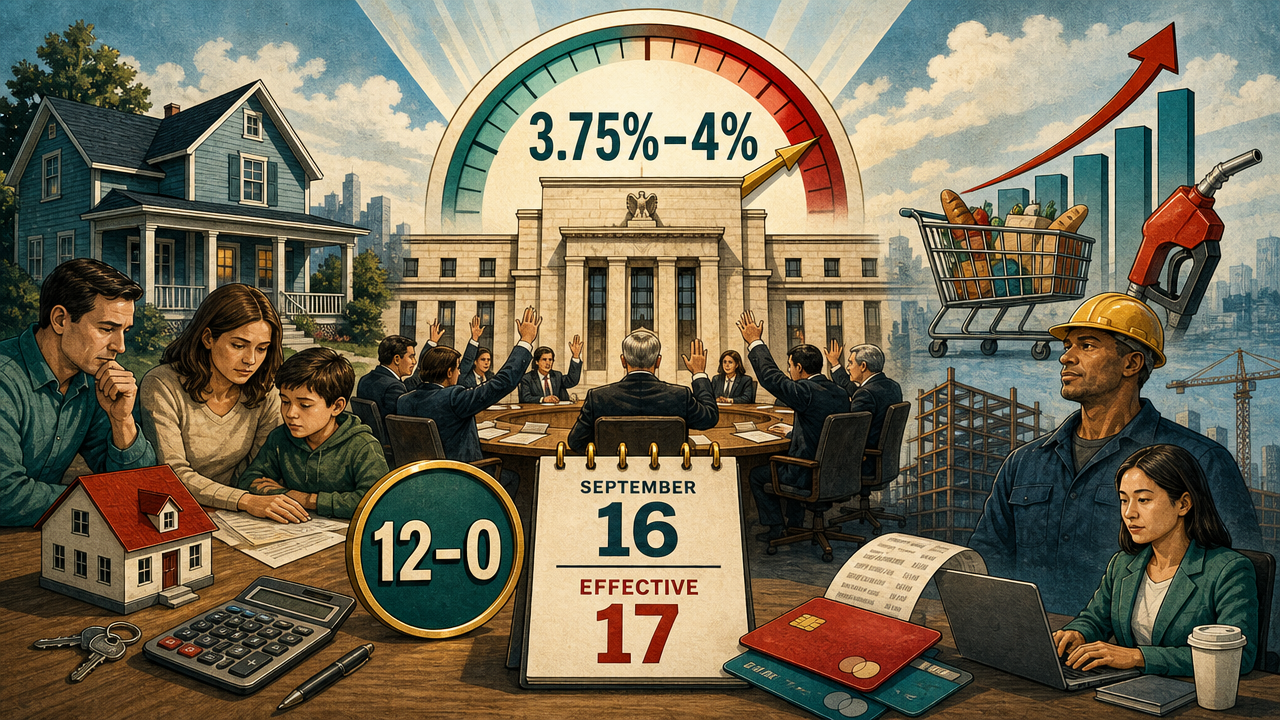
Federal Reserve raises its benchmark interest-rate range to 3.75%–4%
What happened
On September 16, the Federal Reserve voted 12–0 to raise its federal-funds-rate target by one-quarter of a percentage point, to 3.75%–4%. The Fed said inflation remains elevated, while economic activity and job gains have remained solid. The higher target took effect September 17.
What it means for voters
This is not a direct bill to households, but it can affect the rates banks charge for credit cards, car loans, home-equity loans, and some business borrowing. It does not reset a fixed-rate mortgage or an older fixed federal student loan. The tradeoff is that higher rates are meant to slow inflation, but they can also make new borrowing costlier and may cool hiring or spending. The Federal Reserve, not Congress or the White House, made this decision; Congress created the Fed and gave it its price-stability and employment goals.
What to watch
Watch upcoming inflation and jobs reports, plus the Fed’s next scheduled policy meeting on October 27–28, 2026. Those figures will shape whether officials hold rates steady, raise them again, or eventually cut them.
Context from earlier events
At its July 2026 meeting, the Fed had held the target range at 3.5%–3.75%; this is the first move reported in the recent briefing cycle.
Medicare, healthcare access, chronic illness, and medical costs Nationwide
Medicare will add voluntary home-based support options for several chronic conditions
What happened
CMS announced September 15 that people in Original Medicare may gain new ACCESS Model options beginning in spring 2027 for heart failure, COPD, substance-use disorders, tobacco cessation, and some bone, joint, and mobility conditions. Participating organizations may offer remote monitoring, virtual care, health coaching, and connected devices alongside a patient’s regular care.
What it means for voters
For eligible people with Original Medicare, this could mean more support between doctor visits without changing their Medicare benefits, coverage, or choice of doctor. CMS says participation is voluntary. It is not a new cash benefit and it does not automatically mean lower out-of-pocket costs; actual availability depends on whether an organization participates where a patient lives. Medicare Advantage members are not eligible for this particular model, though their plans may offer similar services. CMS, part of the executive branch, runs the program under federal Medicare authority.
What to watch
CMS says the new condition tracks begin in spring 2027. Before then, patients and caregivers can watch for participating organizations and covered conditions in the Medicare ACCESS directory.
Context from earlier events
This is separate from the Medicare drug-price negotiation deadlines covered earlier this week: it concerns care delivery for chronic conditions, not negotiated prescription prices.
Congress, trade sanctions, energy markets, and consumer prices Washington, D.C.; nationwide economic relevance
House sends Russia sanctions package to President Trump
What happened
The House voted 262–159 on September 16 to pass a broad Russia sanctions package, sending it to President Trump. According to Associated Press reporting, the bill targets Russian officials, banks, oil tankers used to move Russian energy, and could require tariffs of up to 100% on major buyers of Russian oil or natural gas, subject to stated exceptions.
What it means for voters
Nothing changes for shoppers or businesses unless the president signs the bill and the government later carries out its provisions. If enacted, the sanctions and possible tariffs could affect energy and trade costs, but there is no reliable basis yet to put a dollar figure on U.S. gas, heating, grocery, or shipping costs. The immediate civic point is that Congress has completed its role on this bill; the president now has the constitutional choice to sign or veto it.
What to watch
Watch for the president’s decision and, if he signs it, for Treasury and other agencies to spell out which sanctions and tariffs will be applied, when, and to whom.
Context from earlier events
The Senate passed the measure last month, according to AP. The House vote was the final congressional step described in the reporting.
Federal courts, immigration enforcement, workers, and due process Southern California; broader federal enforcement relevance
Federal judge limits warrantless civil immigration arrests in Southern California
What happened
A federal judge’s preliminary order, issued September 2 and unsealed September 16, blocks immigration officers in seven Southern California counties from making a civil immigration arrest without a warrant unless they determine the person is likely to escape before a warrant can be obtained. The order also requires documentation of the facts supporting that conclusion.
What it means for voters
The order applies in the federal Central District of California, including Los Angeles, Orange, Riverside, San Bernardino, Ventura, Santa Barbara, and San Luis Obispo counties. It does not end immigration enforcement or decide the whole lawsuit. But it changes the rules officers must follow for this type of arrest while the case continues, which may matter to workers, families, employers, and people seeking legal help in the affected counties. A federal court, not a state or local government, issued the order because the case challenges actions by federal immigration officers.
What to watch
The federal government may appeal or ask a higher court to pause the order. The underlying lawsuit will continue, and the judge has not issued a final ruling on all of the plaintiffs’ claims.
Context from earlier events
Courts in Portland, Colorado, Washington, D.C., and the Eastern District of California have also restricted similar warrantless-arrest practices, according to AP.
Electric bills, utility regulation, energy reliability, and federal courts Michigan and the Midcontinent power region
Appeals court voids an earlier federal order that kept a Michigan coal plant operating
What happened
The U.S. Court of Appeals for the D.C. Circuit on September 11 threw out the Energy Department’s first 2025 emergency order requiring Consumers Energy’s J.H. Campbell coal plant in West Olive, Michigan, to remain open past its planned retirement. The court ruled that order was not a lawful use of the department’s emergency-power authority.
What it means for voters
The ruling concerns one earlier order, not necessarily every later order affecting the plant. Michigan’s attorney general says Consumers Energy reported $295 million in costs tied to keeping the plant open from May 2025 through June 30, 2026, and is seeking to recover them from electricity customers in the north and central Midcontinent region. That means the case could affect utility bills, but regulators and later litigation still determine whether and how costs are passed through. The Energy Department says emergency orders are needed for grid reliability; opponents argue they impose unnecessary costs and delay planned replacement power.
What to watch
A later Energy Department order still requires the plant to operate through November 14, 2026, according to the Michigan attorney general. Watch for an appeal, a new federal order, utility cost-recovery filings, and decisions by the relevant utility regulators.
Context from earlier events
The plant had been scheduled to retire on May 31, 2025. The court ruling only vacated the original May 2025 federal order, while later extensions have been separately issued.
Taxes, small-business relief, fraud enforcement, and accountability Nationwide
Justice Department reports nationwide COVID-loan fraud cases totaling more than $245 million in intended losses
What happened
The Justice Department, Small Business Administration, and SBA inspector general announced results from a two-month enforcement push against alleged fraud involving COVID-era PPP and EIDL loans. DOJ says the activity involved more than $245 million in intended losses and included investigations and cases handled by 40 U.S. attorney’s offices with federal, state, and local partners.
What it means for voters
These were taxpayer-backed emergency loans meant to help small businesses and workers during the pandemic. The announcement does not mean $245 million has been recovered, and not every defendant has been convicted; some cases are charges or allegations that still must be proved in court. Still, prosecutions, restitution orders, and asset recovery can help return funds and may deter future fraud in public benefit and business-assistance programs. Federal prosecutors, the SBA, inspectors general, and courts each have different roles: agencies investigate and refer cases, prosecutors bring them, and courts decide guilt and penalties.
What to watch
Watch for case-by-case outcomes, including trials, guilty pleas, sentences, restitution orders, and any public accounting of recovered funds. DOJ also announced new fraud-enforcement partnerships with Missouri, Nebraska, and Kansas officials.
Context from earlier events
PPP and Economic Injury Disaster Loan programs were emergency federal programs created during the COVID-19 pandemic, and fraud investigations have continued years after the loans were made.
Sources
- U.S. Department of Justice DOJ’s Fraud Division, SBA, and SBA OIG Target $245M in COVID Loan Fraud Enforcement Activity as State Partnerships Continue Expanding
- U.S. Department of Justice District of New Mexico Joins DOJ Fraud Division, SBA, and SBA OIG in Surge Takedown Exceeding $245 Million in COVID-era Loan Fraud
How this briefing was made
We used official records to verify government actions and independent reporting to add context. We also checked popular political videos on YouTube for topic leads. Popularity helped us decide what to investigate, but it was not treated as proof or public opinion. Every included claim still had to be checked against the linked sources.