The daily civic brief
U.S. civic briefing
States can delay Medicaid work-rule coverage cutoffs through June 2027 / USDA proposes tighter SNAP eligibility route tied to TANF / Senate sets Monday procedural vote on energy and permitting package / Arizona lists hand-count audits complete in all 15 counties / FAA expects flight operations to normalize after communications failure / Federal judge temporarily blocks closure of East Potomac public park and golf course
Estimated 4-minute catch-up · 6 stories
Today's audio briefing
Today's spoken briefing
Hear the latest national briefing and what to watch next for every headline. A restrained instrumental bed plays in the web player.
Read the audio transcript
Healthcare; Medicaid; work requirements; household coverage Nationwide
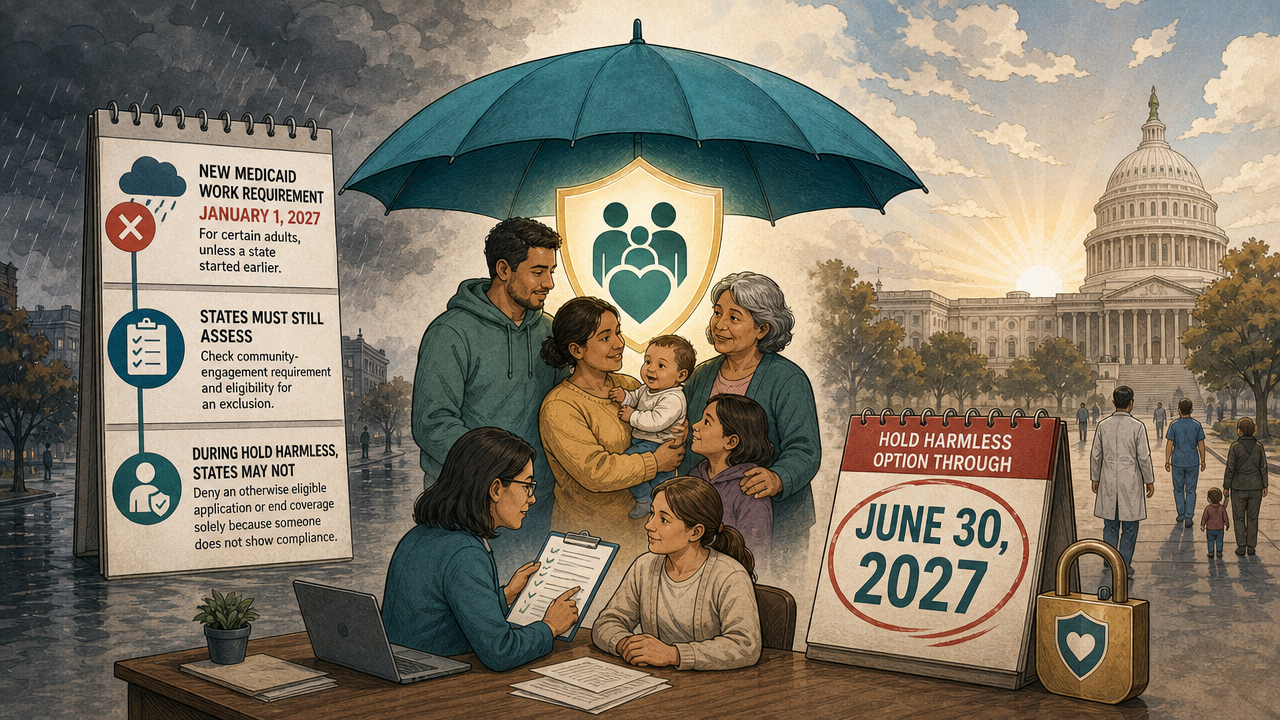
States can delay Medicaid work-rule coverage cutoffs through June 2027
In effect: CMS’s optional hold-harmless period is available through June 30, 2027. It delays certain denials and disenrollments only in states that choose the option; it does not repeal the federal work requirement scheduled to begin January 1, 2027. Verify status
What happened
CMS announced November 13 that states may choose a “hold harmless” period through June 30, 2027. States using it must still assess whether people meet the new Medicaid community-engagement requirement or qualify for an exclusion, but they may not deny an otherwise eligible application or end coverage solely because someone does not show compliance.
What it means for voters
For people who rely on Medicaid, this could prevent a paperwork or system problem from immediately turning into lost health coverage. It is not a nationwide automatic delay: each state has to elect the option. Workers with unstable schedules, seasonal hours, caregiving duties, health limits, or trouble getting documents together should watch notices from their own state Medicaid agency, because states can still check eligibility and work-rule exclusions during the transition.
Save stories & follow topics · Open this story
Get the context & analysis
CMS announced November 13 that states may choose a “hold harmless” period through June 30, 2027. States using it must still assess whether people meet the new Medicaid community-engagement requirement or qualify for an exclusion, but they may not deny an otherwise eligible application or end coverage solely because someone does not show compliance. The underlying federal work requirement is still set to begin January 1, 2027 for certain adults unless a state started earlier.
What to watch
Watch state Medicaid agencies for whether they elect the CMS transition option before January 1, 2027, and for their instructions on reporting, exemptions, renewals, and appeals.
Context from earlier events
On June 1, 2026, CMS issued its interim final rule for the new requirement, generally setting January 1, 2027 as the implementation date.
Check sources (3)
Primary and independent sources
- Centers for Medicare & Medicaid Services CMS Announces a Hold Harmless Period to Strengthen Medicaid Work Requirement Systems and Improve Beneficiary Experience
- Medicaid.gov Optional Hold Harmless Period for Community Engagement Implementation
- Associated Press US gives states another 6 months before they have to remove people from Medicaid for not working
Food assistance; SNAP; household budgets; federal rulemaking Nationwide
USDA proposes tighter SNAP eligibility route tied to TANF
Proposed: USDA published a proposed rule to limit TANF-based categorical eligibility for SNAP. The document requests public comment, and no final rule or effective date was verified as of November 15, 2026. Verify status
What happened
USDA’s Food and Nutrition Administration published a proposed rule that would narrow “categorical eligibility” for SNAP. Under the proposal, a household could use TANF-linked categorical eligibility only when it receives TANF assistance as defined in federal rules, rather than certain non-cash or in-kind TANF-funded services that can qualify households under current regulations.
What it means for voters
For households using SNAP to stretch grocery money, the key point is that no one loses benefits from this proposal alone. If finalized, it could make some families go through fuller income and asset checks or lose an eligibility path that their state currently uses. USDA’s own proposal acknowledges possible added paperwork for states and households, reduced SNAP spending, and effects on school-meal eligibility, so the impact could reach beyond the grocery checkout line.
Save stories & follow topics · Open this story
Get the context & analysis
USDA’s Food and Nutrition Administration published a proposed rule that would narrow “categorical eligibility” for SNAP. Under the proposal, a household could use TANF-linked categorical eligibility only when it receives TANF assistance as defined in federal rules, rather than certain non-cash or in-kind TANF-funded services that can qualify households under current regulations. This is a proposal, not a change in benefits today.
What to watch
Watch the Federal Register and Regulations.gov docket FNA-2026-0661 for the formal comment deadline, public comments, any revisions, and a final rule. As of November 15, 2026, no final rule was verified.
Context from earlier events
USDA proposed a related categorical-eligibility restriction in 2019; the Biden administration withdrew that earlier proposal in 2021, according to the new rule’s background section.
Energy; jobs; utilities; infrastructure; Congress Washington, D.C.; nationwide
Senate sets Monday procedural vote on energy and permitting package
Proposed: H.R. 2347 is pending in the Senate. A November 16 cloture vote is scheduled on the Capito substitute amendment; final Senate passage, House agreement, and presidential action were not verified as of November 15, 2026. Verify status
What happened
The Senate is scheduled to return at 3 p.m. Monday, November 16, and vote after a judicial nomination on whether to limit debate on the Capito substitute amendment to H.R. 2347, called the Bipartisan American Affordability and Jobs Act. That cloture vote is a procedural step, not final passage.
What it means for voters
Energy and transmission rules can eventually affect construction jobs, the pace of new power projects, landowners, and utility bills. But nothing changes for workers or households from Monday’s cloture vote alone. Even if the Senate advances the bill, the chamber can still amend it, must pass final text, and would need agreement with the House and the president before any new federal rule takes effect.
Save stories & follow topics · Open this story
Get the context & analysis
The Senate is scheduled to return at 3 p.m. Monday, November 16, and vote after a judicial nomination on whether to limit debate on the Capito substitute amendment to H.R. 2347, called the Bipartisan American Affordability and Jobs Act. That cloture vote is a procedural step, not final passage. The amendment text includes provisions touching transmission projects and compensation connected to some uses of eminent domain.
What to watch
At about 5:30 p.m. on Monday, November 16, watch the Senate’s cloture vote on the Capito substitute amendment. Then watch for any final-passage vote, House action, and public release of the complete text being considered.
Context from earlier events
No relevant context from earlier events was found.
Check sources (2)
Primary and independent sources
Voting; election administration; audits; certification Arizona
Arizona lists hand-count audits complete in all 15 counties
In effect: Arizona’s statutory hand-count audit and canvass procedures are underway for the November 3, 2026 general election. The Secretary of State lists all county hand-count entries as complete, while certification remains pending. Verify status
What happened
Arizona’s Secretary of State now lists completed hand-count audit results for all 15 counties from the November 3 general election. Most listed no discrepancies.
What it means for voters
Voters deserve a clear answer about what happens after election night. These hand counts test a sample of ballots against machine tabulation, while county canvasses and the statewide canvass complete the official record. The posted results do not support a claim that the listed discrepancies changed an outcome; the state says they stayed within the legal margin.
Save stories & follow topics · Open this story
Get the context & analysis
Arizona’s Secretary of State now lists completed hand-count audit results for all 15 counties from the November 3 general election. Most listed no discrepancies. Gila, Maricopa, Mohave, Pima, and Yuma list discrepancies that the state says were within the legally acceptable margin. Those findings are part of the state’s verification process and are not, by themselves, a statewide certification.
What to watch
Watch Arizona county boards of supervisors complete county canvasses by November 19, 2026. Arizona’s statewide canvass is scheduled for November 23, 2026.
Context from earlier events
No relevant context from earlier events was found.
Check sources (2)
Primary and independent sources
Transportation; public infrastructure; work and commutes; federal agencies Nationwide
FAA expects flight operations to normalize after communications failure
What happened
Federal officials said the nationwide FAA ground stop on Friday lasted more than four hours after communications and radar disruptions at air-traffic-control centers. Transportation Secretary Sean Duffy said a contractor was replacing old copper wiring with fiber when the system became overloaded.
What it means for voters
For travelers, flight crews, airport workers, people trying to get to a shift, and families paying for disrupted trips, the immediate concern is whether cancellations and missed connections clear. The longer-term issue is the federal air-traffic-control system: officials say upgrades are underway, but Friday showed that old equipment and work on replacement systems can still create a nationwide ripple effect.
Save stories & follow topics · Open this story
Get the context & analysis
Federal officials said the nationwide FAA ground stop on Friday lasted more than four hours after communications and radar disruptions at air-traffic-control centers. Transportation Secretary Sean Duffy said a contractor was replacing old copper wiring with fiber when the system became overloaded. Federal authorities expected airline operations to recover by late Sunday, November 15, while the FAA continues investigating.
What to watch
Watch the FAA for its final technical explanation and for operational advisories through November 15. Congress will also face decisions about any additional funding requested for air-traffic-control modernization.
Context from earlier events
Congress approved $12.5 billion for air-traffic-control modernization last year, according to Associated Press reporting; the system upgrade is underway but incomplete.
Check sources (2)
Courts; public land; accountability; executive branch Washington, D.C.
Federal judge temporarily blocks closure of East Potomac public park and golf course
Challenged in court: The National Park Service announced a November 15 closure, but a federal judge temporarily barred the closure during the park’s prior daily open hours through November 28, 2026, unless changed by a further order. Verify status
What happened
A federal judge on November 14 temporarily blocked the federal government from closing East Potomac Park and the East Potomac Golf Course during the hours they were open on November 14. The order stops, for now, a planned November 15 closure tied to a redevelopment plan.
What it means for voters
This is a local decision with a broader civic point: public facilities can change fast when federal agencies change a lease, close a site, or start a project. For D.C. residents, workers, and visitors who use the park’s paths, waterfront space, and low-cost recreation, the judge’s temporary order keeps ordinary access in place while the case continues. It does not decide the final redevelopment plan.
Save stories & follow topics · Open this story
Get the context & analysis
A federal judge on November 14 temporarily blocked the federal government from closing East Potomac Park and the East Potomac Golf Course during the hours they were open on November 14. The order stops, for now, a planned November 15 closure tied to a redevelopment plan. The National Park Service had announced a closure of the park area south of Buckeye Drive, including the municipal course and public paths, beginning November 15.
What to watch
Watch the U.S. District Court for the District of Columbia before the temporary order expires November 28, 2026, unless the court changes it first. Also watch for a revised National Park Service closure notice or a court-approved plan.
Context from earlier events
The National Park Service says it terminated the prior East Potomac golf-course lease on December 30, 2025 and later arranged for the former operator to continue at two other D.C. municipal courses while ceasing East Potomac operations by November 15, 2026.
You're caught up on this briefing. Choose topics and save stories to return on your own schedule.
How this briefing was made
We used official records to verify government actions and independent reporting to add context. We also searched recent election-related videos on YouTube for topic leads. Search rank and popularity were not treated as proof or public opinion. We also checked recent uploads from preferred news and public-affairs channels on YouTube for topic leads. Channel preference was not treated as proof or an endorsement. Every included claim still had to be checked against the linked sources.