The daily civic brief
U.S. civic briefing
Arizona posts all county canvass links as statewide certification remains ahead / North Carolina has finished county canvass; state canvass is next / Alaska’s ranked-choice tabulation is set for November 18, not yet complete / Senate has a procedural vote today on the affordability-and-jobs package / CMS says some people could lose Medicare coverage no earlier than February 2027 / FAA says new SMART tool was not tied to the nationwide ground stop
Estimated 4-minute catch-up · 6 stories
Today's audio briefing
Today's spoken briefing
Hear the latest national briefing and what to watch next for every headline. A restrained instrumental bed plays in the web player.
Read the audio transcript
Voting; election administration; audits; certification Arizona
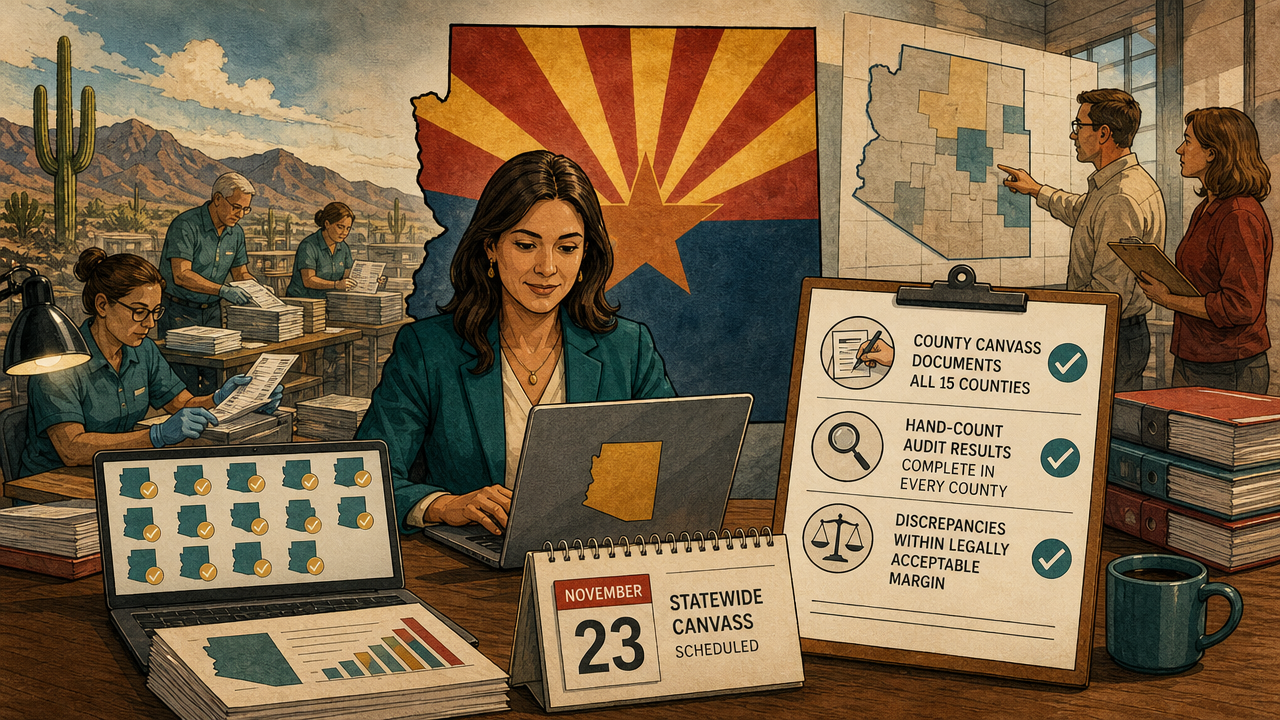
Arizona posts all county canvass links as statewide certification remains ahead
In effect: Arizona’s county canvass and hand-count audit procedures are operating for the November 3, 2026 general election. All county audit entries are listed as complete, while the statewide canvass is scheduled for November 23, 2026. Verify status
What happened
Arizona’s Secretary of State now links canvass documents for all 15 counties from the November 3 general election. The same state page lists hand-count audit results as complete in every county.
What it means for voters
For voters, this is the part of the process where county records, including eligible late-counted and provisional ballots, are formally checked before statewide results are made official. The audit findings do not by themselves prove every contest is certified, but they show the required equipment check has been completed. For working households, the practical point is simple: election-night totals were not the final record, and the next statewide action is still ahead.
Save stories & follow topics · Open this story
Get the context & analysis
Arizona’s Secretary of State now links canvass documents for all 15 counties from the November 3 general election. The same state page lists hand-count audit results as complete in every county. Several counties reported discrepancies, but the state says those were within the legally acceptable margin. This is a major verification step, but it is not the statewide canvass, which is scheduled for November 23.
What to watch
Watch Arizona’s statewide canvass on November 23, 2026. The Secretary of State, Governor, and Chief Justice participate in that state-level certification step.
Context from earlier events
Arizona requires a hand-count sample to test tabulation equipment when county political-party participation triggers that process. The current state page distinguishes this audit work from the later statewide canvass.
Check sources (1)
Primary and independent sources
Voting; election administration; certification; provisional ballots North Carolina
North Carolina has finished county canvass; state canvass is next
In effect: North Carolina’s county canvass occurred November 13, 2026. The state’s election office says the statewide canvass is scheduled for November 24, 2026, so the statewide certification process is still underway. Verify status
What happened
North Carolina county boards of elections met on November 13 to canvass and certify county results from the November 3 general election. The State Board of Elections describes canvass as the official check that votes were counted and tabulated correctly.
What it means for voters
County canvass is where election boards decide eligible provisional ballots and lock down county records. That matters for voters whose ballots needed extra review, including some voters who used a photo-ID exception form or cast a provisional ballot. It also means a close contest can still move through recount rules or statewide certification before its final legal outcome is settled.
Save stories & follow topics · Open this story
Get the context & analysis
North Carolina county boards of elections met on November 13 to canvass and certify county results from the November 3 general election. The State Board of Elections describes canvass as the official check that votes were counted and tabulated correctly. The state canvass is scheduled for November 24, so statewide results are not yet at the final state certification stage.
What to watch
Watch the North Carolina State Board of Elections’ statewide canvass at 11 a.m. on November 24, 2026, along with any recount notices for close races.
Context from earlier events
Before county canvass, counties review provisional ballots. The state says eligible provisional ballots can be added during the 10-day canvass period after Election Day.
Voting; ranked-choice voting; election administration; certification Alaska
Alaska’s ranked-choice tabulation is set for November 18, not yet complete
In effect: Alaska’s ranked-choice counting and ballot-review procedures are in effect for the November 3, 2026 general election. The division says tabulations for required races will be available November 18, 2026, after eligible ballots are reviewed and counted. Verify status
What happened
Alaska’s Division of Elections updated its general-election page on November 15 and still labels the results unofficial. It reports 134,493 ballots received and has posted a downloadable cast-vote record for scanned ballots.
What it means for voters
For Alaska voters, the first-choice totals on a results page are not the final answer in a ranked-choice race that needs later rounds. The waiting period is built into the state’s system to allow eligible ballots, including some mailed from overseas, to be received and reviewed. That can feel slow, but it is not evidence by itself that something is wrong with the count.
Save stories & follow topics · Open this story
Get the context & analysis
Alaska’s Division of Elections updated its general-election page on November 15 and still labels the results unofficial. It reports 134,493 ballots received and has posted a downloadable cast-vote record for scanned ballots. The state says ranked-choice tabulations will not be available until November 18, after eligible ballots are reviewed and counted, with the final regional count also set for that day.
What to watch
Watch the Alaska Division of Elections on November 18, 2026, for the final regional count and ranked-choice tabulations in races that require them. The division lists November 25 as its target date for certification.
Context from earlier events
The state’s posted results show first-choice information before the ranked-choice rounds. It also explains that a cast-vote record is a ballot record, not the tabulation itself.
Check sources (2)
Primary and independent sources
Congress; energy; permitting; infrastructure; jobs Washington, D.C.; nationwide
Senate has a procedural vote today on the affordability-and-jobs package
Proposed: As of November 16, 2026, H.R. 2347 is pending in the Senate. The scheduled vote is on cloture for a substitute amendment, not final passage, and enactment has not been verified. Verify status
What happened
The Senate is scheduled to convene at 3 p.m. on Monday, November 16, and vote at about 5:30 p.m. on whether to limit debate on the Capito substitute amendment to H.R. 2347, the Bipartisan American Affordability and Jobs Act of 2026. That cloture vote is a procedural step.
What it means for voters
Bills with an “affordability” label can sound like an immediate price cut, but that is not what today’s vote does. For workers in construction, energy, manufacturing, or related trades, the eventual bill text could matter if it changes permitting, project timelines, or infrastructure rules. As of November 16, though, the verified near-term effect is only whether the Senate moves closer to a later vote.
Save stories & follow topics · Open this story
Get the context & analysis
The Senate is scheduled to convene at 3 p.m. on Monday, November 16, and vote at about 5:30 p.m. on whether to limit debate on the Capito substitute amendment to H.R. 2347, the Bipartisan American Affordability and Jobs Act of 2026. That cloture vote is a procedural step. It is not final passage of the package and does not, by itself, change any household bill, job rule, or energy policy.
What to watch
Watch the Senate’s scheduled 5:30 p.m. cloture vote on November 16, 2026. If it succeeds, watch for release and review of the operative amendment text, a final Senate vote, House action, and presidential action.
Context from earlier events
The Senate previously agreed to proceed to H.R. 2347 on November 10. The November 16 vote is the next procedural hurdle, not a final lawmaking step.
Check sources (2)
Healthcare; Medicare; eligibility; household coverage Nationwide
CMS says some people could lose Medicare coverage no earlier than February 2027
In effect: CMS describes the Medicare eligibility limits as recent changes to federal law. The agency says affected coverage terminations will occur no earlier than February 1, 2027, so the policy exists but the stated termination timing is future-facing. Verify status
What happened
CMS says recent federal legislation limits Medicare eligibility to U.S. citizens or nationals, lawful permanent residents, Cuban and Haitian entrants, and Compact of Free Association migrants, along with the usual Medicare eligibility rules. CMS says affected patients will receive notices from the Social Security Administration and that coverage terminations will occur no earlier than February 1, 2027.
What it means for voters
This does not change coverage for everyone on Medicare. But for people affected by the eligibility restriction, losing Medicare could mean finding another source of insurance, dealing with new premiums or out-of-pocket costs, or searching for low-cost care. CMS also warns that people who are not eligible for Medicare because of immigration status will not qualify for Marketplace financial help under the described rule.
Save stories & follow topics · Open this story
Get the context & analysis
What to watch
Watch for Social Security Administration notices to affected people and for CMS or state agencies to publish more detail on transition help before February 1, 2027. As of November 16, the reviewed CMS notice does not provide a full public count of affected beneficiaries.
Context from earlier events
No relevant context from earlier events was found.
Check sources (1)
Primary and independent sources
Transportation; aviation safety; public infrastructure; work and commutes Nationwide
FAA says new SMART tool was not tied to the nationwide ground stop
What happened
Federal officials and the company behind the FAA’s new SMART system said the nationwide ground stop that began Friday was not caused by that system. The FAA had described the original problem as communications issues affecting multiple air-route traffic-control centers.
What it means for voters
When air traffic stops, the impact is more than a delayed vacation. Shift workers can miss work, families can get stuck away from home, and people traveling for medical care or caregiving can lose time and money. The immediate ground stop has been cancelled, but the episode puts pressure on federal officials to explain the communications failure and show whether the air-traffic system has enough reliable backup and staffing.
Save stories & follow topics · Open this story
Get the context & analysis
Federal officials and the company behind the FAA’s new SMART system said the nationwide ground stop that began Friday was not caused by that system. The FAA had described the original problem as communications issues affecting multiple air-route traffic-control centers. Reporting on November 16 says the SMART tool helps traffic managers analyze data and make recommendations, while people still make operational decisions.
What to watch
Watch for the FAA’s final technical explanation of the communications failure and for congressional oversight of FAA modernization. As of November 16, officials say SMART was not linked to the outage, but a final public technical report was not verified.
Context from earlier events
The FAA cancelled the nationwide ground stop after the communications disruption. The newer reporting addresses a separate question: whether the recently deployed SMART system caused it.
Check sources (2)
You're caught up on this briefing. Choose topics and save stories to return on your own schedule.
How this briefing was made
We used official records to verify government actions and independent reporting to add context. We also searched recent election-related videos on YouTube for topic leads. Search rank and popularity were not treated as proof or public opinion. We also checked recent uploads from preferred news and public-affairs channels on YouTube for topic leads. Channel preference was not treated as proof or an endorsement. Every included claim still had to be checked against the linked sources.