The daily civic brief
U.S. Civic Update: Certifications, ballot-count litigation, and workplace rights
Election administration remains the main civic story as states move from counting to official certification. Arizona has completed its statewide canvass, while Kansas still has a December 1 certification step ahead. Elsewhere, a California ballot-count case has ended, and the Supreme Court is about to hear major cases involving workplace discrimination law and state gun restrictions.
Estimated 3-minute catch-up · 5 stories
Today's audio briefing
Today's spoken briefing
Hear the latest national briefing and what to watch next for every headline. A restrained instrumental bed plays in the web player.
Read the audio transcript
Voting; election certification; representation Arizona
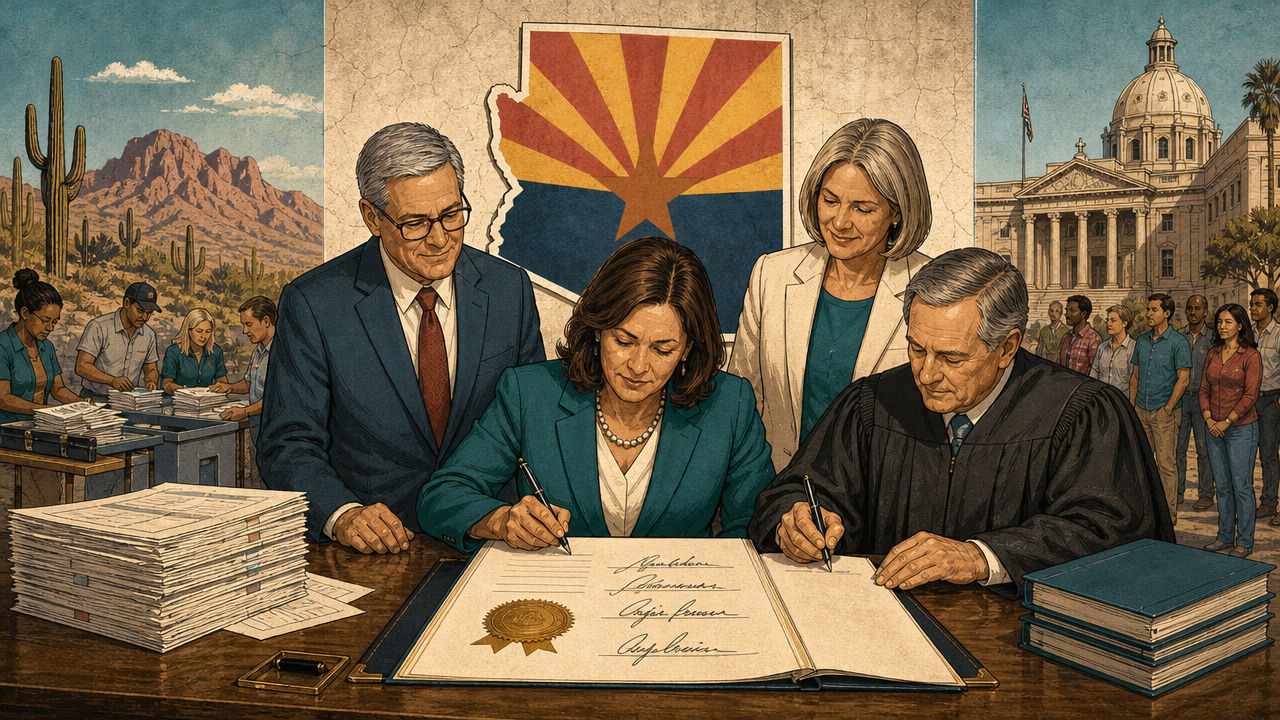
Arizona signs its official statewide canvass for the November election
What happened
Arizona’s secretary of state certified the statewide canvass for the November 3, 2026 general election on November 23. The signed record says it is the complete tabulation for federal and state offices and shows affirming signatures from the governor and attorney general for candidate races, as well as the governor and chief justice for ballot measures.
What it means for voters
For Arizona voters, this is the point where statewide totals move from preliminary reporting to the official record. It settles the state’s canvass process for the offices and ballot measures listed in the document. That matters because the people chosen in these races will make or administer decisions that affect schools, roads, workplace rules, taxes, utilities, and other everyday services.
Save stories & follow topics · Open this story
Get the context & analysis
What to watch
As of 2026-11-28, the statewide canvass is signed. Watch Arizona election offices and courts only for any formally filed recount, contest, or correction notice; no such next step was confirmed in the reviewed record.
Context from earlier events
No relevant context from earlier events was found.
Check sources (1)
Primary and independent sources
Voting; ballot counting; federal courts California; Ninth Circuit federal court
Ninth Circuit action ends federal case seeking to halt California ballot counting
What happened
A federal appeals court approved the Justice Department’s request to dismiss its own lawsuit that had sought to stop California from counting roughly 20,000 ballots while officials checked the immigration status of people who received them, according to the Associated Press. The case is over; the dismissal is not a court finding that the ballots were unlawful or that fraud occurred.
What it means for voters
The ruling means this lawsuit no longer threatens California’s completed ballot-counting process. For voters, especially people who use mail ballots, the case is a reminder that vote-count disputes can affect whether ballots are counted on schedule. But the reviewed report does not establish that any individual ballot was cast illegally or that the election outcome changed.
Save stories & follow topics · Open this story
Get the context & analysis
What to watch
As of 2026-11-28, the appeals-court action ended this Justice Department case. Watch for any separate election contest or official California certification update, but no further proceeding in this case was confirmed.
Context from earlier events
No relevant context from earlier events was found.
Check sources (1)
Primary and independent sources
Voting; election certification; state government Kansas
Kansas has not certified its statewide results yet; the final state step is December 1
What happened
Kansas says its State Board of Canvassers will meet Tuesday, December 1, 2026, to certify the general-election results. The secretary of state’s election calendar lists December 1 as the last day for the board to certify official results, so the results remain unofficial until that statewide action is completed.
What it means for voters
For Kansas voters, this is the final statewide check before election results become official. It matters in close races because certification establishes the formal result, while election-night tallies and other preliminary totals do not. The process affects who will hold offices that set state policy on taxes, education, transportation, health programs, and labor rules.
Save stories & follow topics · Open this story
Get the context & analysis
What to watch
Watch the Kansas State Board of Canvassers meeting on Tuesday, December 1, 2026, and the Kansas Secretary of State’s official results release afterward.
Context from earlier events
No relevant context from earlier events was found.
Check sources (2)
Primary and independent sources
Workplace rights; education; federal courts Washington, D.C.; nationwide
Supreme Court will hear whether education workers can sue under Title IX for sex discrimination
What happened
The U.S. Supreme Court is scheduled to hear Crowther v. Board of Regents of the University System of Georgia on Monday, November 30.
What it means for voters
This case matters to workers at public and federally funded colleges, universities, and schools. A ruling for the employees could preserve another legal path for workplace sex-discrimination claims. A ruling for the institutions would leave Title VII as the main federal remedy described in the reviewed case materials. Either way, this is about legal options, not a change in workplace rules this week.
Save stories & follow topics · Open this story
Get the context & analysis
The U.S. Supreme Court is scheduled to hear Crowther v. Board of Regents of the University System of Georgia on Monday, November 30. The question is whether employees of federally funded education institutions have a private right to sue under Title IX for sex discrimination in employment, or whether Title VII remains their main federal route for such claims.
What to watch
Watch the Supreme Court’s oral argument on November 30, 2026. A decision is not scheduled for a specific date in the reviewed record; the Court’s eventual ruling will determine the legal rule.
Context from earlier events
No relevant context from earlier events was found.
Check sources (2)
Federal courts; public safety; state and local authority Washington, D.C.; nationwide
Supreme Court arguments Wednesday could shape state and local assault-weapons bans
What happened
The Supreme Court is set to hear Viramontes v. Cook County and Grant v.
What it means for voters
This is not mainly a paycheck case, but it could affect family safety rules and the power of states and cities to set firearm laws. A broad ruling could limit existing or future local restrictions; a ruling for the governments could preserve more state and local room to regulate. For workers, families, schools, and public-facing employees, the real-world stakes are felt through whatever rules remain after the Court decides—not before.
Save stories & follow topics · Open this story
Get the context & analysis
The Supreme Court is set to hear Viramontes v. Cook County and Grant v. Higgins together on Wednesday, December 2, 2026. The cases ask whether state and local restrictions on certain semiautomatic firearms violate the Second Amendment. The Court has not ruled, and the arguments themselves do not change any law.
What to watch
Watch the arguments on Wednesday, December 2, 2026. The Court says it posts same-day argument audio and transcripts, but no ruling date is set in the reviewed docket.
Context from earlier events
No relevant context from earlier events was found.
Check sources (2)
You're caught up on this briefing. Choose topics and save stories to return on your own schedule.
How this briefing was made
We used official records to verify government actions and independent reporting to add context. We also searched recent election-related videos on YouTube for topic leads. Search rank and popularity were not treated as proof or public opinion. We also checked recent uploads from preferred news and public-affairs channels on YouTube for topic leads. Channel preference was not treated as proof or an endorsement. Every included claim still had to be checked against the linked sources.