The daily civic brief
U.S. Civic News Scan — September 18, 2026
Today’s biggest practical stories are about casting a ballot, oversight of voter data, job conditions, food policy, healthcare-program integrity, and a federal wildlife rule that now affects land-use decisions. A recurring point is who has power: states run most election mechanics, Congress writes the underlying laws and controls spending, agencies carry out those laws, and courts can stop agencies when they exceed their authority.
Today's audio briefing
Today's spoken briefing
Hear the latest national briefing and what to watch next for every headline. A restrained instrumental bed plays in the web player.
Voting, mail ballots, Postal Service policy, and federal courts Nationwide
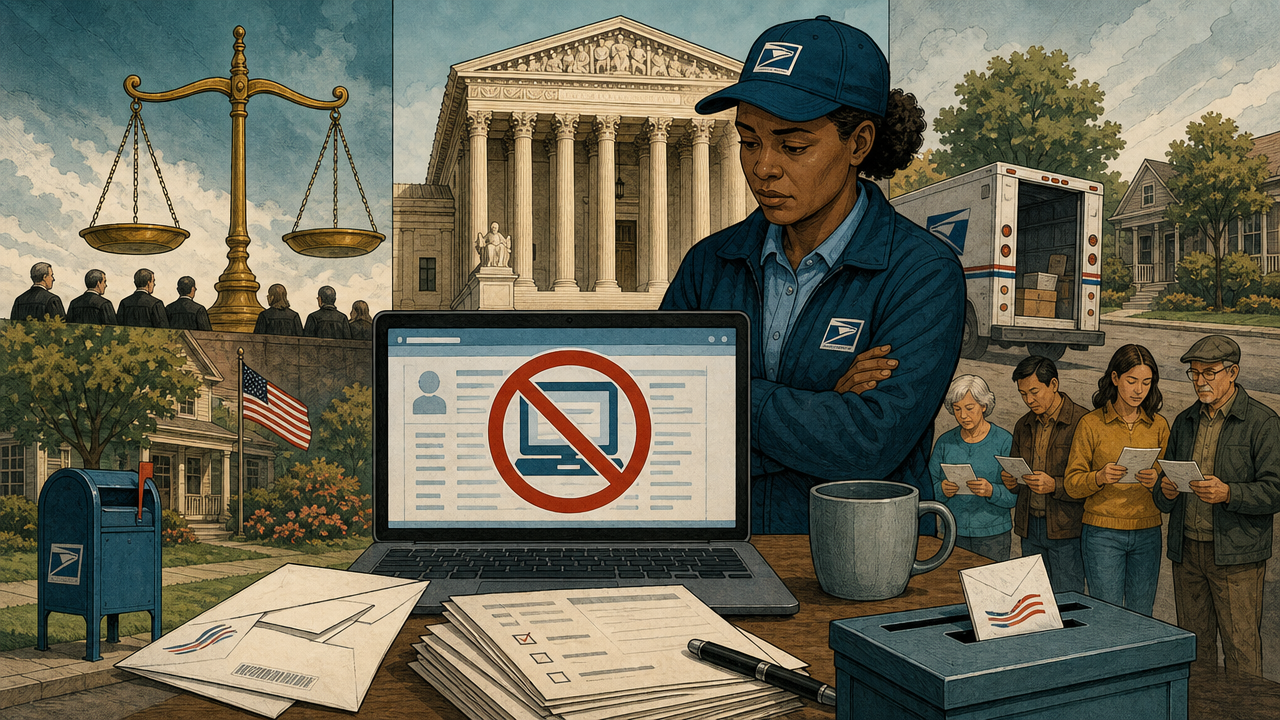
Postal Service halts work on federal ballot-mail portal after court loss
What happened
The U.S. Postal Service has stopped developing a federal computer portal that was meant to collect information about people receiving mail ballots. The move follows the Supreme Court’s September 14 decision leaving lower-court blocks on the Trump administration’s mail-ballot policy in place. USPS also told employees it will not enforce the new rules in the 2026 federal election.
What it means for voters
For voters, this means states can keep using their current mail-ballot systems for the November 3 election rather than switch to the disputed federal process. State and local election offices still set most ballot rules and deadlines, so voters should follow their own election office’s instructions for requesting and returning a ballot. This is a real operational change by USPS, but it does not settle the larger legal fight for good.
What to watch
Watch for any further court orders, a final ruling on the underlying policy, or a congressional change to federal election-mail rules.
Context from earlier events
On September 14, the Supreme Court declined to let the administration’s disputed mail-ballot restrictions take effect before the midterms.
Voting, representation, and state election administration Nationwide; dates and rules vary by state
Early in-person voting begins as the midterm election enters its final stretch
What happened
Early in-person voting begins today in the first states holding it for the 2026 midterm elections. The midterms will decide all House seats and a share of Senate seats, which can change who controls Congress and therefore which bills get votes on taxes, health coverage, food aid, housing, and federal spending.
What it means for voters
Voting early can help people who work long shifts, have limited transportation, or may face a problem on Election Day. But there is no single national early-voting schedule: state and local election officials decide where, when, and how people can vote early. Check the official election office for your state before making a plan, especially if you need an ID, have moved, or want to use a mail ballot instead.
What to watch
Watch state election-office announcements for registration deadlines, early-voting locations and hours, mail-ballot return deadlines, and any court rulings affecting local procedures.
Context from earlier events
The November 3, 2026 general election will determine the next Congress. States administer elections under state law, while Congress can set some national election rules.
Voting, privacy, federal-state authority, and accountability Virginia, with national significance for voter-data privacy
Virginia attorney general seeks answers over reported DHS access to voter-record systems
What happened
Virginia Attorney General Jay Jones says the Department of Homeland Security may have broken state law after a whistleblower alleged that federal employees misrepresented themselves to search state voter-lookup tools for possible noncitizens. Jones asked DHS to say in writing whether it directed staff to access Virginia voter information without the voters’ permission. The allegation has not been proven in court, and DHS’s full response was not yet publicly reported.
What it means for voters
Voter rolls can contain personal information, though states decide what is public and what is protected. The case matters beyond Virginia because federal agencies seeking election data must still follow state access rules unless federal law or a court order gives them authority. For voters, there is no reported change to registration or voting eligibility from this letter; this is an oversight and fact-finding step.
What to watch
Watch for DHS’s written response, any state investigation, a court filing, or similar actions by election officials in other states.
Context from earlier events
Federal agencies have recently sought voter-roll information from states, while state officials and courts have disputed how far federal authority reaches into state election systems.
Federal regulation, property rights, construction, and environmental protection Nationwide
New Endangered Species Act interpretation is now in effect
What happened
A federal rule that removed the regulatory definition of “harm” under the Endangered Species Act took effect September 14. The Fish and Wildlife Service and National Marine Fisheries Service say the change follows their reading of the law and will reduce regulatory burdens. Critics say the prior definition was an important tool for addressing habitat destruction that can kill or injure protected animals without directly targeting them.
What it means for voters
This does not automatically approve a housing project, road, dam, logging operation, or energy project. But it can change the legal ground rules for projects that affect endangered species and their habitat. That may lower compliance costs or speed some projects, while potentially reducing one avenue for protecting habitat. Other federal, state, and local permits may still apply.
What to watch
Watch for court challenges and for agency guidance explaining how it will enforce the law in specific project reviews and permit cases.
Context from earlier events
The prior regulatory definition had treated certain significant habitat modification as “harm.” The services rescinded that definition in a final rule published in July.
Jobs, unemployment benefits, and economic life Nationwide
New unemployment claims fell to 196,000 last week
What happened
The Labor Department reported that 196,000 people filed initial claims for unemployment benefits in the week ending September 12. That was 10,000 fewer than the prior week. The four-week average, which smooths out weekly swings, was 203,250.
What it means for voters
This is not a count of everyone who is unemployed, and it does not show whether a particular community is doing well or badly. It is an early weekly signal of layoffs and job loss. Workers who lose a job generally apply through their state unemployment agency, because states administer benefits under federal-state rules and set many eligibility details.
What to watch
Watch the next weekly claims report, the monthly jobs report, and whether layoffs rise in particular industries or regions.
Context from earlier events
Initial unemployment claims are a weekly federal measure based on state benefit applications. They can move sharply around holidays, weather events, strikes, and seasonal hiring.
Groceries, ranchers, meat processing, food safety, and executive authority Nationwide
White House order directs USDA to expand work on meat-market competition and smaller processors
What happened
President Trump’s September 4 executive order tells the Agriculture Department to put more resources into investigating unfair or deceptive practices in livestock and meat markets. It also directs USDA to look for ways, within existing law, to help eligible small and state-inspected processors reach interstate markets and to review meat-inspection requirements. The order requires USDA reports within 60 days.
What it means for voters
The order does not set grocery-store meat prices, and it does not change food-safety law overnight. Its near-term effect is on agency priorities, investigations, and program design. Small ranchers and processors could benefit if new assistance or interstate pathways are legally available; large processors could face more scrutiny. Any lasting price effect for families is uncertain because cattle supply, feed, labor, transportation, retail competition, and trade also shape grocery bills.
What to watch
By early November, USDA is due to submit reports on enforcement, processor participation in cooperative inspection programs, and legal barriers to interstate sales. Watch for the department’s specific rules, funding decisions, or enforcement cases.
Context from earlier events
Federal law generally limits interstate sales of meat unless products are processed under an eligible federal or cooperative inspection system. Congress, not the president alone, would need to change statutory limits.
Medicare, Medicaid, prescription safety, taxpayer costs, and accountability Maryland; assisted-living residents and federal healthcare programs in multiple states
Long-term-care pharmacy agrees to pay $5.3 million over prescription-billing allegations
What happened
Remedi SeniorCare Holding Corporation agreed to pay more than $5.3 million to resolve federal allegations that it billed Medicare and Medicaid for prescription drugs without valid prescriptions for residents of assisted-living facilities in several states. The Justice Department said the settlement reflects the company’s ability to pay and will be paid over time. The allegations were resolved without a determination of liability.
What it means for voters
The immediate effect is a financial settlement, not a change in anyone’s prescription coverage. Still, the case matters for residents and families because valid prescriptions are a patient-safety issue, and improper billing drains Medicare and Medicaid funds that come from taxpayers and support health coverage. State pharmacy boards, state Medicaid agencies, and federal regulators all have roles in overseeing this area.
What to watch
Watch for any related compliance requirements, state regulatory action, or further federal cases involving long-term-care prescription billing.
Context from earlier events
The False Claims Act lets the federal government seek money back when it alleges false claims were submitted to government programs. A settlement resolves a case but is not the same as a court finding that the allegations were proved.
Sources
How this briefing was made
We used official records to verify government actions and independent reporting to add context. We also checked popular political videos on YouTube for topic leads. Popularity helped us decide what to investigate, but it was not treated as proof or public opinion. Every included claim still had to be checked against the linked sources.