The daily civic brief
U.S. civic and pocketbook scan — September 27, 2026
The biggest fresh actions are about control of public money, health coverage rules, federal jobs, and voting records. None of these stories changes every household’s bill today, but each sets rules that can affect services, coverage, paychecks, or ballot access in the months ahead. Congress, federal agencies, federal courts, state governments, and local election offices all have different parts to play.
Today's audio briefing
Today's spoken briefing
Hear the latest national briefing and what to watch next for every headline. A restrained instrumental bed plays in the web player.
Taxes; housing; schools; healthcare research; federal spending; separation of powers Nationwide
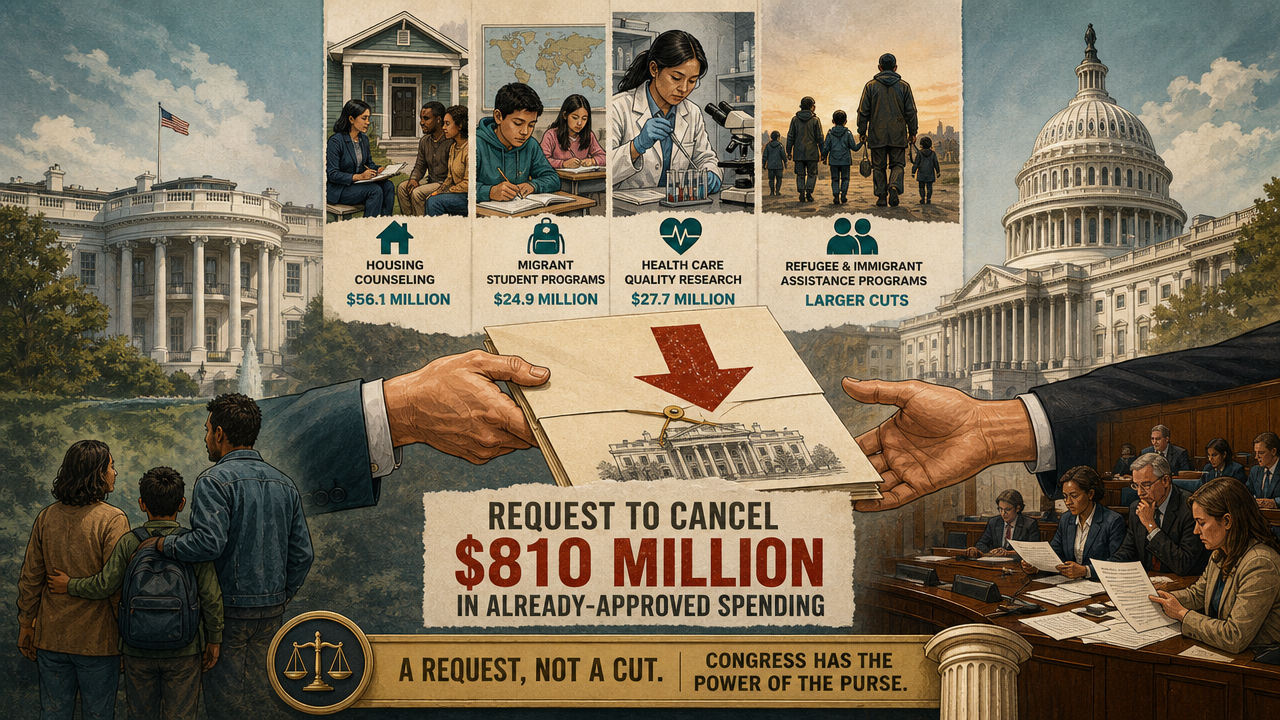
White House asks Congress to cancel $810 million in already-approved spending, including housing counseling and education funds
What happened
The White House sent Congress an 11-item request on September 25 to cancel $810 million that Congress had previously approved. The package includes $56.1 million from HUD housing-counseling grants, $24.9 million from programs for migrant students, $27.7 million from health-care quality research, and much larger proposed cuts to refugee and immigrant-assistance programs. This is a request, not a completed spending cut: Congress has the formal power over appropriations.
What it means for voters
Housing counselors can help people understand mortgages, avoid foreclosure, and work through rental or homeownership problems. The education and health-research items could also affect grants and services, but the size and location of any real-world effects depend on whether Congress accepts the request and whether the money expires first. The bigger civic issue is who gets the last word over money Congress has already appropriated: the White House says the funds are unnecessary; critics say the timing tries to bypass Congress’s normal review window.
What to watch
Watch for House and Senate action on the rescission request, and for any court or congressional challenge to the administration’s attempt to hold the money near the end of the fiscal year.
Context from earlier events
The 1974 Impoundment Control Act created a formal process for presidents to propose cancelling approved funds, while leaving Congress responsible for deciding whether to make the cuts permanent.
Primary and independent sources
Voting; privacy; federal courts; state election administration Nationwide; state and local election offices choose whether to use the system
Supreme Court lets the expanded federal citizenship-check system operate while voter-record case continues
What happened
The U.S. Supreme Court on September 25 paused a lower-court ruling that had blocked the federal government’s expanded SAVE system. The system lets election officials submit identifying information, including Social Security-number data in some searches, to check whether a person is a U.S. citizen. The Court’s order lets the program operate while the appeal continues; it does not end the lawsuit or require states to use it.
What it means for voters
Citizenship is required to vote in federal elections, but election offices must also protect eligible voters from being wrongly flagged. The Court said individualized citizenship checks may continue close to an election, while federal law still restricts systematic voter-roll removal programs within 90 days of a federal election. A voter who gets a citizenship question from an election office should respond quickly and use the office’s official process to provide documents if needed.
What to watch
Watch the D.C. Circuit appeal, whether states choose to use the system, and whether election offices treat a database result as a lead for follow-up rather than automatic proof that someone is ineligible.
Context from earlier events
SAVE was created for agencies checking immigration or citizenship status for public-benefit purposes. The Trump administration expanded it in 2025 for voter-citizenship checks and bulk searches.
Healthcare costs; Medicaid; benefits; state and federal government Nationwide, with state-by-state differences
States are setting different paths for Medicaid work rules ahead of January
What happened
A new federal Medicaid rule requires certain adults to document 80 hours a month of work, school, job training, or qualifying community activity to keep or gain coverage, unless an exemption applies. Most states must have the requirement in place by January 1, 2027, though they may start earlier. New reporting shows that some Republican-led states are considering or adopting rules stricter than the federal baseline.
What it means for voters
For people who rely on Medicaid, this can mean more paperwork on top of work, caregiving, school, or health problems. The rule has exemptions, and a state must give a person 30 days to show compliance or explain why the requirement does not apply when it cannot verify the information. States run Medicaid day to day, but the federal government wrote the national framework, so the details can look different depending on where someone lives.
What to watch
Watch your state Medicaid agency for notices, exemption rules, reporting methods, and start dates. Also watch the pending legal challenges to the federal rule and whether states add requirements beyond the federal minimum.
Context from earlier events
CMS issued the national implementation rule in June 2026 after Congress required the policy in the 2025 tax-and-policy law.
Paychecks; federal jobs; public services; government operations Nationwide
Administration settles case over using shutdowns for mass federal layoffs
What happened
The Trump administration agreed on September 25 to withdraw earlier guidance that treated mass layoffs as work agencies could carry out during a federal shutdown. Under the settlement with federal-worker unions, agencies must remove broad layoff authority from their shutdown plans, and previously issued layoff notices from the 2025 shutdown have been rescinded. The agreement does not prevent all future federal workforce cuts; it focuses on layoffs during a lapse in appropriations.
What it means for voters
This gives federal workers more protection from losing a job because Congress and the president fail to fund the government on time. It also matters to the public: abrupt staff cuts can slow down work at agencies that handle taxes, benefits, housing, environmental reviews, and other services. Congress has already funded the government through December 11, so there is no October 1 shutdown deadline this year.
What to watch
The Office of Personnel Management and Office of Management and Budget have 30 days to tell agencies to withdraw the old guidance. Watch whether updated agency shutdown plans are posted and whether the union case is reopened if there is another funding lapse.
Context from earlier events
During the 43-day 2025 shutdown, agencies sent about 4,200 reduction-in-force notices before workers were reinstated.
Foundations; tribal sovereignty; state government; public workers; education California, with lessons for state–tribal relations nationwide
California makes Native American Day a paid state holiday and strengthens tribal consultation rules
What happened
California Gov. Gavin Newsom signed a group of tribal-policy bills on September 25. The measures make Native American Day an official paid state holiday, put the Governor’s Office of Tribal Affairs into state law permanently, create a Tribal Advisory Committee, and set clearer consultation expectations for state agencies. Other bills in the package address Native higher education, child guardianship, and public-safety gaps on tribal lands.
What it means for voters
The direct paycheck effect is on California state employees who receive the new paid holiday. The wider effect is about how state agencies make decisions on land, education, family services, public safety, and other programs that affect tribal governments and Native residents. California controls these state rules, but tribal governments retain their own authority, and federal law also shapes many tribal programs.
What to watch
Watch when state agencies publish or update consultation practices and how tribal governments describe whether the new process changes decisions early enough to matter.
Context from earlier events
California created the Governor’s Office of Tribal Affairs in 2022. The new law makes that office permanent and adds a formal advisory structure.
Primary and independent sources
How this briefing was made
We used official records to verify government actions and independent reporting to add context. We also checked popular political videos on YouTube for topic leads. Popularity helped us decide what to investigate, but it was not treated as proof or public opinion. Every included claim still had to be checked against the linked sources.