The daily civic brief
U.S. civic briefing
Mississippi posts a 2026 general-election results page, but final certification was not verified / North Carolina’s deadline for certain statewide recount requests is today / Florida’s statewide certification meeting was set for November 17 / Senate clears debate hurdle on H.R. 2347, but the bill is not law / HUD finalizes new verification rules for federally assisted housing / FAA says legacy equipment became unstable during the nationwide ground stop
Estimated 4-minute catch-up · 6 stories
Today's audio briefing
Today's spoken briefing
Hear the latest national briefing and what to watch next for every headline. A restrained instrumental bed plays in the web player.
Read the audio transcript
Voting; election administration; U.S. Senate representation Mississippi
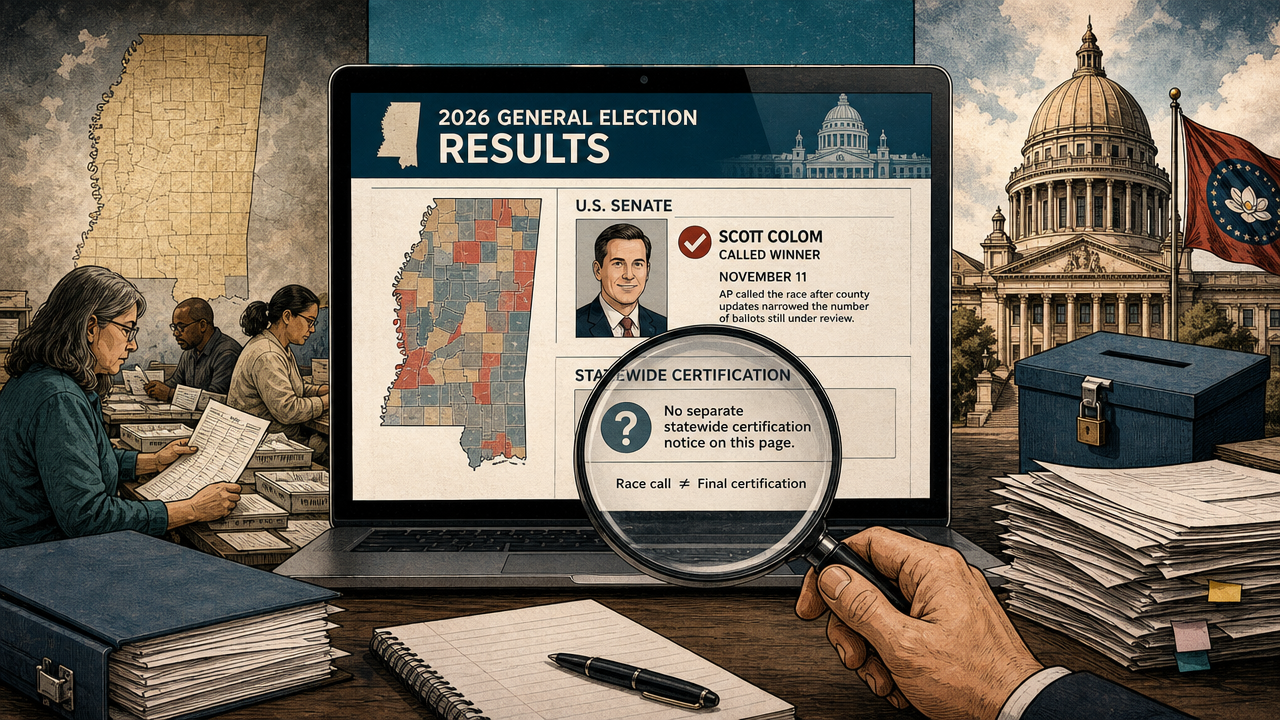
Mississippi posts a 2026 general-election results page, but final certification was not verified
What happened
Mississippi’s Secretary of State now lists a page for 2026 general-election results. Associated Press called the U.S. Senate race for Scott Colom on November 11 after county updates narrowed the number of ballots still under review.
What it means for voters
Mississippians need the state’s final record to know when the Senate result is official. For everyone else, the seat affects who represents Mississippi in the U.S. Senate, where members vote on national laws involving taxes, health programs, labor rules, transportation, and federal spending. Nothing in the records reviewed shows a change that households need to act on today; this is about finishing the vote-counting process correctly.
Save stories & follow topics · Open this story
Get the context & analysis
Mississippi’s Secretary of State now lists a page for 2026 general-election results. Associated Press called the U.S. Senate race for Scott Colom on November 11 after county updates narrowed the number of ballots still under review. But the official page located in this scan did not itself show a separate statewide certification notice, so a race call and final certification should not be treated as the same thing.
What to watch
Watch the Mississippi Secretary of State for a clearly labeled statewide certification record or other final election notice. As of 2026-11-17, this scan did not verify one.
Context from earlier events
No relevant context from earlier events was found.
Check sources (3)
Voting; recounts; election administration North Carolina
North Carolina’s deadline for certain statewide recount requests is today
In effect: North Carolina’s post-election canvass and recount rules are operating for the November 3, 2026 election. The State Board set November 17 at noon as the deadline for written recount demands in its jurisdiction and November 24 for the state canvass. Verify status
What happened
North Carolina county boards completed their canvass on November 13. The State Board of Elections says a candidate seeking a recount in a contest under the State Board’s authority had to submit a written request by noon on Tuesday, November 17.
What it means for voters
A recount is a defined review process, not proof that anything went wrong. For voters in a close statewide or multi-county contest, this deadline determines whether the losing candidate can ask for another count before final statewide certification. The practical effect is mostly about confidence in the result and who will represent voters, not a direct change to anyone’s paycheck or household bill.
Save stories & follow topics · Open this story
Get the context & analysis
North Carolina county boards completed their canvass on November 13. The State Board of Elections says a candidate seeking a recount in a contest under the State Board’s authority had to submit a written request by noon on Tuesday, November 17. The state canvass remains scheduled for November 24. This scan did not locate a statewide notice confirming that a recount request was filed.
What to watch
Watch the North Carolina State Board of Elections for any recount order and for its statewide canvass on November 24, 2026, at 11 a.m.
Context from earlier events
North Carolina’s county canvass took place on November 13, 2026. Statewide certification is a later step, scheduled for November 24.
Check sources (1)
Primary and independent sources
Voting; certification; election administration Florida
Florida’s statewide certification meeting was set for November 17
In effect: Florida’s statutory canvass and certification process is in effect for the November 3, 2026 general election. The state publicly noticed the statewide certification meeting for November 17, but this scan did not verify a completed certification document. Verify status
What happened
Florida’s Division of Elections publicly noticed an Elections Canvassing Commission meeting at 8 a.m. on November 17 to certify results from the 2026 general election and a special state Senate election. The official calendar identifies November 17 as the statewide certification date for federal, state, and multicounty offices.
What it means for voters
Florida voters deserve a clear line between unofficial returns and official statewide results. Certification is the step that turns completed election administration into the state’s formal result for offices that affect representation in Congress, state government, and multicounty districts. It does not change a family’s bills today, but it settles who has authority to make future decisions on taxes, schools, insurance, transportation, and other public services.
Save stories & follow topics · Open this story
Get the context & analysis
Florida’s Division of Elections publicly noticed an Elections Canvassing Commission meeting at 8 a.m. on November 17 to certify results from the 2026 general election and a special state Senate election. The official calendar identifies November 17 as the statewide certification date for federal, state, and multicounty offices. During this scan, a post-meeting certification document or final-results notice was not located.
What to watch
Watch the Florida Division of Elections for the commission’s certification record, official returns, and any notice of a contest or other follow-up. As of 2026-11-17, this scan verified the meeting notice but not its completed record.
Context from earlier events
No relevant context from earlier events was found.
Check sources (2)
Congress; jobs; energy; permitting; federal policy Washington, D.C.; nationwide
Senate clears debate hurdle on H.R. 2347, but the bill is not law
Proposed: The Senate agreed to cloture on a substitute amendment to H.R. 2347 on November 16, 2026. Final Senate passage, House agreement, and presidential action were not verified as of November 17. Verify status
What happened
The Senate voted 70–27 on November 16 to invoke cloture on Sen. Shelley Moore Capito’s substitute amendment to H.R. 2347. Cloture limits debate; it does not equal final Senate passage or enactment.
What it means for voters
This is one step in a bill that could eventually shape infrastructure and energy-related work, permitting, and project timelines. But working households should not assume a new job rule, utility change, tax change, or pay increase has taken effect. The immediate real-world change is procedural: the Senate moved the measure closer to a final vote.
Save stories & follow topics · Open this story
Get the context & analysis
The Senate voted 70–27 on November 16 to invoke cloture on Sen. Shelley Moore Capito’s substitute amendment to H.R. 2347. Cloture limits debate; it does not equal final Senate passage or enactment. The Senate was back in session on November 17, but this scan did not verify a final passage vote, House agreement, or presidential signature.
What to watch
Watch for a final Senate vote on H.R. 2347 or its substitute, then any House action and presidential action. As of 2026-11-17, those later steps were not verified.
Context from earlier events
The Senate scheduled this procedural vote in the prior briefing; the November 16 roll call confirms that the vote occurred and passed.
Check sources (2)
Primary and independent sources
Housing; rent assistance; federal rulemaking Nationwide
HUD finalizes new verification rules for federally assisted housing
Passed: HUD issued a final rule on November 12, 2026. It is scheduled to become effective December 14, 2026, so it is final but not yet in effect as of November 17. Verify status
What happened
HUD published a final rule requiring verification of U.S. citizenship or eligible immigration status for all applicants and recipients in covered housing-assistance programs, regardless of age. The rule also makes prorated assistance temporary while every family member’s eligible status is verified, where federal law permits.
What it means for voters
This matters most to people in covered public-housing and rental-assistance programs, including mixed-status families and some older tenants who previously had different documentation treatment. It does not change private-market rent rules. HUD says housing authorities and owners must notify certain current tenants within 30 days after the rule takes effect; mixed families that have not submitted required evidence face a 90-day deadline from the effective date, with possible extensions. Losing or reducing assistance could put real pressure on a household budget, while HUD says the rule directs assistance toward households it considers fully eligible and keeps some transition protections.
Save stories & follow topics · Open this story
Get the context & analysis
HUD published a final rule requiring verification of U.S. citizenship or eligible immigration status for all applicants and recipients in covered housing-assistance programs, regardless of age. The rule also makes prorated assistance temporary while every family member’s eligible status is verified, where federal law permits. The rule takes effect December 14, 2026; that date is before the broader tenant-document deadlines described in the rule.
What to watch
Watch HUD for implementation guidance before the December 14, 2026 effective date, and watch for any court challenge or stay. Housing authorities and assisted-property owners will also need to send required notices after the rule takes effect.
Context from earlier events
No relevant context from earlier events was found.
Check sources (1)
Transportation; air travel; public infrastructure; workplace commutes Nationwide
FAA says legacy equipment became unstable during the nationwide ground stop
What happened
The FAA says a November 13 technical problem led it to order a nationwide ground stop around 3:30 p.m. Eastern. In a November 15 question-and-answer release, the agency said legacy equipment became unstable as its network received roughly 1,000 connection attempts every four to five seconds, disrupting aircraft communications and radar feeds.
What it means for voters
For workers who fly for a job, commute through airports, move freight, or have family travel planned, a nationwide ground stop can mean missed shifts, added childcare needs, hotel costs, and delayed deliveries. The FAA’s account says the stop was a safety action, but it does not settle the larger question of how quickly aging systems can be modernized without creating new problems. There is no verified final technical report yet.
Save stories & follow topics · Open this story
Get the context & analysis
The FAA says a November 13 technical problem led it to order a nationwide ground stop around 3:30 p.m. Eastern. In a November 15 question-and-answer release, the agency said legacy equipment became unstable as its network received roughly 1,000 connection attempts every four to five seconds, disrupting aircraft communications and radar feeds. The FAA says the system is stable and that it and contractor L3Harris are still investigating the root cause.
What to watch
Watch for the FAA and L3Harris to release a final root-cause explanation and corrective steps. Also watch Congress’s oversight and funding decisions for air-traffic-control modernization; no final new funding decision was verified in this scan.
Context from earlier events
The FAA initially described communications issues affecting multiple air-route traffic-control centers. Its later question-and-answer release gives a more specific account but says the investigation is still ongoing.
You're caught up on this briefing. Choose topics and save stories to return on your own schedule.
How this briefing was made
We used official records to verify government actions and independent reporting to add context. We also searched recent election-related videos on YouTube for topic leads. Search rank and popularity were not treated as proof or public opinion. We also checked recent uploads from preferred news and public-affairs channels on YouTube for topic leads. Channel preference was not treated as proof or an endorsement. Every included claim still had to be checked against the linked sources.