The daily civic brief
U.S. Civic Daily Scan — October 30, 2026
With Election Day on Tuesday, November 3, the biggest immediate stories are voting deadlines and court fights over how elections are run. Today is the last day for advance in-person voting in Georgia and Nevada, while early voting remains open in New York City through November 1. On the pocketbook side, new federal data shows housing, food, health insurance, and transportation remained major household-cost pressures in 2025, though the data uses averages—not a typical family budget.
Estimated 5-minute catch-up · 6 stories
Today's audio briefing
Today's spoken briefing
Hear the latest national briefing and what to watch next for every headline. A restrained instrumental bed plays in the web player.
Read the audio transcript
Voting; election access; state election administration Georgia, Nevada, New York City
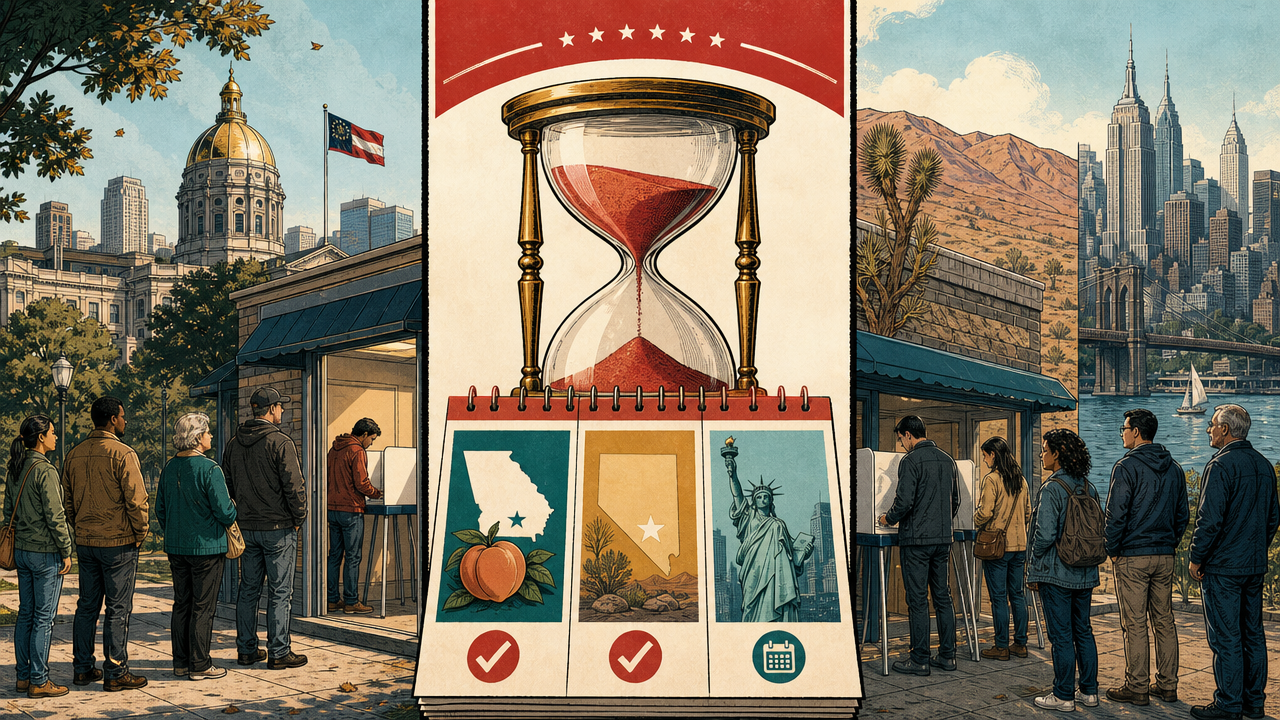
Last-call early voting today in Georgia and Nevada; New York City voting continues
In effect: Official election pages list October 30, 2026, as Georgia’s final advance-voting day and Nevada’s final early-voting day. New York City officially lists an active early-voting period through November 1, 2026. Verify status
What happened
As of October 30, 2026, Georgia and Nevada list today as the final day of in-person advance or early voting for the November 3 general election. New York City early voting is open today from 9 a.m. to 5 p.m. and continues through Sunday, November 1.
What it means for voters
For people working shifts, commuting, or juggling child care, the calendar matters more than campaign noise. A voter in Georgia or Nevada who wants to vote early needs to use the option today; after that, the regular in-person option is Election Day. New York City voters still have weekend early-voting options, but their early-voting site can differ from their Election Day site. Rules, hours, and ballot-return deadlines vary by state and locality, so workers should check their official election office before heading out.
Save stories & follow topics · Link to this story
Get the context & analysis
As of October 30, 2026, Georgia and Nevada list today as the final day of in-person advance or early voting for the November 3 general election. New York City early voting is open today from 9 a.m. to 5 p.m. and continues through Sunday, November 1. Election Day is Tuesday, November 3.
What to watch
Georgia and Nevada voters who do not vote today should confirm their Election Day polling location and hours for November 3. New York City early voting ends November 1; in-person applications for an early-mail or absentee ballot are due November 2.
Context from earlier events
Early voting schedules are set by state and local law, so there is no single national deadline before the November 3, 2026 election.
Check sources (3)
Primary and independent sources
Voting; federal courts; election administration; accountability Nationwide
Federal judge seeks a list of states contacted in administration voter-roll campaign
Challenged in court: The lawsuit seeks to restrict specified federal election-related conduct. As of October 30, Judge Boasberg had ordered disclosure of contacted states and said he intended to rule by November 2; the cited reporting does not show that a broader injunction had been issued. Verify status
What happened
On October 29, Chief U.S. District Judge James Boasberg ordered the Trump administration to identify the states whose election officials received Justice Department pressure connected to the administration’s effort to prevent noncitizens from voting. The judge said he intended to rule by Monday, November 2, on Democratic Party leaders’ request to block certain federal actions affecting state election procedures.
What it means for voters
State and local officials, not the White House, do most of the hands-on work of maintaining voter rolls, sending ballots, staffing polls, and counting votes. The case is about whether federal officials can pressure states to change voter-list or ballot practices so close to Election Day. For voters, the key fact is that this court hearing has not itself changed their registration, ballot, or polling-place rules as of October 30.
Save stories & follow topics · Link to this story
Get the context & analysis
On October 29, Chief U.S. District Judge James Boasberg ordered the Trump administration to identify the states whose election officials received Justice Department pressure connected to the administration’s effort to prevent noncitizens from voting. The judge said he intended to rule by Monday, November 2, on Democratic Party leaders’ request to block certain federal actions affecting state election procedures. The court had not issued that broader order as of October 30.
What to watch
Watch for the administration’s disclosure of the states it contacted and for Judge Boasberg’s expected ruling by Monday, November 2. Any binding change to state voting procedures would need to come through a court order or the relevant state election authority.
Context from earlier events
Federal law bars noncitizens from voting in federal elections, but states have the primary responsibility for administering elections and determining the validity and tabulation of votes under the Justice Department’s own manual.
Check sources (2)
Voting; federal courts; election administration; accountability California
California judge appoints special master to examine federal voter-list claims; DOJ subpoenas county employees
Challenged in court: The Justice Department’s request to stop California from counting ballots linked to its list remains in litigation. The October 29 court order appoints a special master and sets expedited filings; it does not order counties to segregate ballots or change California’s published voting procedures. Verify status
What happened
On October 29, U.S. District Judge David O. Carter appointed Daniel B.
What it means for voters
This does not mean California ballots have been set aside or that any voter has been removed from the rolls. The court is building a factual record about a disputed list after rejecting an immediate change to ballot handling. For California voters, the immediate voting rules remain those published by state and county election officials; the larger court fight could affect election administration and certification later, but the present record does not show a new Election Day rule.
Save stories & follow topics · Link to this story
Get the context & analysis
On October 29, U.S. District Judge David O. Carter appointed Daniel B. Garrie as a special master in the Justice Department’s lawsuit against California over a federal list of more than 20,000 people the government says are likely noncitizens on voter rolls. The order sets an expedited schedule, including witness lists and expert evidence about the list’s reliability due November 6 and an evidentiary hearing after Election Day. Separately, the Associated Press reported that Los Angeles County Registrar-Recorder employees received subpoenas seeking records tied to federal voter-roll inquiries and were ordered to appear November 4.
What to watch
The parties’ expert and witness materials are due November 6, and the court’s October 29 order sets an evidentiary hearing process for the reliability of the federal list. Watch for a written ruling after that process, as well as any Ninth Circuit action on the Justice Department appeal.
Context from earlier events
On October 28, Judge Carter denied the federal government’s request for immediate ballot-segregation relief. California’s official election page says eligible citizens may use same-day registration through Election Day and lists the state’s ballot-return rules.
Check sources (3)
Primary and independent sources
- U.S. District Court for the Central District of California Order Appointing Daniel B. Garrie as Special Master, Setting Hearing, and Setting Briefing Schedule
- Associated Press Justice Department subpoenas California officials in escalation of its scrutiny of elections
- California Secretary of State General Election — November 3, 2026
Voting; federal law enforcement; election integrity California, Florida, Nevada, New York, Pennsylvania
Justice Department announces 48 election-related criminal cases across five states
Challenged in court: The announced matters are criminal charges or informations in individual cases. Charges are allegations that must be resolved in federal court; they are not judicial findings of guilt or proof of outcome-changing fraud. Verify status
What happened
The Justice Department announced October 26 that it had brought charges involving 48 noncitizens in California, Florida, Nevada, New York, and Pennsylvania in cases involving alleged illegal voting, false voter registration, or related election offenses. These are criminal allegations or charges, not findings that a broad election was stolen or that statewide results were affected.
What it means for voters
Workers and families deserve accurate information about election crime without having isolated cases turned into a claim about an entire election. Federal law prohibits noncitizens from voting in federal elections, and prosecutors can bring cases when they believe evidence supports charges. But the announced cases do not change a voter’s current registration, voting location, or ballot deadline, and the release does not establish that the cases changed an election result.
Save stories & follow topics · Link to this story
Get the context & analysis
The Justice Department announced October 26 that it had brought charges involving 48 noncitizens in California, Florida, Nevada, New York, and Pennsylvania in cases involving alleged illegal voting, false voter registration, or related election offenses. These are criminal allegations or charges, not findings that a broad election was stolen or that statewide results were affected. Defendants are presumed innocent unless proven guilty.
What to watch
Watch the individual federal court cases for pleas, dismissals, trials, or verdicts. Also watch official state and local election offices for any actual changes to voting procedures; a Justice Department charging announcement is not itself a new statewide election rule.
Context from earlier events
The Justice Department’s announcement follows separate California litigation over a voter list, but individual criminal cases and the broader civil ballot-counting lawsuit are different legal matters with different evidence and remedies.
Check sources (2)
Economic life; household costs; housing; groceries; healthcare; transportation Nationwide
New federal spending data shows housing, food, insurance, and transportation squeezing family budgets
In effect: This is an official statistical release published October 29, 2026, not a new household-cost policy. BLS says it used a weight adjustment to address missing October and November 2025 survey collection caused by the federal funding lapse. Verify status
What happened
The Bureau of Labor Statistics released its annual Consumer Expenditures report on October 29. It found that average annual spending by U.S. consumer units was $81,905 in 2025, up 4.3% from 2024.
What it means for voters
This is not a new tax, benefit, or price-control policy. It is a reality check on the budget categories that take the biggest bites out of paychecks. For a hypothetical family of four earning about $110,000 before taxes, the report is useful for spotting national pressures, but it cannot predict that family’s exact rent, mortgage, grocery bill, insurance premium, or take-home pay. The BLS numbers are averages for “consumer units,” which can include people living alone and unrelated people sharing a home; they are not median family income or a standard family-of-four budget.
Save stories & follow topics · Link to this story
Go deeper: What the new federal household-spending data says — and does not say — about family budgets
Get the context & analysis
The Bureau of Labor Statistics released its annual Consumer Expenditures report on October 29. It found that average annual spending by U.S. consumer units was $81,905 in 2025, up 4.3% from 2024. Average housing spending rose 5.8% to $27,790, food spending rose 4.6% to $10,633, healthcare spending rose 4.4% to $6,470, and public and other transportation spending rose 6.0%. The report says its 2025 survey estimates needed a weight adjustment because data collection was interrupted during the 2025 federal funding lapse.
What to watch
Watch the Bureau of Labor Statistics’ October 30 Employment Cost Index release for a newer measure of employer costs for wages and benefits, and upcoming inflation reports for whether price growth is easing or spreading into other parts of household budgets.
Context from earlier events
BLS reports that consumer spending data collection was interrupted in October and November 2025 during a federal lapse in appropriations, and that the agency used a weighting adjustment for the annual 2025 estimates.
Check sources (2)
Voting; state government; schools; taxes; representation Georgia
Georgia voters face statewide offices and constitutional amendments as early voting closes
In effect: Georgia’s official election information lists October 30 as the final day of advance in-person voting and November 3 as Election Day. The offices and ballot items vary by voter location. Verify status
What happened
Georgia’s official election page says the November 3 ballot includes a U.S. Senate race, all 14 U.S. House seats, governor, other statewide offices, all seats in the General Assembly, judicial races, local offices, and ballot measures. The state says October 30 is the last day of advance in-person voting.
What it means for voters
This is a reminder that the ballot is not just about the most advertised race. State legislators and governors affect wages, unemployment rules, public schools, taxes, utility oversight, and election laws. Local ballot questions can affect sales taxes and capital spending on schools, buses, roads, libraries, or other public facilities. A hypothetical family of four earning $110,000 before taxes would not necessarily see an immediate bill change from any one ballot question, because effects depend on the exact measure and local jurisdiction.
Save stories & follow topics · Link to this story
Get the context & analysis
Georgia’s official election page says the November 3 ballot includes a U.S. Senate race, all 14 U.S. House seats, governor, other statewide offices, all seats in the General Assembly, judicial races, local offices, and ballot measures. The state says October 30 is the last day of advance in-person voting. Community reporting by Capital B Atlanta notes that Georgia voters will also decide three proposed constitutional amendments, while some metro Atlanta voters have local sales-tax questions tied to school capital projects or infrastructure.
What to watch
Georgia advance voting ends October 30. Voters who wait should use their assigned polling place on November 3, when polls are scheduled to be open from 7 a.m. to 7 p.m.; people in line before closing can vote. Voters should review their exact county ballot before Election Day.
Context from earlier events
Georgia’s ballot combines federal representation with state and local decisions, so different contests can affect different parts of daily life—from national tax and labor policy to local schools and infrastructure.
Check sources (2)
Primary and independent sources
Community perspectives
Reporting that adds community impact and context. Official records remain the factual foundation.
You're caught up on this briefing. Choose topics and save stories to return on your own schedule.
How this briefing was made
We used official records to verify government actions and independent reporting to add context. We also searched recent election-related videos on YouTube for topic leads. Search rank and popularity were not treated as proof or public opinion. Every included claim still had to be checked against the linked sources.