The daily civic brief
U.S. Civic Daily Scan — October 27, 2026
Election deadlines and court fights are the biggest voter-facing developments today. Three states have mail-ballot application deadlines, while federal actions in California and Washington are testing how far the Justice Department can push state election offices during an active election. Outside voting, a new ACA Marketplace proposal could change how people prove eligibility for premium help, and a federal-contract wage increase is scheduled for January.
Estimated 5-minute catch-up · 6 stories
Today's audio briefing
Today's spoken briefing
Hear the latest national briefing and what to watch next for every headline. A restrained instrumental bed plays in the web player.
Read the audio transcript
Voting; federal courts; election administration California
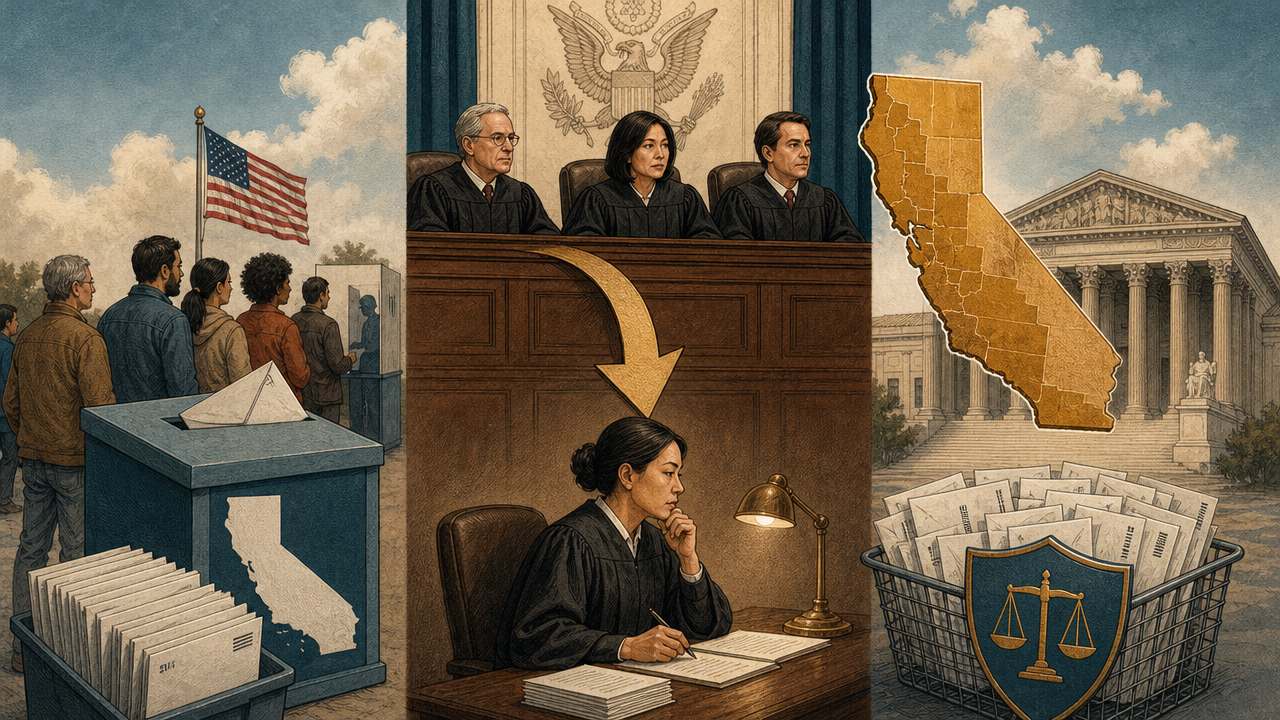
Appeals court sends California ballot dispute back to the trial judge
Challenged in court: As of October 27, 2026, the Ninth Circuit declined the Justice Department’s emergency effort to obtain immediate ballot-segregation relief and returned the dispute to the federal district court. No cited source shows an order changing California’s ballot-counting process. Verify status
What happened
On October 26, the Ninth U.S. Circuit Court of Appeals declined the Justice Department’s request for an immediate order requiring California to set aside and not count mail ballots tied to about 20,000 people the department says are likely noncitizens. The appeals court said the federal government had not given the district court enough time to consider the request.
What it means for voters
California voters still use the state’s normal ballot-return and counting rules unless a court changes them. The case matters beyond California because it tests whether federal officials can force state election offices to change ballot handling close to Election Day based on a list of suspected noncitizens. For workers juggling shifts, childcare, and commutes, the practical point is simple: a lawsuit is not the same as a change in how their ballot is counted.
Save stories & follow topics · Link to this story
Get the context & analysis
On October 26, the Ninth U.S. Circuit Court of Appeals declined the Justice Department’s request for an immediate order requiring California to set aside and not count mail ballots tied to about 20,000 people the department says are likely noncitizens. The appeals court said the federal government had not given the district court enough time to consider the request. A federal district-court hearing was set for October 27; as of this edition, the appellate ruling itself does not order California counties to separate or reject any ballots.
What to watch
Watch for the U.S. District Court for the Central District of California’s October 27 action on the Justice Department’s request. Any order affecting ballot handling should come from the court or California election officials, not from campaign claims.
Context from earlier events
California began mailing vote-by-mail ballots no later than October 5, and county officials began reporting results after polls close on November 3 under the state’s published calendar.
Check sources (2)
Voting; voter rolls; election administration; privacy Washington
Washington reviews Justice Department request involving about 400 voter records
Challenged in court: The cited Washington record confirms a federal information request, not a court order or a new state ballot rule. Related federal-state election disputes are being litigated elsewhere, but no cited source shows Washington’s ballot procedures have been changed by a court. Verify status
What happened
Washington Secretary of State Steve Hobbs said October 26 that his office received a Justice Department letter seeking information about people on the state voter rolls. The state says the letter covers about 400 records and that it is reviewing what information it can lawfully provide.
What it means for voters
Washington votes mainly by mail, so ballot handling and voter privacy are not abstract issues. Eligible voters should not assume their ballot is at risk because of a federal request, but they should make sure their voter information is current and return ballots through official channels. The state also says some counties saw more rejected ballots in the August primary because of delayed postmarks, which makes early ballot return especially useful for people whose work schedules make Election Day hard.
Save stories & follow topics · Link to this story
Get the context & analysis
Washington Secretary of State Steve Hobbs said October 26 that his office received a Justice Department letter seeking information about people on the state voter rolls. The state says the letter covers about 400 records and that it is reviewing what information it can lawfully provide. The Justice Department has not shown, in the cited records, that any particular Washington ballot has been cast illegally or that a court has ordered Washington to set aside ballots.
What to watch
Watch for a formal response by the Washington Secretary of State or a court filing. The state says the Justice Department expects to send another list before November 3, but no cited source confirms a change to Washington’s voting rules.
Context from earlier events
Washington’s office says one record in the Justice Department’s letter dates to 1994 and says 113.5 million primary and general-election ballots have been cast in the state since then.
Check sources (2)
Voting; mail ballots; election deadlines New Jersey, Ohio and Pennsylvania
Mail-ballot application deadlines hit today in New Jersey, Ohio and Pennsylvania
In effect: Official state election calendars list October 27, 2026, as the stated mail-ballot application deadline in each of these three states, with Ohio specifying receipt by 8:30 p.m. Verify status
What happened
Tuesday, October 27, 2026, is the deadline to apply for a general-election mail-in ballot by mail in New Jersey, the deadline for Ohio boards of elections to receive absentee-ballot applications by 8:30 p.m., and Pennsylvania’s deadline to apply for a mail-in or civilian absentee ballot. These are application deadlines, not deadlines to return completed ballots.
What it means for voters
This is a same-day practical deadline for voters who need a mail ballot because of work, disability, caregiving, travel, or a long commute. Missing an application deadline does not automatically mean someone cannot vote: voters may still have early in-person or Election Day options, depending on their state. Check the official election office before leaving home because return rules and hours differ.
Save stories & follow topics · Link to this story
Get the context & analysis
Tuesday, October 27, 2026, is the deadline to apply for a general-election mail-in ballot by mail in New Jersey, the deadline for Ohio boards of elections to receive absentee-ballot applications by 8:30 p.m., and Pennsylvania’s deadline to apply for a mail-in or civilian absentee ballot. These are application deadlines, not deadlines to return completed ballots. Early in-person voting remains available in New Jersey and Ohio under their published schedules.
What to watch
New Jersey voters can apply in person for a mail-in ballot through 3 p.m. on November 2. Ohio early voting is open October 27 from 7:30 a.m. to 8:30 p.m.; completed non-military absentee ballots must reach the board by 7:30 p.m. on November 3. Pennsylvania completed mail-in and civilian absentee ballots must reach the county election office by 8 p.m. on November 3.
Context from earlier events
:null,
Voting; election monitoring; federal-state authority Nationwide
Justice Department monitoring plans are becoming concrete in more election jurisdictions
Proposed: The cited records describe planned Election Day deployments and notices to jurisdictions. They do not show a new nationwide voting rule or a completed deployment as of October 27, 2026. Verify status
What happened
The Justice Department plans to send about 1,000 staff members to observe Election Day voting nationwide, according to reporting that cites a department spokesperson. States and local jurisdictions, including Oregon, Utah and Philadelphia, have publicly said they were notified about anticipated monitoring.
What it means for voters
Poll workers and voters may see more observers around Election Day. That alone does not mean there is a problem with a polling place or a ballot count. For voters, the practical standard is that they should be able to cast a ballot without intimidation; if anyone interferes, the right place to report it is the local election office or the state election-protection channel.
Save stories & follow topics · Link to this story
Get the context & analysis
The Justice Department plans to send about 1,000 staff members to observe Election Day voting nationwide, according to reporting that cites a department spokesperson. States and local jurisdictions, including Oregon, Utah and Philadelphia, have publicly said they were notified about anticipated monitoring. Federal election monitors can observe and report possible federal-law violations, but state and local election officials still run polling places and ballot counts.
What to watch
Watch for the Justice Department to identify additional locations and for state or county election offices to publish voter-facing guidance before November 3. As of October 27, the cited reports do not establish that monitors have authority to run a polling place or handle ballots.
Context from earlier events
Federal monitoring is not new, but the reported 2026 plan is larger than the department’s 2024 effort, according to the cited Associated Press report.
Healthcare; insurance; taxes; federal rulemaking Nationwide
New ACA Marketplace proposal would require verification before premium help begins
Proposed: The rule was published as a proposed rule on October 27, 2026. Comments are due November 27, 2026, and CMS says the proposed provisions would apply beginning with plan-year 2028 eligibility determinations. Verify status
What happened
The Centers for Medicare & Medicaid Services published a proposed rule on October 27 that would require ACA Marketplace exchanges to verify certain information before providing advance premium tax credits or cost-sharing reductions when there is a data mismatch. The proposal covers household income and family size, citizenship or eligible-noncitizen status, other qualifying coverage, and residence.
What it means for voters
For people who buy their own health insurance and depend on Marketplace financial help, the proposal could mean more paperwork and potentially a delay before subsidies start if records do not match. It could also reduce improper payments if the checks work as intended. A hypothetical family of four earning about $110,000 before taxes may or may not qualify for help depending on location, plan costs, and other facts, so this proposal does not establish a dollar impact for that family.
Save stories & follow topics · Link to this story
Get the context & analysis
The Centers for Medicare & Medicaid Services published a proposed rule on October 27 that would require ACA Marketplace exchanges to verify certain information before providing advance premium tax credits or cost-sharing reductions when there is a data mismatch. The proposal covers household income and family size, citizenship or eligible-noncitizen status, other qualifying coverage, and residence. It is not in effect now; CMS proposes applying the changes to eligibility decisions for 2028 coverage, with a first pre-open-enrollment verification window beginning August 1, 2027.
What to watch
Public comments are due November 27, 2026. CMS would need to review comments and issue a final rule before the proposed verification system could take effect for 2028 coverage.
Context from earlier events
Under the current process described in the proposal, people who appear eligible can generally receive financial assistance during a 90- or 95-day period to resolve certain data mismatches.
Check sources (2)
Work and wages; federal contracts; tipped workers Nationwide
Some federal-contract workers will see a scheduled minimum-wage increase in January
Passed: The Labor Department has issued the 2027 rate notice, but the new rates do not begin until January 6, 2027. Coverage is limited to the older set of contracts specified in the notice. Verify status
What happened
The Labor Department announced that the minimum wage for workers covered by the older Executive Order 13658 federal-contract standard will rise from $13.65 to $14.05 an hour on January 6, 2027. The required minimum cash wage for tipped workers under those covered contracts will rise from $9.55 to $9.85.
What it means for voters
This is a real pay-floor increase for workers covered by this narrower group of federal contracts, including some service and concession workers. It does not raise the federal minimum wage for everyone and does not automatically cover newer or renewed contracts. For a worker covered by the notice, the change is 40 cents more per hour before taxes; actual hours and eligibility depend on the contract and job duties.
Save stories & follow topics · Link to this story
Get the context & analysis
The Labor Department announced that the minimum wage for workers covered by the older Executive Order 13658 federal-contract standard will rise from $13.65 to $14.05 an hour on January 6, 2027. The required minimum cash wage for tipped workers under those covered contracts will rise from $9.55 to $9.85. The notice applies only to certain federal contracts entered into between January 1, 2015, and January 29, 2022, that were not renewed or extended on or after January 30, 2022.
What to watch
Watch for employers and contracting agencies to update wage determinations and notices before January 6, 2027. Workers who think their federal-contract wage is wrong can check the contract coverage and contact the Labor Department’s Wage and Hour Division.
Context from earlier events
The covered-contract rate is currently $13.65 an hour, and the current tipped cash wage is $9.55, according to the Labor Department notice.
Check sources (1)
Primary and independent sources
You're caught up on this briefing. Choose topics and save stories to return on your own schedule.
How this briefing was made
We used official records to verify government actions and independent reporting to add context. We also searched recent election-related videos on YouTube for topic leads. Search rank and popularity were not treated as proof or public opinion. Every included claim still had to be checked against the linked sources.