The daily civic brief
U.S. Civic & Pocketbook Scan — October 1, 2026
Housing aid, prescription-drug costs, food benefits, and election administration are all moving through different parts of government this week. The biggest immediate household questions are whether local homeless-service providers can keep programs running, whether Medicaid drug savings reach patients, and how courts are limiting federal agencies that try to attach new conditions to grants.
Today's audio briefing
Today's spoken briefing
Hear the latest national briefing and what to watch next for every headline. A restrained instrumental bed plays in the web player.
Housing; rent assistance; homelessness; federal spending; federal courts Nationwide
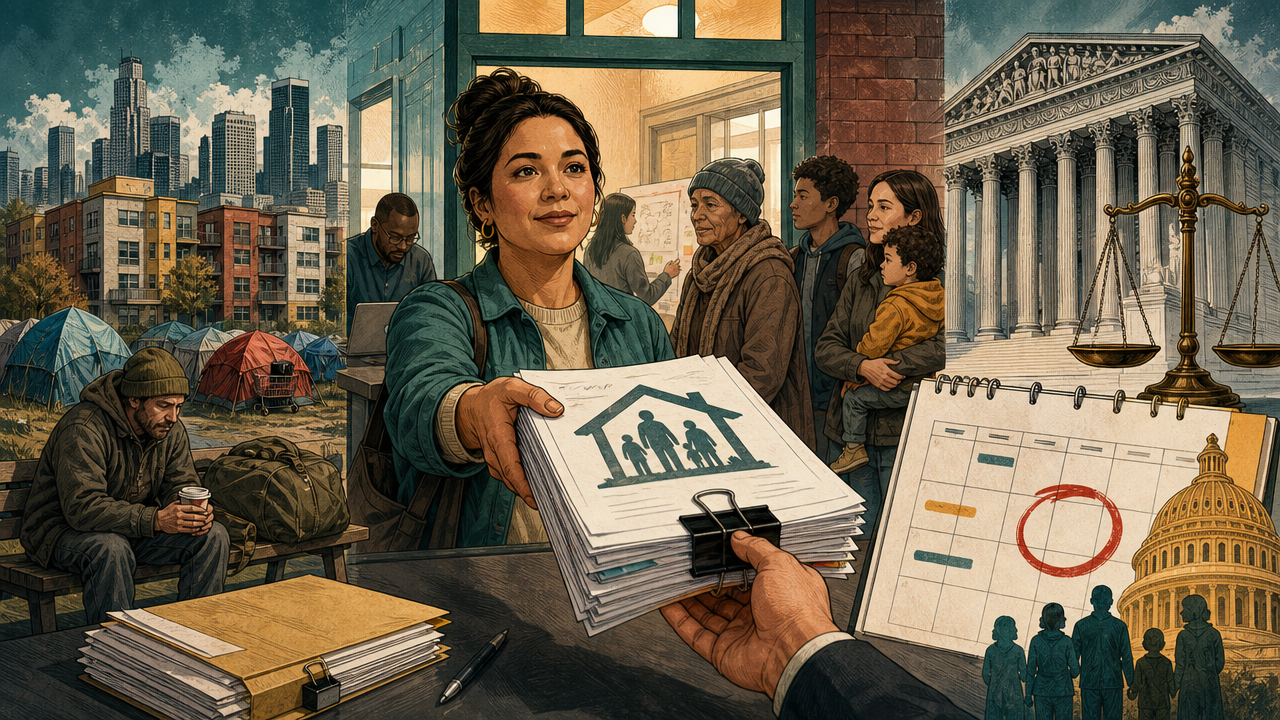
Local homelessness programs finished applying for more than $4 billion under HUD’s changed funding rules
What happened
HUD’s main 2026 competition for homelessness services and housing closed for most applicants at 8 p.m. Eastern on September 30. The competition covers more than $4 billion for local programs. A federal appeals court had temporarily allowed HUD to use its revised rules while the legal fight continues, after a lower court had thrown out the funding notice. Los Angeles-area applications have a separate deadline of October 14.
What it means for voters
This is federal money that local groups use for shelter, rental help, case management, job support, and services for people without stable housing. HUD’s new approach puts more weight on transitional housing and support services than the long-running Housing First model. That could change which local programs get funded and how quickly people can move into permanent homes. HUD controls the federal grant rules, but local agencies and nonprofits decide what services they offer if they receive awards.
What to watch
Watch for HUD’s grant awards and for the First Circuit appeal. The court case could still change the rules or the timing of awards, which could create gaps for local providers.
Context from earlier events
HUD announced its revised Continuum of Care approach in June 2026. The agency’s current page says the appeals court stay let the competition reopen after a lower court ruling had vacated the notice.
Healthcare costs; prescriptions; Medicaid; state and federal government Nationwide
Medicaid drug-price program reached its September 30 sign-up deadline, but the final state tally is not yet public
What happened
CMS said on September 18 that all 50 states, Washington, D.C., and Puerto Rico had applied for its GENEROUS Medicaid drug-payment model. At that time, 40 states and Puerto Rico had signed participation agreements, while the rest had until September 30 to do so. The deadline has now passed, but CMS has not yet published a final count of signed agreements in its latest announcement.
What it means for voters
The program is meant to make certain Medicaid outpatient drugs available to state programs at prices tied to lower prices in other countries. It does not automatically mean every prescription will cost less at the pharmacy counter, because Medicaid copays, covered drugs, manufacturer participation, and state program rules still matter. If the model lowers state drug spending, supporters say it could free up Medicaid dollars for other services; whether that happens depends on state budgets and implementation.
What to watch
Watch for CMS to release the final list of states that signed agreements, the drugmakers and medicines included, and the dates when state Medicaid programs begin collecting the new rebates.
Context from earlier events
CMS says the five-year GENEROUS model began in January 2026.
Voting; public safety; federal grants; federal courts; state government Nationwide
Federal judge blocks FEMA from tying counterterrorism grants to election-rule changes
What happened
A federal judge in Washington, D.C., ruled September 28 that FEMA could not withhold counterterrorism grant money to force states and local governments to make election-administration changes. The court said Congress had not authorized FEMA to add those conditions and that the requirements were not sufficiently tied to the purpose of terrorism-prevention grants.
What it means for voters
The decision protects access, for now, to federal money used by state and local governments for security planning, terrorism prevention, and cybersecurity. It also reinforces that states generally run elections, while Congress sets the limits on what federal agencies can require in exchange for grant money. This ruling does not settle every dispute over voter-roll checks or election procedures, and the federal government can appeal.
What to watch
Watch for an appeal, a request to pause the ruling, or a new grant notice written differently by FEMA or Congress.
Context from earlier events
No relevant context from earlier events was found.
Primary and independent sources
Housing assistance; legal aid; public safety; federal grants; federal courts Nationwide, with plaintiffs in 22 states and Washington, D.C.
Judge strikes down federal grant restrictions for domestic-violence and sexual-assault service groups
What happened
A federal judge in Rhode Island ruled September 29 against Justice Department grant conditions challenged by groups serving domestic-violence and sexual-assault survivors. The organizations said the conditions involved immigration-status certifications and restrictions related to diversity, gender identity, and related programs. The court found DOJ had not adequately supported the change in the record before it.
What it means for voters
These federal grants can help pay for crisis counseling, legal help, and housing assistance for survivors. The ruling means the challenged conditions cannot be enforced against the plaintiff organizations under this decision. It does not create new funding, and the Justice Department could appeal, but it may reduce uncertainty for service providers deciding whether they can keep programs open or apply for funds.
What to watch
Watch for a Justice Department appeal and for guidance explaining whether the ruling will affect providers beyond the organizations that sued.
Context from earlier events
The grants are authorized under the Violence Against Women Act and support survivor services, including legal help, crisis counseling, and housing assistance.
Groceries; SNAP; farming; food prices; Congress Nationwide
Senate committee advances a farm bill proposal that could affect SNAP shopping and farm costs, but it is not law
What happened
The Senate Agriculture Committee reported its Agricultural Act of 2026 proposal on September 24 and placed it on the Senate calendar. The bill includes changes to farm programs, crop insurance, dairy support, and SNAP administration. Among other things, it would set new requirements for online-only businesses seeking to take SNAP benefits, allow states to use contractors in some situations when SNAP applications cannot be processed on time, and revise parts of dairy margin coverage.
What it means for voters
The proposal could affect where some families can use SNAP benefits online and how quickly applications are processed during staffing shortages or emergencies. Farm-policy changes can affect producers’ financial risk and eventually food supply, but no direct grocery-price change is guaranteed. Congress controls whether this bill becomes law: the full Senate and House would each need to pass matching legislation, and the president would need to sign it.
What to watch
Watch for a Senate floor vote, a House farm-bill proposal, and any changes to SNAP rules, crop insurance, or dairy support during negotiations.
Context from earlier events
The current proposal would authorize and revise agricultural programs through fiscal year 2031 if enacted.
Primary and independent sources
Healthcare access; prescriptions; state laws; federal courts; reproductive care Nationwide, with direct effects centered on Alabama, Arkansas, Louisiana, California, Massachusetts, and New York
Three states ask the Supreme Court to undo abortion-provider shield laws in three other states
What happened
Alabama, Arkansas, and Louisiana filed a case asking the U.S. Supreme Court to strike down abortion-provider shield laws in California, Massachusetts, and New York. The plaintiff states argue the laws interfere with enforcement of their abortion bans when providers in the defendant states prescribe and mail abortion medication across state lines. The defendant states say their laws protect clinicians who provide legal care under their own state laws. The Supreme Court has not yet decided whether it will hear the dispute.
What it means for voters
The case could shape whether patients can obtain abortion medication through telehealth and mail across state lines, and whether doctors face legal exposure from another state. That can affect travel costs, time off work, privacy, and access to care. Nothing changes today because of the filing itself; a major change would require the Supreme Court to take the case and rule.
What to watch
Watch for a response from California, Massachusetts, and New York, and for the Supreme Court’s decision on whether to accept the original state-versus-state case.
Context from earlier events
After the Supreme Court ended the constitutional right to abortion in 2022, states adopted sharply different abortion laws. Several states later passed shield laws intended to protect in-state providers from out-of-state investigations and penalties.
Primary and independent sources
- Associated Press GOP-led states attack blue-state laws protecting abortion providers
- Louisiana Department of Justice Louisiana Office of the Attorney General announcement on shield-law lawsuit
- New York State Office of the Attorney General Attorney General James Releases Statement on Supreme Court Shield Law Challenge
How this briefing was made
We used official records to verify government actions and independent reporting to add context. We also checked popular political videos on YouTube for topic leads. Popularity helped us decide what to investigate, but it was not treated as proof or public opinion. Every included claim still had to be checked against the linked sources.