The daily civic brief
U.S. Civic Daily Scan: September 19, 2026
Today’s biggest verified actions touch work visas, food safety, health-program oversight, voting, trade sanctions, and access to the White House. The most direct household effects are likely to be slower and uneven: higher hiring costs in some skilled-worker fields, possible state and local food-rule updates, and future price pressure from new trade penalties. Several of these are steps in a longer process, not changes that take effect for every household today.
Today's audio briefing
Today's spoken briefing
Hear the latest national briefing and what to watch next for every headline. A restrained instrumental bed plays in the web player.
Jobs, wages, immigration policy, and presidential power Nationwide
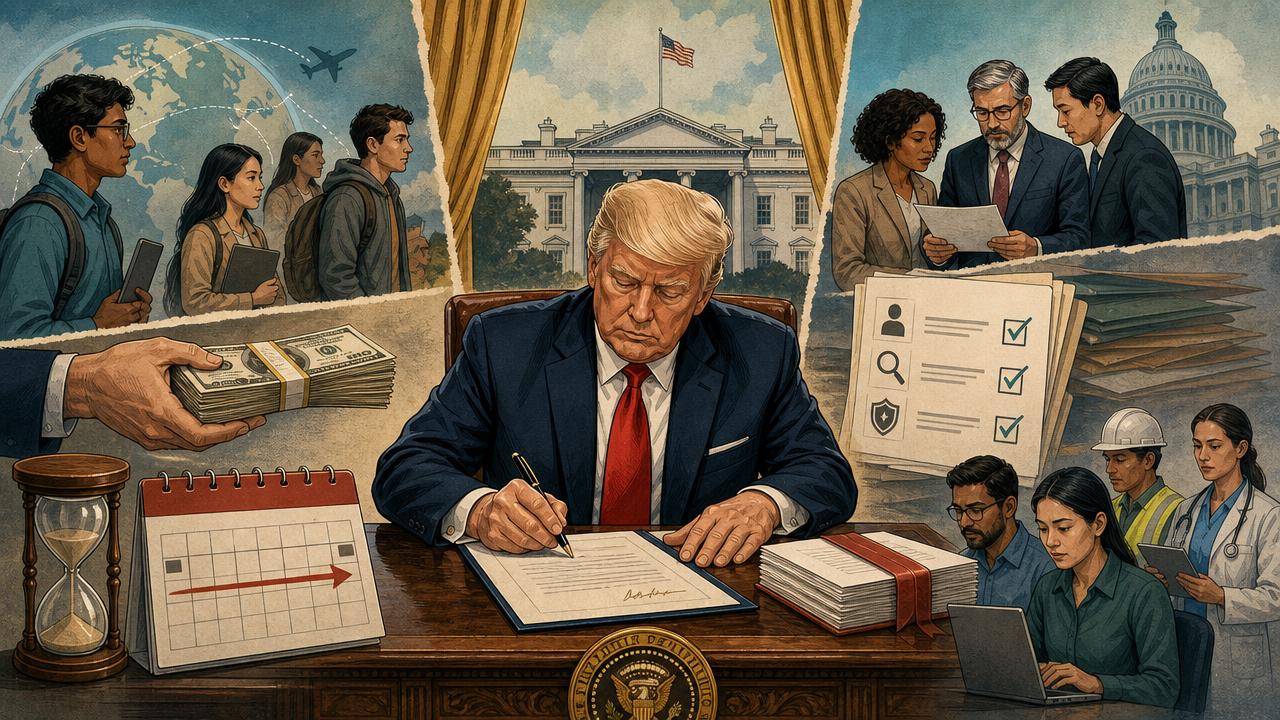
White House extends the $100,000 H-1B entry payment for another year
What happened
President Trump signed a September 18 proclamation extending for another year a restriction on entry for certain H-1B specialty workers who are outside the United States unless their employer pays $100,000. It takes effect at 12:01 a.m. Eastern on September 21, 2026, and is set to run until September 21, 2027 unless extended again. A separate executive order tells federal agencies to strengthen review and coordination around the H-1B program.
What it means for voters
This does not change the pay or immigration status of every H-1B worker already in the country. It most directly affects employers trying to bring covered workers in from abroad, especially in technology, engineering, health care, universities, and staffing firms. The administration says the policy protects U.S. wages; that is the administration’s stated rationale, not a settled finding. Employers that cannot get an exception may face higher hiring costs or delayed hiring, which could affect staffing and prices in some industries. The president controls entry rules under immigration law, but courts can still review the policy.
What to watch
Watch for agency guidance on who qualifies for the national-interest exception, employer lawsuits, and the next H-1B lottery cycle.
Context from earlier events
A similar $100,000 requirement began in September 2025. Associated Press reporting in June said it faced legal challenges and that relatively few payments had been made by mid-February.
Sources
- The White House Restriction on Entry of Certain Nonimmigrant Workers
- The White House Enhancing Program Integrity and Interagency Coordination in the Administration of the H-1B Nonimmigrant Visa Program
- Associated Press What to know about Trump's $100,000 H-1B visa fee and the legal rebuke that followed
Groceries, food safety, restaurants, and state-local government Nationwide; adoption is decided by states, tribes, and local governments
FDA issues an updated model food-safety code for restaurants and stores
What happened
The Food and Drug Administration released its 2026 Food Code on September 17. The code is a model rulebook for restaurants, grocery delis, school food service, vending operations, and other retail food businesses. It includes updates on worker illness policies, allergen cross-contact, cooling food, sanitation, food donations, and inspections.
What it means for voters
This is not a new federal rule that automatically changes your local restaurant tomorrow. States and local health departments choose whether and how to adopt it. That matters because local rules help shape inspections and food-handling practices in places families buy meals and groceries. CDC says states that adopted several key Food Code protections had lower reported rates of norovirus outbreaks, though adoption alone cannot guarantee safety.
What to watch
Watch for your state or local health department to propose code updates, particularly rules on sick food workers, certified managers, and handling ready-to-eat food.
Context from earlier events
FDA updates the Food Code every two years. It is widely used as a model by the governments that regulate retail food service.
Congress, tariffs, energy markets, and consumer prices Washington, D.C.; nationwide economic relevance
Russia and Iran sanctions package becomes law
What happened
President Trump signed H.R. 5334, the Lindsey O. Graham Sanctioning Russia and Iran Act of 2026, on September 18. The law expands sanctions and trade restrictions involving Russia, continues sanctions involving Iran, and authorizes tariffs and other penalties in specified circumstances.
What it means for voters
The law is now in place, but its exact effect on household prices depends on how the administration uses its authorities and how other countries respond. The measure targets Russian energy and allows tariffs of up to 100% on some major buyers of Russian oil or gas, with stated exceptions. Supporters say pressure on Russia’s energy revenue can limit its ability to fund war. Critics of the bill argued that broader tariff authority could raise costs for U.S. businesses and consumers. Congress wrote and passed the law; the president and executive agencies carry it out.
What to watch
Watch for Treasury, State, and Commerce Department actions naming sanctioned people, companies, ships, or countries and for any new tariffs that could affect energy or imported goods.
Context from earlier events
The House sent the bill to the president after a September 16 vote. The September 18 signature completed the legislative process.
Education, athlete pay, health coverage, and Congress Washington, D.C.; colleges and student athletes nationwide
Senate takes a second step toward a federal college-athlete pay and rights bill
What happened
The Senate voted 77–22 on September 17 to move forward with the Protect College Sports Act and released updated bill language. The vote allows debate to continue; it did not make the bill law. The Senate Commerce Committee says the revised bill addresses athlete compensation, health and safety standards, lawsuits, conference changes, and NCAA oversight.
What it means for voters
College athletes, their families, schools, and fans could see major changes if Congress finishes the bill and the House also approves it. Supporters say it would create national rules for name, image, and likeness pay, scholarships, agent conduct, and health protections. Opponents, including some athlete advocates, argue that federal limits could restrict athletes’ bargaining power or compensation. For now, existing state rules, school policies, court cases, and agreements remain in force.
What to watch
The Senate is scheduled to return September 22. Watch for amendments, a final Senate vote, and whether the House takes up the same version.
Context from earlier events
The Senate first cleared a procedural vote on September 15. The September 17 vote and updated text moved the bill another step ahead but did not resolve it.
Sources
- U.S. Senate Committee on Commerce, Science, and Transportation Committee Releases Updated Protect College Sports Act Bill Text
- Roll Call NIL bill foes likely out of timeouts as it clears second procedural hurdle
- Associated Press A sweeping college sports overhaul bill clears early hurdle in Senate vote
Voting, election enforcement, and due process Multiple states
Justice Department announces 16 election-related criminal cases across several states
What happened
The Justice Department announced September 18 that 16 people face charges connected to alleged illegal voting, registration, false citizenship claims, identity fraud, or related conduct. The cases span Texas, Idaho, Georgia, Massachusetts, Wisconsin, New Jersey, and Michigan. Charges and indictments are accusations, not convictions, and each defendant is presumed innocent.
What it means for voters
Federal law bars noncitizens from voting in federal elections, and individual violations can bring serious criminal and immigration consequences. But these cases do not show that widespread noncitizen voting changed an election result. Associated Press reporting on the earlier Texas cases noted that research has found noncitizen voting to be rare; Texas referred 117 possible cases for investigation from nearly 18 million registered voters after a database review. The Justice Department prosecutes federal crimes, while states and local election offices run voter registration and elections.
What to watch
Watch for court filings, plea agreements, or trial outcomes rather than treating the allegations as proven. Also watch how election offices communicate eligibility rules as early voting expands.
Context from earlier events
The cases come during a wider federal push focused on noncitizen voting and voter-record access before the 2026 midterms.
Medicaid, healthcare costs, fraud enforcement, and accountability Washington, D.C.; accountability relevance nationwide
Nurse pleads guilty in $14 million D.C. Medicaid mental-health fraud case
What happened
A Maryland nurse pleaded guilty September 17 to conspiracy to commit health care fraud in a scheme that prosecutors say billed D.C. Medicaid for mental-health services that were not provided or were inflated. The Justice Department says her participation caused more than $550,000 in Medicaid losses; she has not yet been sentenced.
What it means for voters
This is a local case, but it shows how false billing can drain public health funds meant for care, including services for children and teens. A guilty plea is different from an accusation: the defendant admitted guilt in court. Recovering money and stopping improper billing can protect Medicaid budgets, but it does not automatically lower a family’s medical bill or fix shortages in behavioral-health care. D.C. Medicaid, federal investigators, and the federal court system all played roles in the case.
What to watch
Watch for sentencing, restitution, and any action against other people or companies tied to the billing scheme.
Context from earlier events
Federal health-care fraud enforcement often combines Justice Department prosecutions with work by the FBI, the Health and Human Services inspector general, and state or local Medicaid-fraud units.
Government accountability, press access, and the First Amendment Washington, D.C.
Trump says CNN, MS NOW, and Politico will be barred from the White House
What happened
President Trump said September 18 that he was barring CNN, MS NOW, and Politico from the White House, citing what he called unfair coverage. The White House had not publicly detailed the scope or mechanics of the proposed restrictions when reporting was published. The affected outlets can still report on the federal government from outside the White House.
What it means for voters
This is not a direct change to a household bill, but it concerns how the public learns about decisions on taxes, benefits, health care, jobs, and national security. A president has some control over physical access to government spaces, but a content-based ban can raise constitutional and legal questions once access has been opened to other news organizations. The immediate effect depends on whether the White House actually enforces a formal policy and whether a court is asked to review it.
What to watch
Watch for written White House rules, responses from the White House Correspondents’ Association and affected outlets, and any lawsuit seeking emergency court action.
Context from earlier events
The administration previously restricted Associated Press access during a dispute over use of the name “Gulf of America”; that dispute remains in court.
How this briefing was made
We used official records to verify government actions and independent reporting to add context. We also checked popular political videos on YouTube for topic leads. Popularity helped us decide what to investigate, but it was not treated as proof or public opinion. Every included claim still had to be checked against the linked sources.